
Why Do Seasons Change? 7 Comprehensive Reasons for Scientific Clarity
Understanding why do seasons change allows us to grasp how Earth interacts with the Sun in a cosmic dance that has shaped climate, biology, agriculture, and cultural history. Many people casually experience winter’s chill, spring’s renewal, summer’s warmth, and autumn’s transition — yet few deeply understand the actual astronomical mechanics behind these changes.
This article takes you on an in-depth journey through the science of why do seasons change, presenting the explanation from multiple angles — astronomical, physical, environmental, historical, and educational — to provide full clarity.
READ: What Causes An Earthquake?
The Core Scientific Explanation Behind Why Do Seasons Change
Earth’s Axial Tilt — The Primary Reason
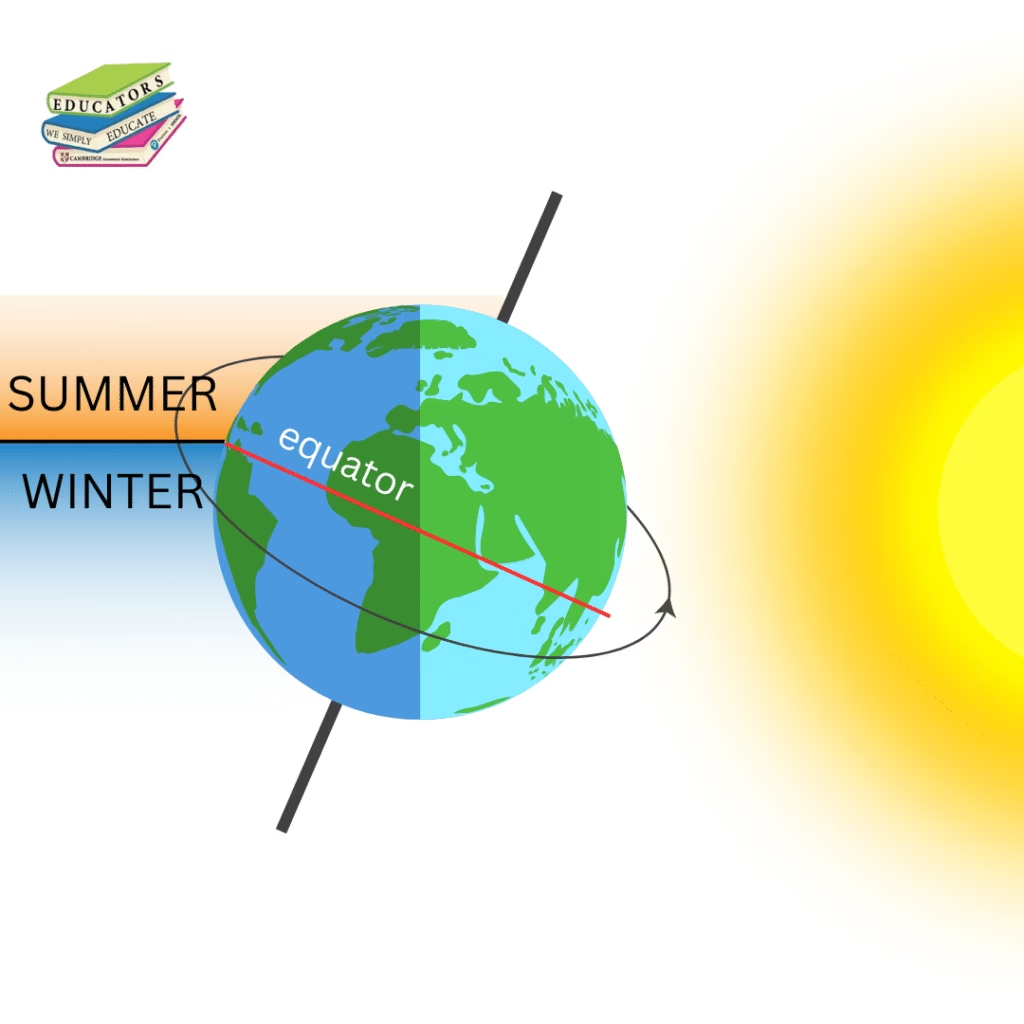
If you have ever wondered fundamentally why do seasons change, the ultimate answer lies in Earth’s 23.5-degree axial tilt. Without this tilt, there would be:
- No winter
- No summer
- No spring or autumn
- No dramatic temperature variations
- Nearly uniform daylight throughout the year
Because Earth is tilted:
- The Northern Hemisphere leans toward the Sun in June → receives more direct sunlight
- It leans away from the Sun in December → receives less direct sunlight
It’s not about Earth being closer or farther from the Sun; it’s about how sunlight hits the surface.
When sunlight arrives at a steep angle:
- It concentrates energy → warming → summer
When sunlight arrives at a shallow angle:
- It spreads over a larger surface → reduced heating → winter
This simple but profound geometry drives the entire seasonal cycle.
Earth’s Revolution Around the Sun — The Yearly Journey
Earth spends approximately 365.24 days completing one orbit around the Sun. As it orbits, its axial tilt direction stays fixed toward Polaris (the North Star).
This results in:
- A consistent pattern of seasonal change
- Predictable calendar shifts
- Regular transitions between solstice and equinox events
This orbital cycle explains why do seasons change at nearly the same times every year for each hemisphere, with only minor variations due to leap years and atmospheric conditions.
Misconception: Seasons Are Caused by Distance from the Sun
Many people assume seasons occur because Earth’s orbit is elliptical. But here’s the surprising truth:
- Earth is actually closest to the Sun in early January (perihelion)
- And farthest from the Sun in early July (aphelion)
Yet:
- January is winter for the Northern Hemisphere
- July is summer there
This proves that distance is NOT why do seasons change — axial tilt is the key.
How Sunlight Angle and Intensity Affect Seasonal Temperature
When exploring why do seasons change, the angle of incoming sunlight is crucial.
Direct vs. Angular Sunlight
- In summer, the Sun appears higher in the sky
- In winter, the Sun is lower — shorter shadows
Direct sunlight → higher energy density → hotter
Low-angle sunlight → lower energy distribution → colder
This is why:
- Snow melts fastest under midday sun
- Winter sunlight feels weak and indirect
Daylight Duration Impact
Another essential reason why do seasons change relates to the number of daylight hours across the year.
- Summer → long days & short nights → more heating
- Winter → short days & long nights → more cooling
Example:
- At the Arctic Circle during summer, the Sun never sets — leading to the “Midnight Sun”
- During polar winter, the Sun never rises — causing “Polar Night”
Day length directly contributes to seasonal temperature differences.
Hemisphere Seasonal Opposites — Why North and South Differ
When it is summer in the Northern Hemisphere, the Southern Hemisphere experiences winter, and vice versa.
This is because:
- When one hemisphere tilts toward the Sun → receives more energy
- The opposite hemisphere tilts away → receives less energy
This explains why do seasons change differently depending on geographic orientation.
Equinoxes and Solstices — The Turning Points of the Year
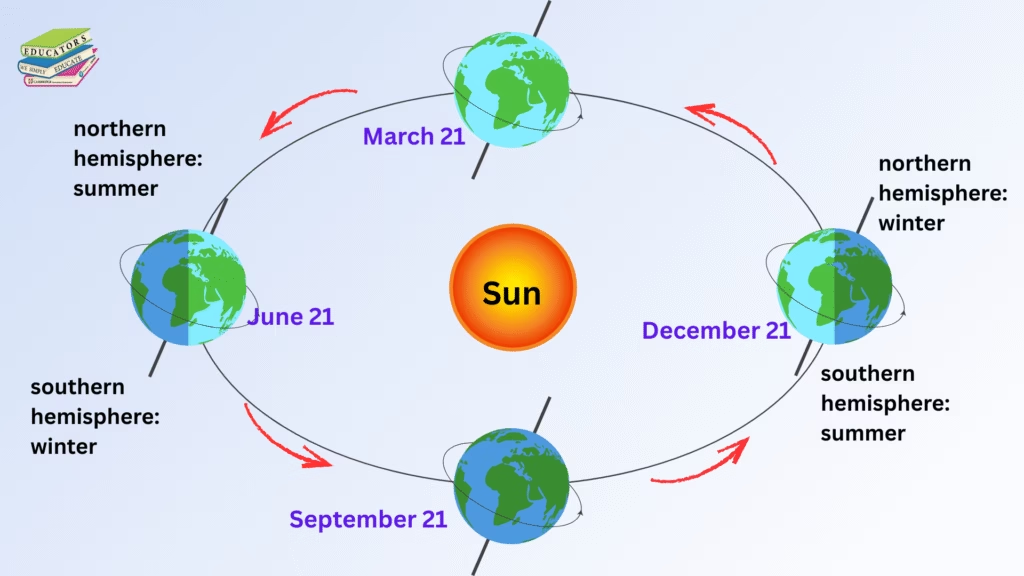
The four critical seasonal transition markers:
- Summer Solstice (~June 21)
Longest day of the year (Northern Hemisphere) - Winter Solstice (~December 21)
Shortest day of the year (Northern Hemisphere) - Spring (Vernal) Equinox (~March 21)
Equal day and night - Autumn (Fall) Equinox (~September 21)
Equal day and night
During equinoxes, the tilt is neutral relative to sunlight — providing insight into why do seasons change across the entire globe simultaneously.
Latitude and Seasonal Variability
Different latitudes experience seasonal change differently.
Equatorial Regions
Near the equator:
- Sun is direct all year
- Minimal daylight variation
- Temperature nearly constant
- Seasons defined by rainfall patterns:
wet season vs. dry season
These regions experience muted seasonal temperature change despite the global pattern of why do seasons change.
Mid-Latitude Regions (like Europe, North America)
These areas experience:
- Four distinct seasons
- Strong temperature contrast
- Noticeable changes in sun angle
- Pronounced daylight variation
Polar Regions
- Extreme seasons
- Months of daylight
- Months of darkness
- Severe temperature contrast
Polar areas vividly illustrate why do seasons change, driven by extreme sunlight variation.
Biological and Ecological Consequences of Season Change
Seasons influence life cycles:
- Animal migration — birds fly south for warmth
- Hibernation — bears sleep through winter
- Breeding seasons — many animals time reproduction seasonally
- Tree leaf shedding — deciduous trees drop leaves in autumn
- Spring flowering — plants awaken with warmth
Understanding why do seasons change helps explain ecological rhythm and environmental adaptation.
Agricultural Impact of Seasonal Change
Human civilization has historically been shaped by seasonal patterns.
- Spring → planting
- Summer → growth
- Autumn → harvest
- Winter → storage and dormancy
Farmers depend deeply on knowing why do seasons change, using seasonal calendars for crop timing and yield optimization.
Cultural and Historical Understanding of Seasons
Different civilizations explained seasons before modern science.
- Greeks used the Persephone myth as explanation for winter & spring
- Ancient Egyptians relied on Nile flooding cycles rather than climatic seasons
- Celts celebrated solstices with festivals like Yule and Litha
- Indigenous cultures used star charts and animal behavior to predict seasons
The cultural heritage of why do seasons change illustrates how humanity navigated seasonal rhythms.
Seasons on Other Planets
Earth is not the only planet with seasons.
- Mars — more dramatic seasonal temperature swings due to greater orbit eccentricity
- Saturn & Jupiter — experience seasons due to axial tilt
- Uranus — has an extreme tilt of 98 degrees, causing bizarre seasonal patterns
Comparing planetary systems helps refine the scientific explanation of why do seasons change in a broader cosmic context.
Climate Change and Seasonal Alterations
While axial tilt remains constant, human-driven climate change affects:
- Length of summers
- Severity of winters
- Start and end timing of seasonal transitions
- Ecosystem responses
Example trends:
- Earlier springs
- Delayed winters
- Shifting migration patterns
- Altered agriculture zones
So while axial tilt explains why do seasons change, climate change modifies how each season behaves.
Frequently Asked Questions (FAQ)
Q: Why do seasons change on Earth?
A: Because of Earth’s 23.5-degree axial tilt, which changes how sunlight hits the hemispheres throughout the year.
Q: Why isn’t distance from the Sun the cause of seasons?
A: Earth is closest to the Sun in January, yet it’s winter in the Northern Hemisphere — proving tilt is the true cause.
Q: Why is it winter in one hemisphere when it’s summer in the other?
A: Because one hemisphere tilts toward the Sun while the other tilts away.
Q: Why are seasonal changes mild near the equator?
A: Sunlight arrives nearly straight year-round, reducing seasonal variation.
Q: Do other planets have seasons?
A: Yes — planets with axial tilt have seasonal patterns, sometimes extreme.
Q: Will seasons change in the future due to climate change?
A: Yes — the timing, intensity, and duration of seasons are already shifting due to global warming.
Conclusion
Understanding why do seasons change reveals the elegant celestial mechanics that govern our world. The key reason is Earth’s axial tilt, which alters sunlight angle and daylight length throughout the year. This drives a cascade of environmental, biological, cultural, and agricultural effects that shape life on Earth. From solstices to equinoxes, crop cycles to animal migrations, and star mythology to modern science, the seasons remind us that Earth is part of a beautiful astronomical rhythm.