
How to Calculate Moles in Chemistry: Formula, Methods, Examples & Tips
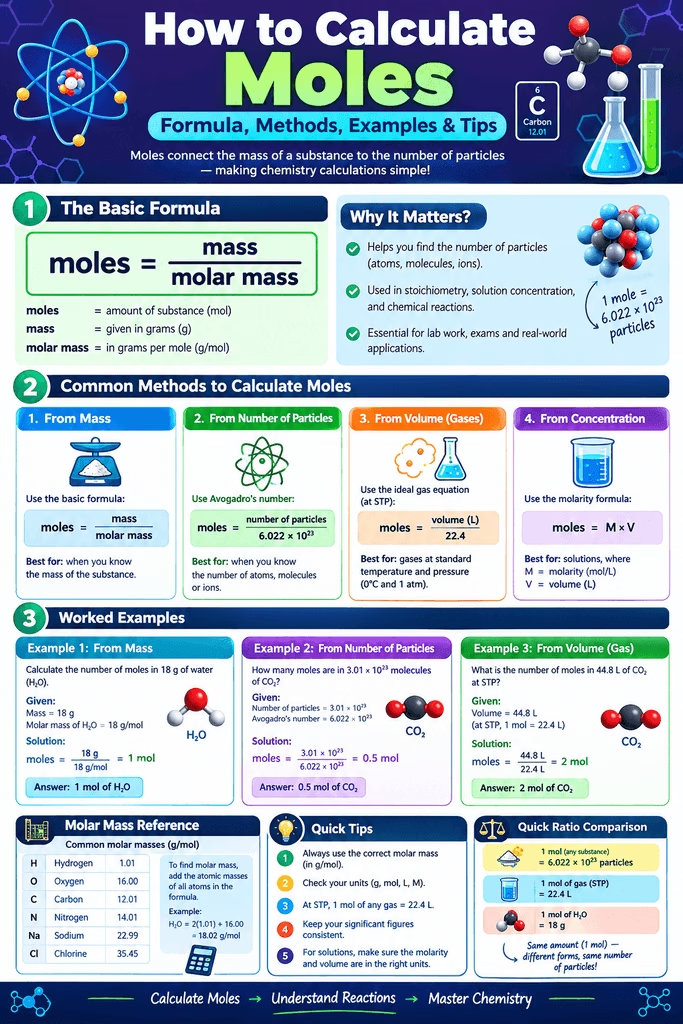
Understanding how to calculate moles in chemistry is one of the most important skills in basic and advanced chemistry. The mole provides a convenient way to count extremely large numbers of atoms, molecules, ions, and other microscopic particles. Because individual particles are far too small to count directly, chemists use the mole as a standard counting unit.
Whether you are calculating the amount of a substance from its mass, determining the number of particles in a sample, finding the concentration of a solution, or solving a chemical equation, the mole concept appears repeatedly. Once you understand the relationships between mass, molar mass, particles, volume, and moles, many chemistry calculations become much easier.
This guide explains how to calculate moles in chemistry step by step, including the essential formulas, practical examples, common mistakes, and useful problem-solving strategies.
Read More: The Powerful Role of Conjugate Acid-Base Pairs in Chemistry
What Is a Mole in Chemistry?
A mole is the SI unit used to measure the amount of a substance. One mole contains exactly 6.02214076×10236.02214076 \times 10^{23} specified elementary entities. This number is known as the Avogadro constant.
For example:
- 1 mol of carbon atoms contains 6.02214076×10236.02214076 \times 10^{23} carbon atoms.
- 1 mol of water molecules contains 6.02214076×10236.02214076 \times 10^{23} water molecules.
- 1 mol of sodium ions contains 6.02214076×10236.02214076 \times 10^{23} sodium ions.
The word “mole” works much like other counting units. Just as one dozen means 12 objects, one mole represents approximately 6.022×10236.022 \times 10^{23} particles.
The particles represented by a mole depend on the substance. They may be atoms, molecules, ions, formula units, electrons, or other specified entities.
Read More: A Beginner’s guide to the Periodic Table: Importance, Application, present days and history.
Why Is the Mole Important?
Atoms and molecules are incredibly small. Even a tiny amount of material contains an enormous number of particles. It would be impractical to count these particles individually.
The mole creates a connection between the microscopic world of atoms and molecules and measurable quantities such as grams and liters.
For example, a laboratory balance can measure grams, but it cannot directly tell you how many molecules are present. By using molar mass, you can convert the measured mass into an amount in moles.
This makes the mole essential for:
- Chemical equations
- Stoichiometric calculations
- Solution preparation
- Concentration calculations
- Gas calculations
- Particle counting
- Determining empirical formulas
- Determining molecular formulas
- Laboratory experiments
The Basic Mole Formula
The most commonly used formula for calculating an amount in moles from mass is:
n=mMn = \frac{m}{M}
Where:
- nn = amount of substance in moles
- mm = mass of the substance in grams
- MM = molar mass in grams per mole
Therefore, if you know the mass and molar mass of a substance, you can determine the number of moles by dividing the mass by the molar mass.
Example 1: Calculating Moles from Mass
Suppose you have 18 g of water, H2OH_2O.
The molar mass of water is:
(2×1.008)+16.00=18.016 g/mol(2 \times 1.008) + 16.00 = 18.016\text{ g/mol}
Using the formula:
n=1818.016n = \frac{18}{18.016} n≈0.999 moln \approx 0.999\text{ mol}
Therefore, 18 g of water contains approximately 1.00 mol of water molecules.
Read More: Is AP Chemistry Hard? 7 Encouraging Facts That Make It Easier to Master
How to Calculate Molar Mass
Before calculating moles in chemistry from mass, you usually need to determine the molar mass of the substance.
Molar mass is the mass of one mole of a substance. Its unit is generally grams per mole (g/mol).
To calculate molar mass, add the atomic masses of all the atoms represented in the chemical formula.
Example 2: Molar Mass of Carbon Dioxide
The formula for carbon dioxide is:
CO2CO_2
Carbon has an atomic mass of approximately 12.01 g/mol, while oxygen has an atomic mass of approximately 16.00 g/mol.
Therefore:
M(CO2)=12.01+(2×16.00)M(CO_2)=12.01+(2\times16.00) M(CO2)=44.01 g/molM(CO_2)=44.01\text{ g/mol}
Thus, the molar mass of carbon dioxide is approximately 44.01 g/mol.
Example 3: Molar Mass of Calcium Hydroxide
Consider:
Ca(OH)2Ca(OH)_2
Approximate atomic masses:
- Ca = 40.08
- O = 16.00
- H = 1.008
Therefore:
M=40.08+2(16.00+1.008)M = 40.08 + 2(16.00 + 1.008) M=74.096 g/molM = 74.096\text{ g/mol}
So, calcium hydroxide has a molar mass of approximately 74.09 g/mol.
Read More: What Is an Ideal Gas? 10 Remarkable Comprehensive Insights
Calculating Moles from the Number of Particles
Another important way to calculate moles in chemistry is by using the number of particles.
The relationship is:
n=NNAn=\frac{N}{N_A}
Where:
- nn = amount in moles
- NN = number of particles
- NAN_A = Avogadro constant
The Avogadro constant is:
NA=6.02214076×10²³ mol−1N_A=6.02214076\times10^{23}\text{ mol}^{-1}
Thus:
n=N6.02214076×1023n=\frac{N}{6.02214076\times10^{23}}
Example 4: Moles from Number of Molecules
Suppose a sample contains:
3.011×10233.011\times10^{23}
water molecules.
Then:
n=3.011×10236.022×1023n=\frac{3.011\times10^{23}}{6.022\times10^{23}} n=0.500 moln=0.500\text{ mol}
Therefore, the sample contains approximately 0.500 mol of water.
Calculating the Number of Particles from Moles
The previous formula can also be rearranged to calculate the number of particles.
N=nNAN=nN_A
Suppose you have 2 mol of oxygen molecules.
N=2(6.02214076×10²³)N=2(6.02214076\times10^{23}) N=1.204428152×1024N=1.204428152\times10^{24}
Therefore, 2 mol of oxygen molecules contains approximately:
1.204×10241.204\times10^{24}
molecules.
Read More: What is Organic Chemistry? 10 Fascinating and Powerful Insights into Carbon-Based Science
Calculating Moles from Solution Concentration
In chemistry, solutions are frequently described using molar concentration, also called molarity.
Molarity is defined as:
C=nVC=\frac{n}{V}
where:
- CC = concentration in mol/L
- nn = amount in moles
- VV = volume in liters
Rearranging the equation gives:
n=CVn=CV
This is another important method for determining moles in chemistry.
Example 5: Moles from Molarity
Suppose 0.50 L of a sodium chloride solution has a concentration of 2.0 mol/L.
Using:
n=CVn=CV
we get:
n=(2.0)(0.50)n=(2.0)(0.50) n=1.0 moln=1.0\text{ mol}
Therefore, the solution contains 1.0 mol of sodium chloride.
Important Unit Reminder
When using:
n=CVn=CV
the volume should normally be expressed in liters when concentration is given in mol/L.
For example:
250 mL=0.250 L250\text{ mL}=0.250\text{ L}
Failing to convert milliliters into liters is a common source of errors.
Calculating Moles from Gas Volume
For gases, the number of moles can sometimes be calculated using the ideal gas equation:
PV=nRTPV=nRT
Rearranging:
n=PVRTn=\frac{PV}{RT}
Where:
- PP = pressure
- VV = volume
- nn = amount in moles
- RR = gas constant
- TT = absolute temperature in kelvin
When using the ideal gas equation, all units must be compatible.
For example, if pressure is measured in atmospheres and volume in liters, a commonly used value of the gas constant is:
R=0.082057 L\cdotpatm\cdotpmol−1\cdotpK−1R=0.082057\text{ L·atm·mol}^{-1}\text{·K}^{-1}
Temperature must be converted to kelvin:
T(K)=T(°C)+273.15T(K)=T(°C)+273.15
Example 6: Calculating Moles of a Gas
Suppose a gas occupies 10.0 L at 1.00 atm and 273.15 K.
Using:
n=PVRTn=\frac{PV}{RT} n=(1.00)(10.0)(0.082057)(273.15)n=\frac{(1.00)(10.0)}{(0.082057)(273.15)} n≈0.446 moln\approx0.446\text{ mol}
Therefore, the sample contains approximately 0.446 mol of gas under these conditions.
Calculating Moles Using Stoichiometry
Chemical equations allow you to determine how substances react with one another.
Consider the balanced equation:
2H2+O2→2H2O2H_2+O_2\rightarrow2H_2O
The coefficients indicate the mole ratio:
2:1:22:1:2
This means:
- 2 mol of H2H_2 react with 1 mol of O2O_2.
- 2 mol of H2H_2 produce 2 mol of H2OH_2O.
- 1 mol of O2O_2 produces 2 mol of H2OH_2O.
Stoichiometric calculations generally involve converting the known quantity into moles first, using the mole ratio from the balanced equation, and then converting the answer into the required unit.
Example 7: Stoichiometric Mole Calculation
Suppose 3 mol of hydrogen reacts completely with oxygen.
The equation is:
2H2+O2→2H2O2H_2+O_2\rightarrow2H_2O
The ratio of hydrogen to water is:
2:2=1:12:2=1:1
Therefore:
3 mol H2→3 mol H2O3\text{ mol }H_2\rightarrow3\text{ mol }H_2O
So, 3 mol of hydrogen can theoretically produce 3 mol of water, assuming sufficient oxygen and complete reaction.
Read More: What is a Base in Chemistry: 15 Fascinating Insights That Make This a Powerful Guide
A General Method for Mole Calculations
Many chemistry problems can be solved using a simple sequence.
Step 1: Identify What You Know
Determine whether the problem gives you:
- Mass
- Number of particles
- Concentration and volume
- Gas pressure, volume, and temperature
- A chemical equation
- Another quantity that can be converted into moles
Step 2: Identify What You Need
Read the question carefully. It may ask for:
- Moles
- Mass
- Number of particles
- Concentration
- Volume
- Amount of product
Step 3: Choose the Appropriate Formula
Common equations include:
n=mMn=\frac{m}{M} n=NNAn=\frac{N}{N_A} n=CVn=CV n=PVRTn=\frac{PV}{RT}
Step 4: Check Units
Make sure your units match the formula.
For example:
- Mass should generally be in grams when using molar mass in g/mol.
- Volume should be in liters for molarity calculations.
- Temperature must be in kelvin for the ideal gas equation.
- Particle counts should correspond to the entities specified in the question.
Step 5: Calculate and Report the Answer
Perform the calculation carefully and include the correct unit.
Mole Calculations from Mass: More Examples
Consider 50.0 g of sodium chloride, NaClNaCl.
The molar mass is:
22.99+35.45=58.44 g/mol22.99+35.45=58.44\text{ g/mol}
Therefore:
n=50.058.44n=\frac{50.0}{58.44} n≈0.856 moln\approx0.856\text{ mol}
Thus, 50.0 g of sodium chloride represents approximately 0.856 mol.
Now consider 100 g of calcium carbonate, CaCO3CaCO_3.
Its molar mass is:
40.08+12.01+(3×16.00)40.08+12.01+(3\times16.00) =100.09 g/mol=100.09\text{ g/mol}
Therefore:
n=100100.09n=\frac{100}{100.09} n≈0.999 moln\approx0.999\text{ mol}
So, 100 g of calcium carbonate is approximately 1 mol.
Mole-to-Mass Conversion
Sometimes a question gives the number of moles and asks for mass.
The formula is:
m=nMm=nM
For example, suppose you have 2.5 mol of carbon dioxide.
The molar mass of CO2CO_2 is 44.01 g/mol.
Therefore:
m=(2.5)(44.01)m=(2.5)(44.01) m=110.025 gm=110.025\text{ g}
Depending on the required significant figures, the answer may be reported as approximately 110 g.
Mole-to-Particle Conversion
To convert moles into particles:
N=nNAN=nN_A
For example, 0.25 mol of sodium atoms contains:
N=(0.25)(6.022×10²³)N=(0.25)(6.022\times10^{23}) N=1.506×10²³N=1.506\times10^{23}
atoms.
This conversion is particularly useful when a problem asks how many atoms, molecules, or ions are present.
Particle-to-Mole Conversion
To convert particles into moles:
n=NNAn=\frac{N}{N_A}
For example, if you have 1.2044×10241.2044\times10^{24} oxygen molecules:
n=1.2044×10246.022×1023n=\frac{1.2044\times10^{24}}{6.022\times10^{23}} n≈2.00 moln\approx2.00\text{ mol}
Always identify what the particles represent. A mole of oxygen molecules is different from a mole of oxygen atoms in terms of the type of entity being counted.
Calculating Moles of Atoms in a Compound
A compound may contain several types of atoms. The chemical formula tells you the ratio of these atoms.
For example:
H2OH_2O
contains:
- 2 hydrogen atoms
- 1 oxygen atom
Therefore, 1 mol of water molecules contains:
- 2 mol of hydrogen atoms
- 1 mol of oxygen atoms
Similarly, 3 mol of water molecules contain:
3×2=6 mol H atoms3\times2=6\text{ mol H atoms}
and:
3×1=3 mol O atoms3\times1=3\text{ mol O atoms}
This distinction is important in questions involving the number of atoms within a compound.
Read More: What Is a Mole in Chemistry? 6 Mind-Blowing Facts & Easy Calculations
Calculating Moles in Chemical Reactions
Balanced chemical equations provide mole ratios between reactants and products.
For example:
N2+3H2→2NH3N_2+3H_2\rightarrow2NH_3
The equation tells us that:
1 mol N21\text{ mol }N_2
reacts with:
3 mol H23\text{ mol }H_2
to produce:
2 mol NH32\text{ mol }NH_3
Suppose 6 mol of hydrogen reacts completely with excess nitrogen.
The ratio is:
3H2:2NH33H_2:2NH_3
Therefore:
6×23=4 mol6\times\frac{2}{3}=4\text{ mol}
So, 6 mol of hydrogen can theoretically produce 4 mol of ammonia.
Limiting Reactants and Moles
In many reactions, more than one reactant is provided. The reactant that is consumed first is called the limiting reactant.
Consider:
2H2+O2→2H2O2H_2+O_2\rightarrow2H_2O
Suppose you have 5 mol of H2H_2 and 2 mol of O2O_2.
According to the equation, 1 mol of oxygen requires 2 mol of hydrogen. Therefore, 2 mol of oxygen requires 4 mol of hydrogen.
Since 5 mol of hydrogen is available, oxygen is consumed first. Oxygen is therefore the limiting reactant.
The amount of water formed is:
2 mol O2×2 mol H2O1 mol O22\text{ mol }O_2\times\frac{2\text{ mol }H_2O}{1\text{ mol }O_2} =4 mol H2O=4\text{ mol }H_2O
Understanding the mole ratios is essential for these calculations.
Mole Fraction
Moles can also be used to calculate mole fraction.
The mole fraction of component A is:
XA=nAntotalX_A=\frac{n_A}{n_{\text{total}}}
For example, if a mixture contains 2 mol of nitrogen and 3 mol of oxygen:
ntotal=2+3=5 moln_{\text{total}}=2+3=5\text{ mol}
Therefore:
XN2=25=0.40X_{N_2}=\frac{2}{5}=0.40
and:
XO2=35=0.60X_{O_2}=\frac{3}{5}=0.60
The mole fractions add up to 1:
0.40+0.60=1.000.40+0.60=1.00
Common Mistakes When Calculating Moles
Although the formulas are relatively simple, several mistakes occur frequently.
1. Using the Wrong Molar Mass
Always calculate the molar mass carefully. Pay attention to subscripts and parentheses.
For example, Ca(OH)2Ca(OH)_2 contains two oxygen atoms and two hydrogen atoms, not one of each.
2. Forgetting Unit Conversions
A common error is using milliliters directly in a molarity equation when the concentration is expressed in mol/L.
Convert:
mL→LmL\rightarrow L
before calculating.
3. Confusing Atoms and Molecules
One mole of oxygen atoms and one mole of oxygen molecules contain the same number of entities, but the entities are different.
- 1 mol O1\text{ mol }O = 1 mol oxygen atoms
- 1 mol O21\text{ mol }O_2 = 1 mol oxygen molecules
4. Using an Unbalanced Equation
Stoichiometric calculations require a balanced chemical equation. The coefficients determine the mole ratios.
5. Using Celsius in the Ideal Gas Equation
Temperature must be in kelvin when using:
PV=nRTPV=nRT
Convert Celsius to kelvin before substitution.
6. Rounding Too Early
Keep extra digits during intermediate calculations and round the final answer according to the appropriate significant figures.
Significant Figures in Mole Calculations
Significant figures communicate the precision of a measurement.
Suppose a mass is given as 25.0 g and the molar mass is 58.44 g/mol.
n=25.058.44n=\frac{25.0}{58.44}
The result should generally be reported with three significant figures:
n=0.428 moln=0.428\text{ mol}
Do not report excessive digits simply because your calculator displays them.
A Useful Mole Conversion Map
A convenient way to organize mole calculations is to think of the mole as a central conversion point.
Mass ↔ Moles
n=mMn=\frac{m}{M}
or:
m=nMm=nM
Particles ↔ Moles
n=NNAn=\frac{N}{N_A}
or:
N=nNAN=nN_A
Solution Volume and Concentration ↔ Moles
n=CVn=CV
Gas Variables ↔ Moles
n=PVRTn=\frac{PV}{RT}
This conversion framework makes many chemistry problems easier to recognize.
Why Dimensional Analysis Helps
Dimensional analysis is a powerful method for checking calculations.
For example:
25.0 g×1 mol58.44 g25.0\text{ g}\times\frac{1\text{ mol}}{58.44\text{ g}}
The grams cancel:
g×molg\cancel{\text{g}}\times\frac{\text{mol}}{\cancel{\text{g}}}
leaving:
mol\text{mol}
This confirms that the calculation produces the desired unit.
Dimensional analysis can also help identify incorrect formulas, conversion factors, and units before they lead to a wrong answer.
Quick Reference Table
| Given Information | Formula | Result |
| Mass and molar mass | n=m/Mn=m/M | Moles |
| Moles and molar mass | m=nMm=nM | Mass |
| Number of particles | n=N/NAn=N/N_A | Moles |
| Moles | N=nNAN=nN_A | Particles |
| Concentration and volume | n=CVn=CV | Moles |
| Gas pressure, volume, temperature | n=PV/RTn=PV/RT | Moles |
| Moles and concentration | C=n/VC=n/V | Concentration |
| Moles and volume | V=n/CV=n/C | Volume |
Frequently Asked Questions (FAQ)
What is the easiest way to calculate moles?
If you know the mass of a substance and its molar mass, use:
n=mMn=\frac{m}{M}
Divide the mass in grams by the molar mass in grams per mole.
What is the formula for calculating moles?
The formula depends on the information provided. Common formulas include:
n=mMn=\frac{m}{M}
for mass,
n=NNAn=\frac{N}{N_A}
for particles,
n=CVn=CV
for solutions, and
n=PVRTn=\frac{PV}{RT}
for gases.
How many particles are in one mole?
One mole contains exactly:
6.02214076×10236.02214076\times10^{23}
specified elementary entities.
This value is the Avogadro constant.
How do I calculate moles from grams?
First determine the molar mass of the substance. Then use:
n=mass in gramsmolar mass in g/moln=\frac{\text{mass in grams}}{\text{molar mass in g/mol}}
How do I calculate moles from molarity?
Use:
n=CVn=CV
where CC is concentration in mol/L and VV is volume in liters.
How do I calculate moles from molecules?
Divide the number of molecules by Avogadro’s constant:
n=N6.02214076×1023n=\frac{N}{6.02214076\times10^{23}}
Why do I need a balanced chemical equation?
The coefficients in a balanced equation provide the mole ratios between reactants and products. These ratios are required for stoichiometric calculations.
Can I calculate moles without knowing the molar mass?
Yes, depending on the information provided. If you know the number of particles, concentration and volume, or suitable gas variables, you can calculate the amount without directly using molar mass.
Conclusion
Learning how to calculate moles in chemistry provides a foundation for solving a wide range of chemistry problems. The mole connects measurable quantities such as mass and volume with the microscopic particles that make up matter.
The most important relationships to remember are:
n=mMn=\frac{m}{M}
for converting mass to moles,
n=NNAn=\frac{N}{N_A}
for converting particles to moles,
n=CVn=CV
for finding moles from solution concentration and volume, and
n=PVRTn=\frac{PV}{RT}
for calculating the amount of a gas under appropriate conditions.
For chemical reactions, always start with a balanced equation and use its coefficients as mole ratios. Pay close attention to units, significant figures, chemical formulas, and the type of particle being counted.
Once these relationships become familiar, mole calculations become much more systematic. Rather than memorizing isolated procedures, focus on recognizing what information you have, identifying the appropriate relationship, converting the units correctly, and checking whether the final answer makes chemical sense.