
The Powerful Role of Conjugate Acid-Base Pairs in Chemistry
Chemistry explains many natural processes through the movement of particles and energy. One important concept in acid-base chemistry is the idea of a conjugate acid-base pair. This concept helps students understand how acids and bases behave during chemical reactions. It is a major part of the Brønsted–Lowry theory, which describes acids as proton donors and bases as proton acceptors.
Understanding a conjugate acid-base pair makes it easier to predict chemical behavior in solutions, especially in reactions involving water. From laboratory experiments to biological systems, this concept plays an important role in chemistry.
Definition of a Conjugate Acid-Base Pair
A conjugate acid-base pair consists of two substances that differ by one proton, also known as a hydrogen ion (H⁺). When an acid donates a proton, it becomes its conjugate base. Similarly, when a base accepts a proton, it becomes its conjugate acid.
The two members of a conjugate acid-base pair are connected because one transforms into the other by gaining or losing a proton.
For example:
HCl + H₂O → H₃O⁺ + Cl⁻
In this reaction:
- HCl donates a proton and becomes Cl⁻
- H₂O accepts a proton and becomes H₃O⁺
Therefore:
- HCl and Cl⁻ form one conjugate acid-base pair
- H₂O and H₃O⁺ form another pair
This relationship is the foundation of many acid-base reactions.
The Brønsted–Lowry Theory
The Brønsted–Lowry theory explains acids and bases through proton transfer. According to this theory:
- An acid donates a proton
- A base accepts a proton
Every acid produces a conjugate base after losing a proton. Likewise, every base forms a conjugate acid after gaining a proton. Because of this relationship, every acid-base reaction involves a conjugate acid-base system.
Consider the following reaction:
NH₃ + H₂O ⇌ NH₄⁺ + OH⁻
Here:
- NH₃ accepts a proton and acts as a base
- NH₄⁺ is its conjugate acid
- H₂O donates a proton and acts as an acid
- OH⁻ is its conjugate base
The reaction clearly shows how a conjugate acid-base pair forms during proton exchange.
How to Identify a Conjugate Acid-Base Pair
Identifying a conjugate acid-base pair becomes simple once you look for the transfer of one proton.
You can follow these steps:
- Identify the acid and the base
- Determine which substance loses a proton
- Determine which substance gains a proton
- Compare the formulas before and after the reaction
If two substances differ by only one H⁺ ion, they belong to the same conjugate acid-base pair.
For example:
H₂CO₃ ⇌ HCO₃⁻ + H⁺
In this reaction:
- H₂CO₃ loses one proton
- HCO₃⁻ is the conjugate base
Thus, H₂CO₃ and HCO₃⁻ form a conjugate acid-base pair.
Characteristics of Conjugate Acid-Base Pairs
A conjugate acid-base pair has several important characteristics.
Difference of One Proton
The acid and base in the pair always differ by one proton. This is the most important feature.
Reversible Reactions
Most acid-base reactions are reversible. A conjugate base can accept a proton again, while a conjugate acid can donate it back.
Strength Relationship
The strength of acids and bases in a conjugate pair relationship is connected. A strong acid forms a weak conjugate base, while a strong base forms a weak conjugate acid.
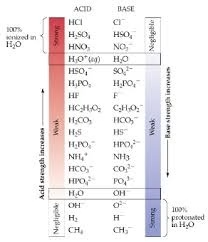
For example:
- HCl is a strong acid
- Cl⁻ is a very weak base
This inverse relationship helps chemists predict reaction direction and equilibrium.
Strong and Weak Acids in Conjugate Pairs
The behavior of a conjugate acid-base pair depends greatly on acid strength.
Strong Acids
Strong acids completely ionize in water. Their conjugate bases are extremely weak because they have little tendency to accept protons again.
Examples include:
- HCl → Cl⁻
- HNO₃ → NO₃⁻
Weak Acids
Weak acids ionize only partially. Their conjugate bases are comparatively stronger.
For example:
CH₃COOH ⇌ CH₃COO⁻ + H⁺
Acetic acid and acetate ion form a conjugate acid-base pair that exists in equilibrium.
Importance in Buffer Solutions
Buffer solutions rely heavily on a conjugate acid-base system. A buffer resists sudden changes in pH when acids or bases are added.
A common buffer contains:
- A weak acid and its conjugate base
- Or a weak base and its conjugate acid
For example:
CH₃COOH and CH₃COO⁻ form a useful conjugate acid-base buffer system.
When extra acid enters the solution, the conjugate base neutralizes it. When extra base enters, the weak acid reacts with it. This stabilizes the pH.
Buffers are important in:
- Human blood
- Industrial chemistry
- Pharmaceutical production
- Biological research
Role in Water Chemistry
Water itself can act as both an acid and a base. Such substances are called amphoteric substances.
Consider this reaction:
H₂O + H₂O ⇌ H₃O⁺ + OH⁻
In this case:
- One water molecule donates a proton
- Another accepts it
This creates two conjugate acid-base pairs:
- H₂O and OH⁻
- H₃O⁺ and H₂O
This reaction explains the natural ionization of water.
Examples from Daily Life
The concept of a conjugate acid-base pair is not limited to textbooks. It appears in many real-life situations.
Digestion
Hydrochloric acid in the stomach participates in acid-base reactions that aid digestion.
Baking
Baking soda reacts with acidic substances to produce carbon dioxide gas. These reactions involve conjugate acids and bases.
Agriculture
Soil pH depends on acid-base chemistry. Farmers often adjust soil conditions using compounds that affect conjugate acid-base reactions.
Medicine
Many medicines work by controlling acid levels in the body through conjugate systems.
Common Mistakes Students Make
Students often confuse acids and conjugate acids. Remember:
- The acid loses a proton
- The conjugate acid is formed by gaining a proton
Another common mistake is forgetting that the substances must differ by exactly one proton to form a conjugate acid-base pair.
Careful observation of chemical formulas helps avoid these errors.
Why This Concept Matters
The idea of a conjugate acid-base pair is essential for understanding chemistry at a deeper level. It explains:
- Proton transfer
- Chemical equilibrium
- Buffer action
- pH control
- Biological reactions
Without this concept, acid-base chemistry would be much harder to understand.
Students studying general chemistry, biochemistry, or environmental science regularly encounter conjugate pairs in equations and experiments.
Conclusion
A conjugate acid-base pair consists of two related substances that differ by one proton. When an acid loses a proton, it forms its conjugate base. When a base gains a proton, it forms its conjugate acid. This simple relationship forms the basis of many chemical reactions.
From water chemistry to biological systems, the concept of a conjugate acid-base pair helps explain how substances interact and maintain balance. Understanding this topic provides a strong foundation for learning more advanced chemistry concepts in the future.