
What Role Do Entrepreneurs Play in Economics? 9 Essential Contributions Explained
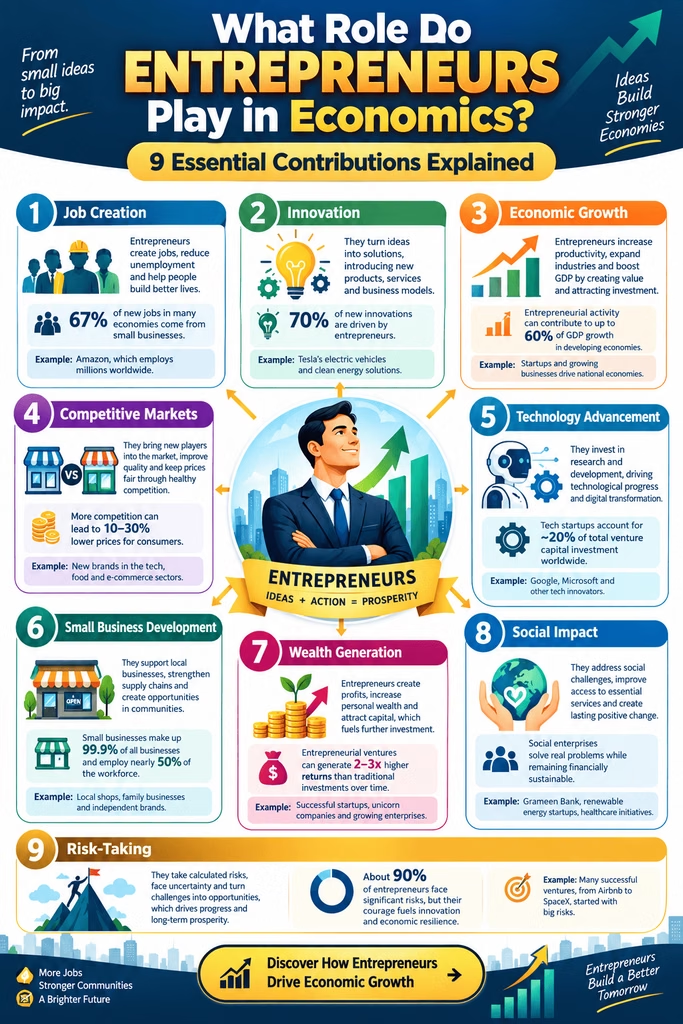
Entrepreneurship is one of the driving forces behind economic activity. Entrepreneurs identify opportunities, organize resources, introduce new products and services, create businesses, employ workers, and accept financial risks in pursuit of potential rewards. Their decisions can influence production, employment, innovation, competition, investment, and the overall development of an economy.
Understanding how entrepreneurs play in economics is important because economic growth does not happen only through government policies, natural resources, or large corporations. Individuals and small business owners also contribute significantly by turning ideas into productive activities. From a local shop to a technology startup, entrepreneurial ventures can connect consumers with goods and services while creating opportunities for workers and suppliers.
This article explains the major economic functions of entrepreneurs, their relationship with economic growth, their contribution to innovation and employment, and the challenges they face.
Read More: What is Economics?
What Is an Entrepreneur?
An entrepreneur is a person who identifies a business opportunity and organizes resources to create or operate a business. Entrepreneurs may develop a completely new product, improve an existing service, establish a new production method, or find a more efficient way to serve customers.
Entrepreneurs generally combine several resources, including:
- Capital
- Labor
- Natural resources
- Technology
- Knowledge
- Business networks
- Management skills
They make decisions about what to produce, how to produce it, whom to serve, and how to respond to changing market conditions.
Entrepreneurs can operate businesses of many different sizes. A person running a neighborhood bakery is an entrepreneur, just as the founder of a technology company can be. Their industries and scales may differ, but both involve organizing resources and making decisions under uncertainty.
Read More: What Can You Do With an Economics Degree?
Understanding How Entrepreneurs Play in Economics
The economic importance of entrepreneurship comes from the way entrepreneurs transform resources into productive economic activities. They recognize unmet needs, mobilize resources, establish organizations, and make decisions about production and investment.
When entrepreneurs create businesses, they can generate a chain of economic activity. A new restaurant, for example, may employ cooks and servers, purchase ingredients from farmers and wholesalers, rent commercial space, use financial services, and attract customers. Each of these relationships can contribute to economic activity.
The major ways entrepreneurs contribute to an economy include:
- Creating employment
- Encouraging innovation
- Increasing competition
- Mobilizing resources
- Supporting economic growth
- Meeting consumer needs
- Increasing productivity
- Generating income and wealth
- Supporting local and regional development
These functions are interconnected rather than completely separate.
Read More: What is Demand in Economics?
1. Entrepreneurs Create Employment Opportunities
One of the most visible economic contributions of entrepreneurship is job creation.
When a business is established and grows, it may require employees to perform different tasks. A manufacturing company may hire production workers, engineers, accountants, sales representatives, drivers, and administrative staff. A growing digital business may employ programmers, designers, marketers, customer-service representatives, and managers.
Employment generated by entrepreneurial businesses provides workers with income. Workers can then use that income to purchase goods and services, contributing to demand throughout the economy.
Entrepreneurial businesses can also create indirect employment. Suppose a new furniture manufacturer opens a factory. Besides hiring factory workers, the company may purchase wood from suppliers, use transportation services, employ maintenance providers, and work with advertising agencies. These suppliers may consequently need additional workers.
Therefore, entrepreneurship can influence employment beyond the boundaries of an individual business.
Small Businesses and Employment
Small and medium-sized enterprises can be particularly important sources of employment. Many entrepreneurs begin with small operations and gradually expand as demand increases.
A small business may start with one owner and eventually employ several people. If many entrepreneurs establish and expand businesses simultaneously, the combined employment effect can become significant.
2. Entrepreneurs Encourage Innovation
Innovation is another major contribution of entrepreneurship.
Entrepreneurs often search for better ways to solve problems. Innovation can involve creating something entirely new, improving an existing product, changing a production process, or developing a more convenient way to deliver a service.
For example, entrepreneurs have contributed to the development of:
- Digital payment systems
- Online marketplaces
- Mobile applications
- Renewable-energy solutions
- New manufacturing techniques
- Delivery services
- Educational technology
- Agricultural technologies
Innovation can make products more useful, reduce production costs, save time, or improve customer experiences.
Read More: Is Economics a Social Science?
Innovation and Economic Efficiency
When entrepreneurs introduce improved production methods, businesses may produce more output using fewer resources. This can increase productivity.
For instance, a company that develops an automated system may allow workers to complete certain repetitive tasks more quickly. The resulting productivity improvement can reduce costs or enable the company to produce more goods.
Not every entrepreneurial idea succeeds, of course. However, experimentation and competition can encourage businesses to search continuously for better solutions.
3. Entrepreneurs Increase Competition
Competition is an important feature of market economies, and entrepreneurs can strengthen it by entering existing markets.
Imagine that only one company provides a particular service in a community. A new entrepreneur may establish another business offering a similar service. Customers then have more choices.
Businesses facing competition may respond by:
- Improving product quality
- Reducing prices
- Offering better customer service
- Introducing new features
- Improving convenience
- Finding more efficient production methods
Competition can therefore encourage businesses to respond to consumer preferences.
Entrepreneurial entry does not automatically guarantee lower prices or better products in every market. However, the possibility of new competitors can influence how established businesses behave.
4. Entrepreneurs Mobilize Economic Resources
An economy contains many resources, but resources become economically useful when they are organized effectively.
Entrepreneurs bring together factors of production such as land, labor, capital, and technology. They decide how these resources should be combined to produce goods or services.
Consider a person who identifies an opportunity to establish a food-processing business. The entrepreneur may:
- Secure financing.
- Rent or purchase production space.
- Acquire machinery.
- Hire employees.
- Purchase raw materials.
- Develop a production process.
- Market the finished products.
- Sell the products to consumers or other businesses.
The entrepreneur coordinates these activities into an operating enterprise.
This coordinating function is economically important because resources that are separately available do not automatically organize themselves into productive businesses.
5. Entrepreneurs Contribute to Economic Growth
Economic growth generally refers to an increase in the production of goods and services over time. Entrepreneurship can contribute to growth by expanding productive capacity, increasing investment, introducing innovations, and creating employment.
When successful businesses expand, they may build new facilities, purchase equipment, hire more workers, and increase production.
New businesses can also introduce activities that did not previously exist in a particular market.
Entrepreneurship and Productivity
Productivity measures how efficiently resources are used to produce output. Entrepreneurs can contribute to productivity by experimenting with new technologies, management techniques, and production methods.
Higher productivity can allow an economy to produce more output from a given amount of resources.
For example, an agricultural entrepreneur may introduce improved irrigation equipment or data-based farming methods. If these methods increase crop production without requiring a proportional increase in resources, agricultural productivity may improve.
6. Entrepreneurs Satisfy Consumer Needs
Entrepreneurs often begin businesses because they identify a demand or an unmet need.
Consumers have diverse preferences. They may want faster delivery, lower prices, specialized products, better quality, greater convenience, or completely new experiences.
Entrepreneurs attempt to respond to these demands by creating products and services.
For example, an entrepreneur might notice that students in a community need affordable online tutoring. The entrepreneur could establish a digital tutoring platform that connects students with instructors.
This process creates an economic relationship between consumer demand and business supply.
Responding to Changing Preferences
Consumer preferences change over time. Technological developments, demographic changes, income levels, cultural trends, and environmental concerns can influence what people want.
Entrepreneurs who recognize these changes may develop businesses around emerging demands.
This responsiveness can help markets adjust to changing economic conditions.
7. Entrepreneurs Increase Productivity Through Technology
Technology plays an increasingly important role in modern economies. Entrepreneurs can accelerate technological adoption by applying new tools to business activities.
Examples include:
- Cloud-based business systems
- Artificial intelligence applications
- Digital payment platforms
- Automated manufacturing
- E-commerce
- Data analytics
- Online education
- Modern agricultural equipment
Technology can improve communication, reduce administrative work, improve inventory management, and make services accessible to more customers.
Entrepreneurs may also create businesses specifically designed around technological innovation.
Technology Diffusion
When one business successfully adopts a useful technology, other businesses may imitate or adapt it. Over time, technological practices can spread throughout an industry.
This diffusion can contribute to broader productivity improvements.
8. Entrepreneurs Generate Income and Wealth
Entrepreneurial activity can generate income for several groups.
Business owners may receive profits when their enterprises succeed. Employees receive wages or salaries. Suppliers receive payments for goods and services. Governments may collect taxes from business activity and employee income.
As businesses grow, their economic relationships can become increasingly extensive.
For example, a successful clothing company may purchase fabric from suppliers, pay employees, rent warehouses, use transportation companies, advertise through media platforms, and sell products to retailers or consumers.
The revenue generated by these transactions circulates through different parts of the economy.
Profit as an Economic Incentive
Profit can serve as an incentive for entrepreneurs to accept uncertainty and commit resources to business ventures.
However, entrepreneurship does not guarantee profit. Businesses can experience losses, and some may fail completely. Entrepreneurs therefore operate under uncertainty and must make decisions without knowing exactly what future market conditions will be.
9. Entrepreneurs Support Local and Regional Development
Entrepreneurship can have a particularly noticeable effect on local communities.
A new business may create jobs, increase demand for local suppliers, use commercial property, attract customers, and introduce new services.
For example, an entrepreneur opening a food-processing facility in a rural area may create opportunities for local farmers to sell agricultural products. The facility may also employ local workers and purchase transportation and maintenance services from nearby providers.
In this way, entrepreneurial activity can connect different parts of a local economy.
Entrepreneurship in Rural Areas
Rural entrepreneurship can be important for diversifying local economies. Agricultural processing, tourism, handicrafts, digital services, and small-scale manufacturing can provide additional sources of economic activity.
Entrepreneurship alone cannot solve all regional economic problems, but it can be one component of local development.
Entrepreneurs and the Factors of Production
Traditional economics commonly identifies four major factors of production:
- Land
- Labor
- Capital
- Entrepreneurship
Entrepreneurship differs from the other factors because it involves coordinating them and making decisions about their use.
An entrepreneur may combine labor and capital with natural resources and technology to create goods or services.
For example, a manufacturing entrepreneur may combine:
Land: factory space
Labor: employees
Capital: machinery and financial investment
Entrepreneurship: organization, decision-making, risk-taking, and opportunity recognition
The entrepreneur determines how the other resources should be coordinated to pursue a business objective.
Entrepreneurs and Risk
Risk and uncertainty are important features of entrepreneurship.
Before launching a business, an entrepreneur may not know:
- How many customers will purchase the product
- Whether competitors will enter the market
- How costs will change
- Whether technology will become outdated
- Whether consumer preferences will change
- Whether the business will generate sufficient revenue
Entrepreneurs therefore make decisions based on available information and expectations about the future.
Some risks can be estimated using historical data and probability. Other forms of uncertainty are much harder to predict.
This uncertainty is one reason entrepreneurial activity can produce both significant successes and substantial business failures.
Entrepreneurs and Capital Formation
Entrepreneurial activity can encourage investment in productive assets.
When entrepreneurs establish or expand businesses, they may invest in:
- Buildings
- Machinery
- Vehicles
- Software
- Research and development
- Training
- Inventory
- Business infrastructure
Such investment can increase an economy’s productive capacity.
Entrepreneurs may finance investments using personal savings, bank loans, investors, venture capital, or other financing mechanisms, depending on the nature and scale of the business.
Entrepreneurs and Structural Economic Change
Economies change over time. Industries that were once dominant may shrink, while new industries emerge.
Entrepreneurs can contribute to this process by creating businesses in emerging sectors.
For example, economic activity has increasingly expanded into areas such as digital services, renewable energy, biotechnology, software, e-commerce, and advanced manufacturing.
Entrepreneurial businesses can help shift resources toward activities where entrepreneurs and investors perceive new opportunities.
This process can involve adjustment costs. Workers may need new skills, existing companies may lose market share, and some older business models may become less profitable.
Consequently, entrepreneurship can contribute to economic transformation while also creating challenges for workers and established firms.
Entrepreneurs and International Trade
Entrepreneurs can also participate in international markets.
A business may export products to foreign consumers, import materials from international suppliers, or provide digital services across borders.
International entrepreneurship can:
- Expand markets for businesses
- Increase export earnings
- Introduce domestic firms to international competition
- Encourage technology and knowledge transfer
- Create relationships with overseas suppliers and customers
Digital technologies have made international participation possible for some small businesses that previously would have faced greater barriers to reaching foreign customers.
The Role of Entrepreneurs in Developing Economies
Entrepreneurship can be especially relevant in developing economies where businesses may contribute to employment, market development, innovation, and access to goods and services.
Small enterprises can provide economic opportunities in communities where large companies have limited presence.
Entrepreneurs may establish businesses in areas such as:
- Agriculture
- Food processing
- Retail
- Transportation
- Education
- Healthcare services
- Manufacturing
- Information technology
- Renewable energy
However, entrepreneurial development depends heavily on the broader economic environment.
Access to finance, infrastructure, education, reliable electricity, digital connectivity, property rights, market access, and predictable regulations can affect whether businesses can start and grow.
Challenges Faced by Entrepreneurs
Although entrepreneurship can contribute to economic development, entrepreneurs face numerous challenges.
Limited Access to Finance
Many new businesses require funding before they generate sufficient revenue. Entrepreneurs may struggle to obtain loans or investment, particularly when they lack collateral or an established financial history.
Market Uncertainty
Consumer demand can change unexpectedly. A product that initially appears promising may fail to attract enough customers.
Competition
Entrepreneurs must compete with established companies and other new businesses. Strong competition can make it difficult for young firms to survive.
Regulatory Requirements
Businesses may need to comply with taxation, licensing, labor, environmental, safety, and other regulations. Well-designed regulation can protect consumers and workers, but complex or unpredictable requirements can increase business costs.
Skill Gaps
Entrepreneurs need more than a good idea. They often require knowledge of accounting, marketing, operations, finance, technology, human resources, and management.
Infrastructure Constraints
Poor transportation, unreliable electricity, limited internet access, and inadequate logistics can increase costs and restrict market opportunities.
Addressing these challenges can help create conditions in which productive entrepreneurship is more likely to develop.
Difference Between Entrepreneurs and Business Managers
Entrepreneurs and managers can both make important economic contributions, but their roles are not identical.
An entrepreneur typically identifies an opportunity, establishes or develops a venture, organizes resources, and accepts the uncertainty associated with business decisions.
A manager generally focuses on organizing and supervising activities within an existing organization.
There can be significant overlap. An entrepreneur may also act as the manager of a business, particularly during its early stages.
The distinction is therefore about the primary economic role rather than completely separate occupations.
How Government Can Support Entrepreneurship
Government policies can influence the environment in which entrepreneurs operate.
Potential areas of support include:
- Access to business education
- Financial programs for eligible businesses
- Reliable infrastructure
- Digital connectivity
- Transparent regulations
- Efficient business registration
- Research and development support
- Skills training
- Access to domestic and international markets
The goal of such policies can be to reduce unnecessary barriers while maintaining appropriate protections for workers, consumers, and the environment.
Effective entrepreneurship ecosystems generally involve multiple institutions, including governments, educational organizations, financial institutions, businesses, investors, and professional networks.
Entrepreneurship and Sustainable Economic Development
Modern entrepreneurship increasingly includes environmental and social considerations.
Some entrepreneurs develop businesses that address challenges such as:
- Renewable energy
- Waste reduction
- Recycling
- Energy efficiency
- Sustainable agriculture
- Water conservation
- Environmentally efficient transportation
These ventures can pursue commercial objectives while addressing environmental or social needs.
However, the economic and environmental effects of any particular business depend on its actual operations, supply chain, resource use, and long-term outcomes.
Why Entrepreneurship Matters to the Economy
The importance of entrepreneurship comes from its ability to connect ideas, resources, markets, and people.
An entrepreneur may begin with an observation about a problem or unmet need. Turning that observation into a functioning business requires investment, organization, experimentation, and decision-making.
When businesses succeed, they can create employment, increase production, introduce innovations, strengthen competition, and generate income. When businesses fail, resources may be released and redirected toward other activities.
At the economy-wide level, thousands or millions of such decisions contribute to the continual process of economic change.
Frequently Asked Questions (FAQ)
What role do entrepreneurs play in economics?
Entrepreneurs play in economics a central role by organizing resources, creating businesses, generating employment, encouraging innovation, increasing competition, and contributing to production and economic growth.
How do entrepreneurs help create jobs?
Entrepreneurs create jobs by establishing and expanding businesses that require workers. Their activities can also create indirect employment through suppliers, distributors, service providers, and related businesses.
Why are entrepreneurs important for economic growth?
Entrepreneurs can contribute to economic growth by increasing investment, introducing innovations, creating employment, expanding production, and improving productivity.
How do entrepreneurs encourage innovation?
Entrepreneurs often search for new products, services, technologies, and production methods that can solve problems or satisfy changing consumer needs. Competition can further encourage businesses to innovate.
Do entrepreneurs always make profits?
No. Entrepreneurship involves uncertainty, and businesses can experience losses or fail. Potential profit is an incentive, but it is not guaranteed.
How do entrepreneurs affect competition?
New businesses can enter existing markets and give consumers additional choices. This may encourage established companies to improve quality, prices, services, or products.
What resources do entrepreneurs organize?
Entrepreneurs coordinate factors such as labor, capital, natural resources, technology, knowledge, and business networks to produce goods or services.
Can entrepreneurship help developing economies?
Yes. Entrepreneurship can contribute to employment, investment, innovation, local production, and access to goods and services. Its effects depend partly on the broader business environment and available infrastructure.
What challenges do entrepreneurs face?
Common challenges include limited financing, market uncertainty, competition, regulatory requirements, skill shortages, infrastructure limitations, and changing consumer preferences.
What is the relationship between entrepreneurship and innovation?
Entrepreneurship provides a mechanism through which ideas can be converted into commercial products, services, and processes. Innovation can therefore become an important part of entrepreneurial activity.
Conclusion
Entrepreneurs are important economic actors because they transform opportunities and ideas into organized economic activity. They bring together labor, capital, technology, natural resources, and knowledge to produce goods and services.
The answer to the question of how entrepreneurs play in economics includes several interconnected functions. Entrepreneurs create employment, encourage innovation, increase competition, mobilize resources, support investment, improve productivity, satisfy consumer needs, generate income, and contribute to local and national economic development.
Their influence extends beyond individual businesses. A successful enterprise can create relationships with employees, suppliers, customers, investors, financial institutions, and other businesses. These connections allow entrepreneurial activity to become part of a much broader economic system.
At the same time, entrepreneurship involves uncertainty. Not every business succeeds, and entrepreneurs operate within economic, technological, regulatory, and competitive constraints. The wider environment—including access to finance, infrastructure, education, technology, and markets—can strongly affect entrepreneurial outcomes.
Ultimately, entrepreneurship is one component of a dynamic economy. By identifying opportunities, organizing resources, experimenting with new ideas, and responding to changing market conditions, entrepreneurs help shape how economies produce, distribute, and consume goods and services.