
Neurons and the Reflex Arc: 7 Admirable Concepts Made Simple
Introduction to Mammalian Nerve Cells
The mammalian nervous system is a highly complex network responsible for regulating and coordinating body activities. At the heart of this intricate infrastructure are the specialized cells known as neurons. These cellular units possess the unique ability to receive, process, and transmit information via electrical and chemical signals.
Unlike standard somatic cells, neurons are structurally adapted to bridge vast anatomical distances. They allow a mammal to perceive its environment, process emotional and cognitive data, and execute swift motor responses. The flawless operation of mammalian life—from a blue whale managing its heartbeat to a cheetah calculating a high-speed turn—relies fundamentally on these structures.
To understand how the mammalian nervous system governs complex behaviors, we must explore the specialized morphology, physiological mechanisms, and cooperative networks formed by neurons.
1. Structural Anatomy of Neurons
The unique functions of neurons are directly tied to their shape. While standard animal cells are typically round or compact, neurons feature long, branching extensions optimized for communication. A typical mammalian neuron contains three primary structures: the soma (cell body), dendrites, and the axon.
The Soma (Cell Body)
The soma is the metabolic and genetic core of the neuron. It contains the nucleus, which houses the cell’s DNA and coordinates transcription. Surrounding the nucleus is the cytoplasm, filled with specialized organelles that support high-volume protein synthesis.
Because neurons are highly active cells, they require massive amounts of protein. This demand is met by the Nissl bodies—dense clusters of rough endoplasmic reticulum and free ribosomes unique to neurons. These structures rapidly manufacture the proteins needed for cellular maintenance and chemical messaging.
The soma also contains abundant mitochondria to generate the ATP (energy) required to maintain internal ion balances during signaling.
Dendrites
Branching outward from the soma are the dendrites, named for their tree-like appearance. Dendrites act as the primary antennae of neurons, receiving incoming signals from other cells.
To maximize their surface area, mammalian dendrites are often covered in tiny, specialized outgrowths called dendritic spines. These spines serve as dedicated contact sites for incoming chemical signals. A single neuron can display thousands of dendritic spines, allowing it to collect and process vast amounts of data simultaneously.
The Axon and Axon Hillock
While dendrites receive signals, the axon is the single long extension responsible for carrying signals away from the cell body toward other targets.
The axon originates at a specialized region of the soma called the axon hillock. This area acts as the neuron’s decision-making center, integrating all incoming signals to determine whether an electrical impulse should be fired.
The main length of the axon is protected by a specialized plasma membrane called the axolemma, which houses the ion channels necessary for conducting electrical signals. At its opposite end, the axon splits into several fine branches known as axon terminals (or telodendria). These terminals feature swollen tips called synaptic knobs, which store chemical messengers and sit positioned directly across from target cells.
2. Structural and Functional Classification
Not all neurons look or act exactly the same. To manage different types of information, mammalian neurons have evolved into distinct shapes and functional categories.
Structural Varieties
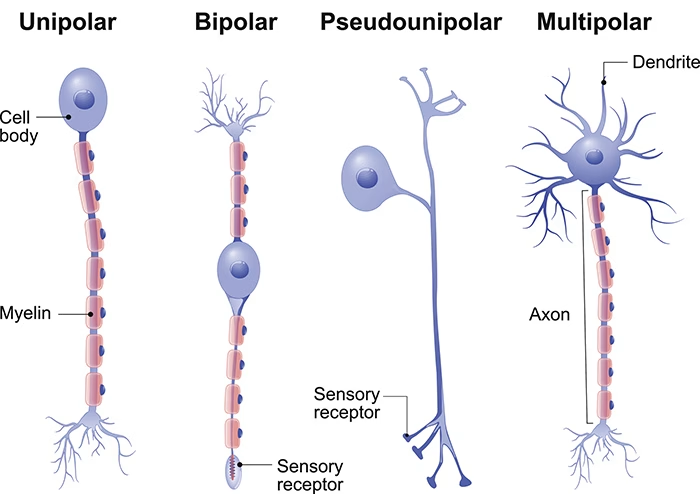
Neurons are categorized by the number of extensions emerging directly from the cell body:
- Multipolar Neurons: These feature a single axon and numerous dendritic branches. This is the most common structural arrangement in mammalian brains and spinal cords.
- Bipolar Neurons: These possess exactly two extensions—one axon and one dendritic tree—projecting from opposite sides of the soma. These are highly specialized structures found in sensory systems, such as the retina of the eye and the olfactory epithelium of the nose.
- Pseudounipolar Neurons: These feature a short, single extension from the soma that quickly splits into two functional paths. One path travels out to the sensory periphery, while the other connects directly to the central nervous system. These shapes are typical of primary sensory neurons found in the dorsal root ganglia of the spinal cord.
While the brain handles our complex thoughts and conscious choices, many of our most vital, life-saving responses are managed directly within the spinal cord. This lightning-fast processing relies on a coordinated circuit built from three distinct classes of neurons: sensory, motor, and relay.
By looking at their structural differences and observing how they interact, we can understand how the mammalian body processes external stimuli and executes rapid physical movements.
Comparing Sensory and Motor Neurons
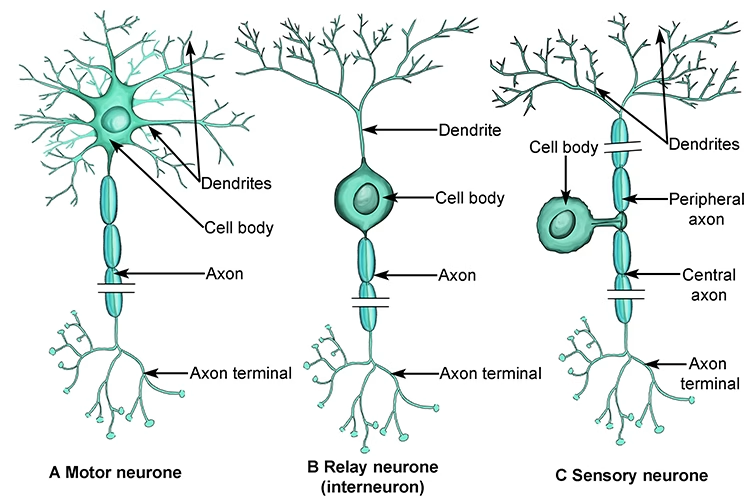
Sensory and motor neurons are the cellular highways of the peripheral nervous system. Though they look similar at a glance, they are structurally adapted to carry information in opposite directions.
Sensory (Afferent) Neurons
Sensory neurons collect data from internal organs or external stimuli (like heat, pressure, or light) and transmit those impulses toward the central nervous system.
Structurally, most mammalian sensory neurons are pseudounipolar. The cell body (soma) sits off to the side in a cluster called the dorsal root ganglion, completely out of the main pathway. This unique shape allows the electrical signal to bypass the cell body entirely, rushing straight from the long peripheral axon directly to the central axon for maximum speed.
Motor (Efferent) Neurons
Motor neurons carry instructions away from the central nervous system out to effectors, such as muscles or glands, to trigger a physical response.
Structurally, motor neurons are multipolar. They feature a large cell body bristling with dense trees of dendrites, designed to receive input from thousands of other cells simultaneously. Emerging from this busy cell body is a single, exceptionally long axon that travels out of the spinal cord to plug directly into a muscle fiber or gland.
The Relay Neuron: The Central Connector
Positioned directly between sensory inputs and motor outputs is the relay neuron (also commonly called an interneuron). Located exclusively within the gray matter of the spinal cord and brain, relay neurons act as local circuit switchboards.
Structurally, relay neurons are short, highly branched multipolar cells. Because they do not need to transmit signals across long physical distances, they lack the elongated axons seen in sensory or motor fibers. Instead, their dense networks of short dendrites and axons are optimized to analyze incoming sensory data, combine it with context, and immediately determine the appropriate motor response.
Coordinated Operation: The Reflex Arc
A reflex arc is the functional neural pathway that controls a reflex—an immediate, involuntary reaction to a stimulus.
To maximize survival, this circuit is designed for raw speed. It bypasses the conscious brain entirely, routing the signal directly through the spinal cord. This architectural shortcut allows the mammalian body to react to threats, like touching a hot surface or stepping on a sharp object, in fractions of a second—well before the brain even registers the sensation of pain.
The Five Essential Components of a Reflex Arc
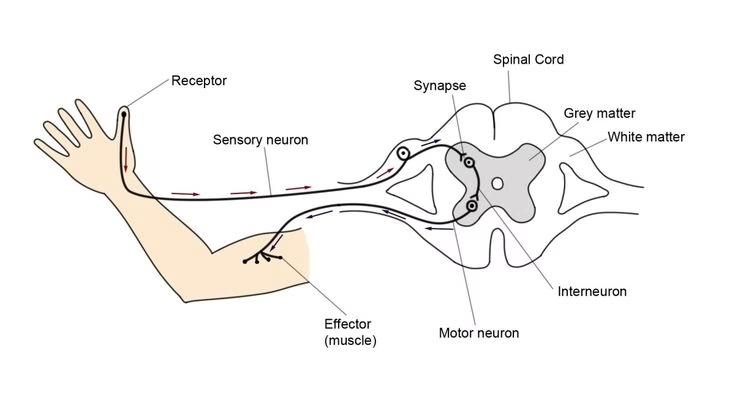
Every somatic reflex arc is built from five distinct anatomical structures, operating like a relay team to pass an electrical and chemical message from the point of impact back to the responding muscle.
The Receptor
The circuit begins with a specialized sensory receptor embedded in the tissue (such as the skin, tendons, or muscles). These receptors are tuned to detect specific environmental hazards. For example, nociceptors detect tissue damage (pain), while thermoreceptors detect extreme temperature changes.
The Sensory (Afferent) Neuron
Once the receptor is activated, it triggers an electrical impulse in the sensory neuron. This cell serves as the incoming highway, carrying the action potential away from the periphery and into the dorsal (back) horn of the spinal cord.
The Integration Center (Spinal Cord)
Inside the gray matter of the spinal cord, the sensory neuron transfers its signal across a microscopic gap (synapse) to a relay neuron (or interneuron). The relay neuron serves as the local switchboard. It instantaneously analyzes the urgency of the incoming signal and routes it directly to the appropriate exit path.
The Motor (Efferent) Neuron
The relay neuron fires neurotransmitters across a second synapse to activate a motor neuron sitting in the ventral (front) horn of the spinal cord. The motor neuron serves as the outgoing highway, rapidly conducting an electrical command out of the spinal column and down the limb toward the target area.
The Effector
The axon terminal of the motor neuron plugs directly into an effector—typically a skeletal muscle fiber—at a specialized junction called the neuromuscular junction. The arrival of the signal causes the muscle to contract sharply, physically pulling the body part away from the danger.
READ: Which Part of Your Brain Is Involved in Your Motivation?