
Stars The Cosmic Kitchen: Birth and Death Explained
Introduction
The universe is filled with glowing celestial bodies that shape galaxies and influence cosmic events. Every star has a beginning, a period of stability, and an eventual end. The lifecycle of a star depends mainly on its mass, temperature, and chemical composition. Some stellar objects live for billions of years, while others burn out much faster.
Understanding the lifecycle of a star helps scientists explain how galaxies evolve and how elements essential for life are created. From the birth of a glowing sphere inside a nebula to its final transformation into a white dwarf, neutron object, or black hole, each stage reveals important details about the universe.
This article explores the complete lifecycle of a star, including its formation, development, aging process, and final fate.
What Is a Star?
A star is a massive ball of hot gases, mainly hydrogen and helium, held together by gravity. Inside its core, nuclear fusion converts hydrogen into helium, releasing enormous amounts of energy. This energy produces heat and light, allowing the object to shine across space.
The Sun is the closest example of a star to Earth. Although it appears unique from our perspective, it follows the same general evolutionary stages as many other stellar bodies in the universe.
READ : Nuclear fission
The Birth of a Star
Formation Inside a Nebula
The lifecycle of a star begins inside a nebula. A nebula is a giant cloud of gas and dust floating through space. Over time, gravity causes particles within the cloud to pull together.
READ: What Is an Ideal Gas?
As the material becomes denser, it forms a protostar. During this phase, temperature and pressure increase steadily. The growing object continues gathering surrounding matter until nuclear fusion begins in its core.
Protostar Stage
A protostar is an early developmental phase before full stellar ignition occurs. At this point, the object does not yet generate energy through fusion. Instead, heat comes mainly from gravitational contraction.
Eventually, the core becomes hot enough for hydrogen atoms to fuse into helium. Once sustained fusion starts, a true star is born.
Main Sequence Stage
The longest phase in the lifecycle of a star is called the main sequence stage. During this period, fusion inside the core remains stable. Hydrogen continuously converts into helium, producing energy that balances the inward pull of gravity.
E=mc2
Most stellar objects in the universe currently exist in this stage. The Sun, for example, has remained in the main sequence phase for approximately 4.6 billion years.
Characteristics of the Main Sequence
The properties of a star during this stage depend largely on mass:
- Large stellar bodies burn fuel rapidly and appear blue or white.
- Medium-sized objects, like the Sun, appear yellow.
- Smaller ones burn fuel slowly and often appear red.
Mass determines temperature, brightness, lifespan, and future evolution.
Red Giant or Supergiant Phase
Eventually, hydrogen in the core becomes depleted. Without enough hydrogen fusion, the balance between gravity and outward pressure changes.
Red Giant Formation
For medium-sized bodies, the core contracts while outer layers expand dramatically. The object becomes a red giant. During this phase, helium fusion begins, creating heavier elements such as carbon and oxygen.
The outer surface cools slightly, giving the giant a reddish appearance despite its enormous size.
Red Supergiants
Massive stellar bodies follow a similar path but grow into red supergiants instead. These enormous structures can become hundreds of times larger than the Sun.
Inside a supergiant, fusion continues producing increasingly heavier elements, including neon, silicon, and iron.
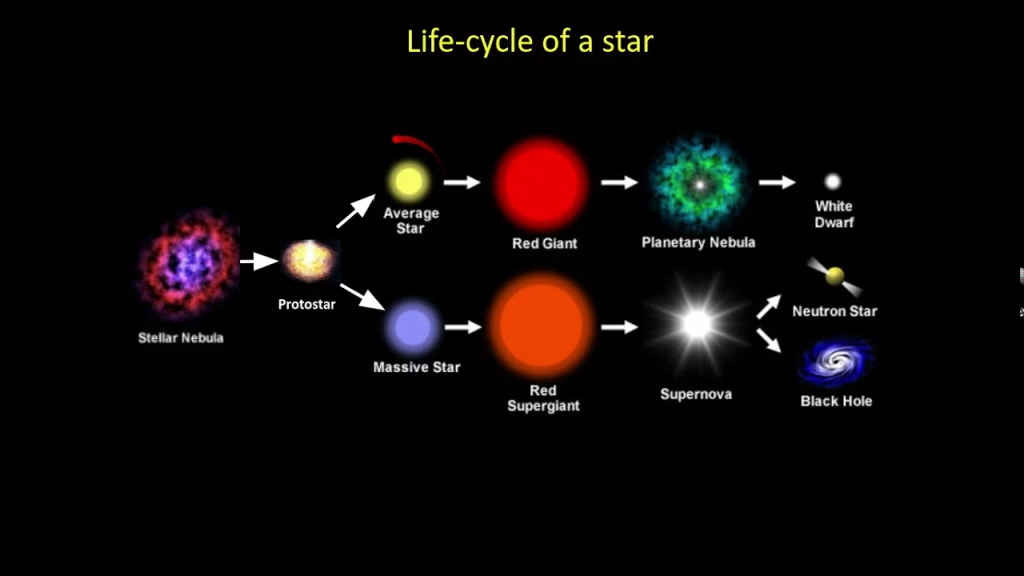
The Death of a Star
The ending stages vary depending on mass. Some stellar objects fade quietly, while others explode violently.
White Dwarf Formation
A medium-sized star eventually sheds its outer layers into space. The remaining core becomes a white dwarf.
A white dwarf is extremely dense and hot but no longer supports nuclear fusion. Over billions of years, it gradually cools and fades.
Planetary Nebula
Before becoming a white dwarf, expelled outer gases create a glowing shell known as a planetary nebula. Despite the name, it has no connection to planets.
This colorful cloud enriches space with heavier elements that may later contribute to the formation of new stellar systems.
Supernova Explosion
A massive star experiences a far more dramatic ending. Once iron accumulates in the core, fusion can no longer generate energy efficiently.
Gravity suddenly overwhelms the core, causing rapid collapse followed by an enormous explosion called a supernova.
Supernova events release tremendous energy and scatter heavy elements throughout space. Many elements found on Earth, including gold and iron, were formed during these explosions.
Neutron Objects and Black Holes
After a supernova, the remaining core may become one of two extraordinary structures.
Neutron Object
If the remaining mass is moderate, the core compresses into a neutron object. These incredibly dense remnants consist mainly of neutrons packed tightly together.
A teaspoon of neutron material would weigh billions of tons on Earth.
Black Hole
If the remaining core is extremely massive, gravity becomes so powerful that not even light can escape. This creates a black hole.
Black holes strongly influence surrounding matter and remain one of the most fascinating phenomena in modern astronomy.
How Mass Controls the Lifecycle
Mass is the most important factor in determining the fate of a star. Larger stellar bodies consume nuclear fuel rapidly, leading to shorter lifespans. Smaller ones burn slowly and can survive for trillions of years.
The following patterns generally occur:
| Mass Type | Lifespan | Final Stage |
| Low mass | Very long | White dwarf |
| Medium mass | Billions of years | White dwarf |
| High mass | Millions of years | Neutron object or black hole |
Because of these differences, not every stellar body evolves identically.
The Importance of Stellar Evolution
The lifecycle of a star plays a major role in shaping the universe. Stellar explosions distribute heavy elements into surrounding space. These materials later contribute to the formation of planets, moons, and even living organisms.This is why these stellar bodies are known as the “Kitchen of the Universe”.
Without stellar evolution, many essential elements required for life would not exist.
Astronomers also study stellar lifecycles to estimate the ages of galaxies and understand cosmic history.
Binary Systems and Unusual Evolution
Not every star evolves alone. Many exist in binary systems where two stellar bodies orbit each other. Interactions between companions can alter normal development patterns.
For example, matter transfer between close companions may trigger unusual explosions or accelerate evolution. Some systems produce X-rays, while others create rare astronomical events.
The Future of the Sun
The Sun currently remains in the main sequence phase. Scientists estimate it will continue stable hydrogen fusion for about five billion more years.
Eventually, the Sun will expand into a red giant. Its outer layers may engulf nearby planets before drifting away into space. The remaining core will likely become a white dwarf.
Although this process sounds dramatic, it will occur far in the future.
Observing Stellar Lifecycles
Modern telescopes allow astronomers to observe different stages of stellar evolution throughout the universe. Because lifecycles span millions or billions of years, scientists study many different objects at various stages rather than watching one complete transformation.
Space observatories and advanced imaging technology continue improving our understanding of stellar physics and cosmic evolution.
Conclusion
The lifecycle of a star is one of the most fascinating processes in astronomy. From its birth inside a nebula to its eventual transformation into a white dwarf, neutron object, or black hole, every stage reveals the power of gravity and nuclear fusion.
A star not only provides light and heat but also creates the heavy elements necessary for planets and life itself. By studying stellar evolution, scientists gain valuable insight into the history and structure of the universe.
Whether small and long-lived or massive and explosive, every star contributes to the ongoing cycle of cosmic creation and destruction.