
Neuron Communication Explained: Phases of Action Potential and Efficiency in Transmission
What Is an Action Potential?
An action potential is a sudden reversal of electrical charge across the membrane of a neuron. Under resting conditions, the inside of the cell is negatively charged compared to the outside. When stimulated strongly enough, the membrane potential changes rapidly, producing an electrical impulse.
This impulse travels along the axon without losing strength. Unlike ordinary electrical currents, action potentials are regenerated continuously as they move through the neuron.
The movement of sodium and potassium ions across the membrane is responsible for generating the action potential.
Resting Membrane Potential
Before an action potential begins, the neuron remains in a resting state. The resting membrane potential is usually around –70 millivolts.
Several factors maintain this negative internal charge:
- More sodium ions are outside the cell
- More potassium ions are inside the cell
- The membrane is more permeable to potassium
- The sodium-potassium pump actively transports ions
The sodium-potassium pump moves three sodium ions out and two potassium ions into the neuron. This process helps maintain ionic balance and prepares the cell for signal transmission.
Threshold Potential
A neuron does not fire an action potential in response to every stimulus. The membrane must reach a threshold level, usually around –55 millivolts.
When the threshold is reached, voltage-gated sodium channels open rapidly. This event initiates the action potential.
The threshold mechanism ensures that only sufficiently strong stimuli produce nerve impulses. This prevents unnecessary signaling and improves the efficiency of the nervous system.
Phases of an Action Potential
The transmission of electrical impulses in a neuron occurs through several well-defined phases.
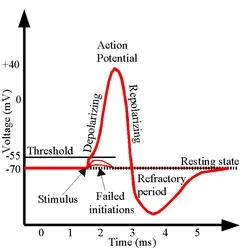
Depolarization Phase
During depolarization, voltage-gated sodium channels open. Sodium ions rush into the neuron because of both concentration and electrical gradients.
As positively charged sodium ions enter the cell, the membrane potential becomes less negative and eventually turns positive.
This phase represents the rapid rise of the action potential. The membrane potential may reach approximately +30 millivolts.
Depolarization occurs very quickly, often within less than a millisecond.
Repolarization Phase
After depolarization, sodium channels close and potassium channels open. Potassium ions move out of the neuron, restoring the negative internal charge.
As potassium exits the cell, the membrane potential begins returning toward the resting level.
Repolarization is essential because it resets the membrane and prepares the neuron for future signaling.
Hyperpolarization Phase
Sometimes the membrane potential becomes even more negative than the resting level. This stage is called hyperpolarization.
Potassium channels close slowly, allowing extra potassium ions to leave the neuron. As a result, the membrane briefly becomes more negative than –70 millivolts.
Eventually, ion channels reset, and the sodium-potassium pump restores the normal resting membrane potential.
Refractory Periods
After firing an action potential, a neuron enters refractory periods that limit additional signaling.
Absolute Refractory Period
During this phase, another action potential cannot occur regardless of stimulus strength. Sodium channels are inactive and must reset first.
Relative Refractory Period
During this phase, a stronger-than-normal stimulus can trigger another impulse. The membrane is still recovering from hyperpolarization.
Refractory periods ensure one-way transmission of action potentials and prevent overlapping signals.
Transmission Along the Axon
Once generated, the action potential moves along the axon membrane.
In an unmyelinated neuron, each adjacent section of membrane depolarizes sequentially. The signal travels continuously but relatively slowly.
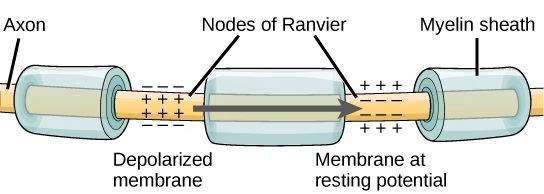
In a myelinated neuron, conduction occurs differently. The myelin sheath prevents ion movement across most regions of the membrane. Action potentials occur only at the Nodes of Ranvier.
This process is called saltatory conduction.
v=d/t
The impulse appears to jump from node to node, greatly increasing transmission speed while conserving energy.
Efficiency of Action Potential Transmission
The nervous system is remarkably efficient. Several adaptations allow a neuron to transmit signals rapidly and accurately.
Myelination
Myelin is one of the most important features improving conduction efficiency.
The myelin sheath:
- Reduces ion leakage
- Increases conduction velocity
- Conserves metabolic energy
- Protects the axon
In humans, some myelinated fibers conduct impulses at speeds exceeding 100 meters per second.
Diseases that damage myelin, such as Multiple Sclerosis, slow signal transmission and impair nervous system function.
Saltatory Conduction
Saltatory conduction is more energy-efficient than continuous conduction because ion exchange occurs only at Nodes of Ranvier.
This mechanism reduces the workload of the sodium-potassium pump and decreases energy consumption within the neuron.
Axon Diameter
Large axons conduct impulses faster than small ones. Wider axons reduce internal resistance to ion flow.
Giant axons in certain animals demonstrate how increased diameter improves transmission speed.
Ion Channel Distribution
Voltage-gated ion channels are strategically concentrated in specific membrane regions.
High channel density at Nodes of Ranvier allows rapid regeneration of action potentials in a myelinated neuron.
Importance of Action Potentials
Action potentials are essential for nearly every bodily function.
Sensory Processing
Sensory receptors generate impulses in response to environmental changes. The neuron carries these signals to the brain for interpretation.
Muscle Contraction
Motor neurons transmit action potentials to muscle fibers, producing movement.
Reflex Actions
Reflex arcs depend on rapid signaling through interconnected neurons.
Brain Function
Thoughts, emotions, learning, and memory rely on electrical communication between billions of neurons.
Synaptic Transmission
When an action potential reaches the axon terminal of a neuron, it triggers neurotransmitter release.
Calcium channels open, allowing calcium ions to enter the terminal. Vesicles containing neurotransmitters fuse with the membrane and release their contents into the synaptic cleft.
Neurotransmitters bind to receptors on the next cell and may initiate another action potential.
Common neurotransmitters include:
- Dopamine
- Acetylcholine
- Serotonin
- GABA
- Glutamate
Efficient synaptic transmission is essential for accurate nervous system communication.
Disorders Affecting Action Potential Transmission
Several medical conditions interfere with the ability of a neuron to conduct impulses properly.
Multiple Sclerosis
This disorder damages myelin sheaths, slowing or blocking action potentials.
Epilepsy
Abnormal electrical activity causes excessive firing of neurons.
Peripheral Neuropathy
Damage to peripheral nerves disrupts signal conduction and sensation.
Sodium Channel Disorders
Mutations affecting ion channels may alter the excitability of a neuron.
Understanding these disorders helps researchers develop treatments targeting nerve signaling mechanisms.
Energy Requirements of Signal Transmission
Although action potentials are rapid, they require significant energy.
The sodium-potassium pump continuously restores ionic gradients after each impulse. This pump consumes ATP generated through cellular respiration.
The brain uses a large portion of the body’s energy supply because billions of neurons remain active continuously.
Efficient impulse transmission minimizes unnecessary energy expenditure while maintaining fast communication.
Comparison Between Electrical and Chemical Transmission
A neuron uses both electrical and chemical methods of communication.
Electrical transmission occurs along the axon through action potentials. This process is extremely fast.
Chemical transmission occurs at synapses through neurotransmitters. Although slightly slower, chemical signaling allows flexibility and modulation.
Together, these mechanisms create a highly adaptable communication network.
Why Action Potentials Are All-or-None
Action potentials follow the all-or-none principle. Once threshold is reached, the neuron produces a full action potential.
A stronger stimulus does not increase the size of the impulse. Instead, stronger stimuli increase the frequency of action potentials.
This principle ensures consistent signal strength throughout transmission.
Conclusion
The transmission of action potentials is one of the most important biological processes in the human body. Every neuron depends on carefully controlled ion movement to generate and conduct electrical signals. Through phases such as depolarization, repolarization, and hyperpolarization, nerve cells transmit information rapidly and accurately.
The efficiency of a neuron is enhanced by adaptations including myelin sheaths, saltatory conduction, and specialized ion channels. These features allow the nervous system to coordinate movement, sensation, thought, and reflexes with extraordinary speed.
Understanding how a neuron conducts action potentials provides insight into the functioning of the brain, spinal cord, and peripheral nerves. It also helps explain the mechanisms behind neurological diseases and modern medical treatments.