
What Is a Verb Phrase?: Your Key to Perfect Grammar
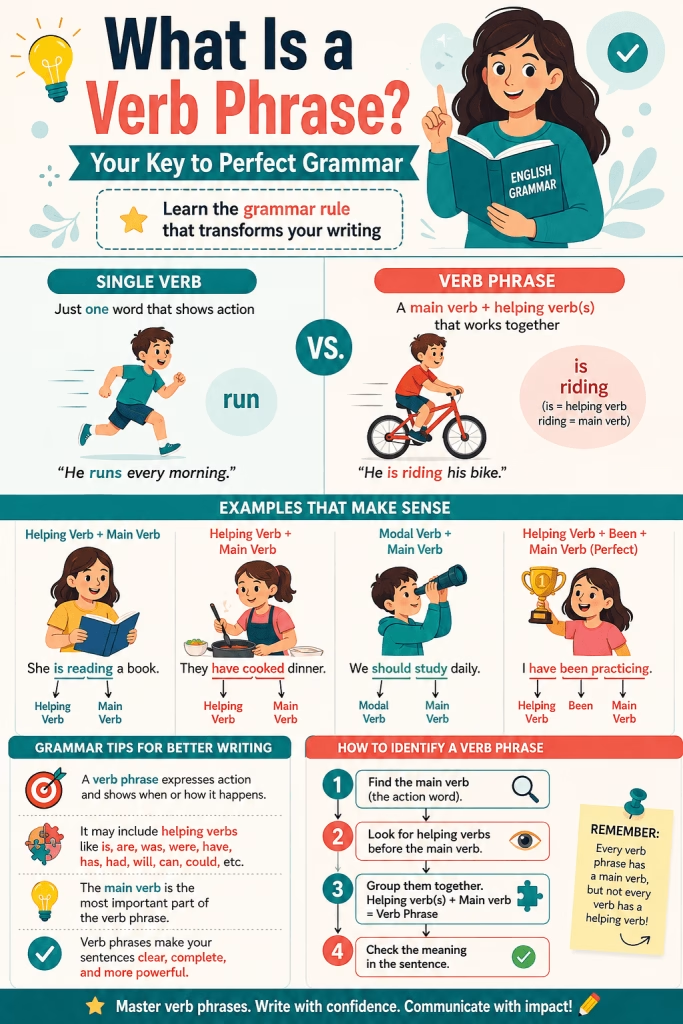
Language works because words join together in meaningful patterns. Among those patterns, the verb phrase plays a central role. If you want to write clear sentences, understand grammar deeply, or improve your speaking skills, learning how a verb phrase works is essential. A verb phrase does far more than simply show action. It can express time, mood, possibility, obligation, completion, and ongoing activity. In everyday communication, every strong sentence depends on the correct use of a verb phrase.
This guide explains what a verb phrase is, how it functions, how to identify it, and how to use it correctly in writing and speech. By the end, you will have a complete understanding of the verb phrase and its importance in English grammar.
What is a Verb Phrase?
A verb phrase is a group of words that includes a main verb and one or more helping verbs, also called auxiliary verbs. Together, these words function as the verb in a sentence. The main verb carries the core meaning, while the helping verbs add grammatical detail.
For example, consider this sentence:
– She is reading a novel.
In this sentence, “is reading” is the verb phrase. The word “reading” is the main verb, and “is” is the helping verb. Together, they show that the action is happening right now.
Here is another example:
– They have completed the project.
In this sentence, “have completed” is the *verb phrase*. The helping verb “have” works with the main verb “completed” to show that the action is finished.
A verb phrase may be short, with only two words, or longer, with several helping verbs. For instance:
– The report may have been written already.
Here, “may have been written” is the *verb phrase*. It includes multiple helping verbs and one main verb.
Read More: What Is a Linking Verb? 10 Effective Steps for Definition, Examples, and Usage
Why the Verb Phrase Matters
The verb phrase is important because it carries much of the grammatical meaning in a sentence. It tells the reader or listener not only what happens but also when it happens, whether it is possible, whether it is required, and whether it is complete or continuing.
Without a proper verb phrase, a sentence may sound incomplete or confusing.
Compare these examples:
– She singing beautifully.
– She is singing beautifully.
The first sentence is incorrect because it lacks a complete verb phrase. The second sentence is correct because “is singing” forms a complete structure.
The verb phrase also helps create precise meaning. Consider the difference among these sentences:
– He writes every day.
– He is writing now.
– He has written already.
– He may write tomorrow.
Each sentence contains a different *verb phrase*, and each one expresses a different time or condition.
Parts of a Verb Phrase
To understand the verb phrase fully, it helps to know its parts. Most verb phrases contain two main elements:
1. Main verb
2. Helping verb or helping verbs
Main Verb
The main verb shows the central action or state. It is the most important word in the verb phrase because it gives the phrase its basic meaning.
Examples of main verbs include:
– run
– eat
– think
– become
– write
In the sentence below, the main verb is easy to spot:
– She has arrived.
The main verb is “arrived.”
Helping Verbs
Helping verbs work with the main verb to build the complete *verb phrase*. They can show tense, voice, mood, or emphasis.
Common helping verbs include:
– am
– is
– are
– was
– were
– be
– being
– been
– have
– has
– had
– do
– does
– did
– may
– might
– can
– could
– shall
– should
– will
– would
– must
For example:
– They are traveling.
– He has finished.
– We might leave soon.
In each sentence, the helping verb supports the main verb and completes the *verb phrase*.
Types of Verb Phrases
A *verb phrase* can appear in several forms. The exact structure depends on what the sentence needs to express. Below are the main types.
1. Simple Verb Phrase
A simple verb phrase contains only a main verb or a main verb with one helping verb.
Examples:
– Birds fly.
– She is laughing.
– They have arrived.
Even a single main verb can function as a *verb phrase* when it stands alone as the complete verbal element of the sentence.
2. Complex Verb Phrase
A complex *verb phrase* contains more than one helping verb before the main verb.
Examples:
– The task may have been completed.
– She will be waiting.
– They should have informed us.
This type of verb phrase allows English speakers to express very specific meanings.
3. Modal Verb Phrase
A modal verb phrase includes a modal auxiliary such as can, could, may, might, shall, should, will, would, or must.
Examples:
– He can swim.
– They should leave.
– I might call later.
This kind of verb phrase often expresses ability, possibility, permission, advice, or necessity.
Verb Phrase and Tense
One of the most important functions of a *verb phrase* is to show tense. English uses verb phrases to express present time, past time, future time, and more complex aspects such as ongoing or completed actions.
Present Tense
Examples:
– She writes every day.
– She is writing now.
– She has written three pages.
Each sentence contains a different *verb phrase* and a different present-time meaning.
Past Tense
Examples:
– He walked home.
– He was walking home.
– He had walked home before sunset.
Again, the verb phrase changes the meaning.
Future Meaning
English often uses helping verbs to create future meaning.
Examples:
– We will travel tomorrow.
– She will be working later.
– They will have finished by noon.
In each case, the verb phrase signals future time.
Verb Phrase and Aspect
Aspect shows whether an action is complete, ongoing, or completed before another action. The verb phrase is the tool that expresses aspect in English.
Progressive Aspect
The progressive aspect shows an ongoing action. It uses a form of “be” plus the present participle.
Examples:
– I am studying.
– They were talking.
– She will be arriving soon.
In each example, the verb phrase shows that the action is in progress.
Perfect Aspect
The perfect aspect shows a completed action with relevance to another time. It uses a form of “have” plus the past participle.
Examples:
– We have eaten.
– She had left.
– They will have completed the work.
Each verb phrase here expresses completion.
Perfect Progressive Aspect
This form combines duration and completion. It uses “have,” “been,” and the present participle.
Examples:
– He has been working all day.
– They had been waiting for hours.
– I will have been teaching for ten years by then.
This type of verb phrase is especially useful for detailed time relationships.
Verb Phrase and Voice
The verb phrase also helps express voice. Voice shows whether the subject performs the action or receives it.
Active Voice
In active voice, the subject performs the action.
– The teacher explained the lesson.
The verb phrase is “explained.”
Passive Voice
In passive voice, the subject receives the action.
– The lesson was explained by the teacher.
The verb phrase is “was explained.”
Passive constructions often use a form of “be” plus a past participle. Because of this, the verb phrase is essential in forming the passive voice correctly.
How to Identify a Verb Phrase
Finding a verb phrase in a sentence becomes easier when you follow a simple method.
Step 1: Find the main action or state
Ask what the subject is doing or being.
Example:
– The children are playing outside.
The action is “playing.”
Step 2: Check for helping verbs
Look for words that come before the main verb and support it.
In the sentence above, “are” helps “playing,” so “are playing” is the *verb phrase*.
Step 3: Include all connected verb words
If there are several helping verbs, include all of them.
Example:
– The message may have been sent already.
The full verb phrase is “may have been sent.”
Examples of Verb Phrases in Sentences
The best way to understand a verb phrase is to study examples in context.
– She is cooking dinner.
– They have visited Paris twice.
– I will call you tomorrow.
– We might be moving soon.
– The cake was baked this morning.
– He has been practicing the piano.
– The package should have arrived by now.
– Birds migrate in winter.
– The road is being repaired.
– You must complete the form today.
In every sentence above, the verb phrase is the grammatical center.
Common Patterns of Verb Phrases
English uses several common verb phrase patterns. Here are some of the most useful ones:
– main verb only: “runs”
– be + present participle: “is running”
– have + past participle: “has run”
– modal + base verb: “will run”
– modal + be + present participle: “will be running”
– modal + have + past participle: “may have run”
– be + past participle: “was chosen”
– have been + present participle: “have been working”
Learning these patterns makes it easier to recognize a *verb phrase* quickly.
Verb Phrase vs. Single Verb
A single verb can function as the complete predicate verb in a sentence, but not every single verb is what learners imagine when they hear the term verb phrase. In school grammar, the term often refers to a main verb plus at least one helping verb. However, in a broader grammatical sense, even one main verb can serve as the verbal unit of the sentence.
Examples:
– She sleeps.
– They laughed.
In these sentences, the verb stands alone. In more detailed grammar study, this can still be treated as the sentence’s *verb phrase*, though many classroom explanations reserve the term for multi-word verbs.
Verb Phrase vs. Phrasal Verb
A verb phrase is not the same as a phrasal verb. This distinction is important.
A phrasal verb is a verb combined with a particle or preposition, creating a meaning that may differ from the original verb.
Examples of phrasal verbs:
– give up
– look after
– turn on
– run into
Example sentence:
– She gave up smoking.
Here, “gave up” is a phrasal verb. It is different from a verb phrase, which focuses on the verb structure, especially the relationship between helping verbs and the main verb.
Still, a sentence can contain both:
– She has given up sugar.
In this sentence, “has given up” is the full *verb phrase*, while “given up” is the phrasal verb unit.
Verb Phrase vs. Gerund Phrase
Learners also confuse the verb phrase with a gerund phrase. A gerund is a verb form ending in -ing that acts as a noun.
Example:
– Swimming every morning improves stamina.
“Swimming every morning” is a gerund phrase, not a verb phrase, because it acts as the subject of the sentence.
Compare that with:
– She is swimming every morning.
Here, “is swimming” is the *verb phrase* because it functions as the verb of the sentence.
Common Mistakes with Verb Phrases
Writers and learners often make mistakes when using a *verb phrase*. Here are some of the most common problems.
1. Missing Helping Verbs
Incorrect:
– She going to school.
Correct:
– She is going to school.
The sentence needs a complete verb phrase.
2. Wrong Verb Form After a Helping Verb
Incorrect:
– They have went home.
Correct:
– They have gone home.
The verb phrase must follow the correct form.
3. Incorrect Modal Construction
Incorrect:
– He must goes now.
Correct:
– He must go now.
After a modal, the verb phrase uses the base form of the main verb.
4. Confusing Passive and Active Forms
Incorrect:
– The letter was wrote yesterday.
Correct:
– The letter was written yesterday.
A passive verb phrase requires the past participle.
Tips for Using Verb Phrases Correctly
If you want to master the verb phrase, keep these tips in mind:
– Identify the main verb first.
– Check whether the sentence needs a helping verb.
– Match the tense to the time you want to express.
– Use the correct participle form after “have,” “has,” “had,” or any form of “be.”
– Be careful with modal verbs.
– Read your sentence aloud to hear whether the *verb phrase* sounds complete.
These habits can improve both grammar and style.
Teaching and Learning the Verb Phrase
For teachers, students, and self-learners, the verb phrase is a valuable topic because it connects grammar with real communication. Instead of memorizing rules in isolation, it helps to examine authentic sentences.
A useful teaching method is to present several versions of one sentence:
– She writes.
– She is writing.
– She has written.
– She will write.
– She will have written.
This comparison shows how each verb phrase changes meaning. It also helps learners understand why grammar matters in practical communication.
Another effective strategy is sentence labeling. Students can underline the verb phrase in a paragraph and then explain the tense, aspect, or mood of each one. This builds confidence and accuracy.
Verb Phrases in Everyday English
The verb phrase appears constantly in everyday speech and writing. Whether you are sending an email, posting online, writing an essay, or having a conversation, you rely on it. Native speakers use the verb phrase naturally, but understanding its structure gives you more control.
For example, compare these everyday statements:
– I work from home.
– I am working from home today.
– I have worked from home for years.
– I might be working late tonight.
Each verb phrase gives the sentence a specific nuance. That is why grammar study is not just academic. It directly improves communication.
How the Verb Phrase Improves Writing
A strong verb phrase helps writers create accurate, polished sentences. It can also improve clarity and tone. Academic writing, business writing, and creative writing all depend on correct verb structures.
For instance, in formal writing, tense consistency matters. If the verb phrase shifts without reason, the writing becomes confusing. In persuasive writing, modal constructions such as “should consider” or “must address” help express recommendations and urgency. In storytelling, the verb phrase shapes the flow of events.
When writers understand the verb phrase, they make fewer grammar mistakes and communicate more precisely.
Practice Sentences
Here are a few practice examples. Try identifying the verb phrase in each sentence:
– The scientists are studying distant planets.
– My friend has called twice today.
– The meeting will begin at noon.
– The windows were cleaned yesterday.
– She may have forgotten the keys.
– We had been waiting for an hour.
In these examples, the verb phrase may contain one word or several words, but in every case it forms the sentence’s verb structure.
Conclusion
The verb phrase is one of the most important building blocks in English grammar. It includes the main verb and, often, one or more helping verbs. Together, these words express action, time, completion, continuity, possibility, obligation, and voice. Once you understand how a verb phrase works, you can read more accurately, write more clearly, and speak more confidently.
Learning the verb phrase is not only about passing grammar tests. It is about understanding how English creates meaning. From simple sentences such as “She runs” to more complex ones such as “She might have been running,” the verb phrase shapes the message. That is why every serious learner of English should study the verb phrase carefully.
If you practice identifying the main verb, spotting the helping verbs, and recognizing common patterns, the verb phrase will soon become much easier to understand. With time, you will begin to use each verb phrase naturally and correctly in your own communication.