
How Many neurons Are in the Brain? Explore the Human Brain’s Remarkable Network
The human brain is one of the most complex biological structures known to science. It allows us to think, remember, learn, communicate, recognize people and places, control movement, experience emotions, and respond to the world around us. At the center of all these abilities are specialized cells called neurons. These cells communicate with one another through electrical and chemical signals, creating an enormous biological network that allows the brain to process information.
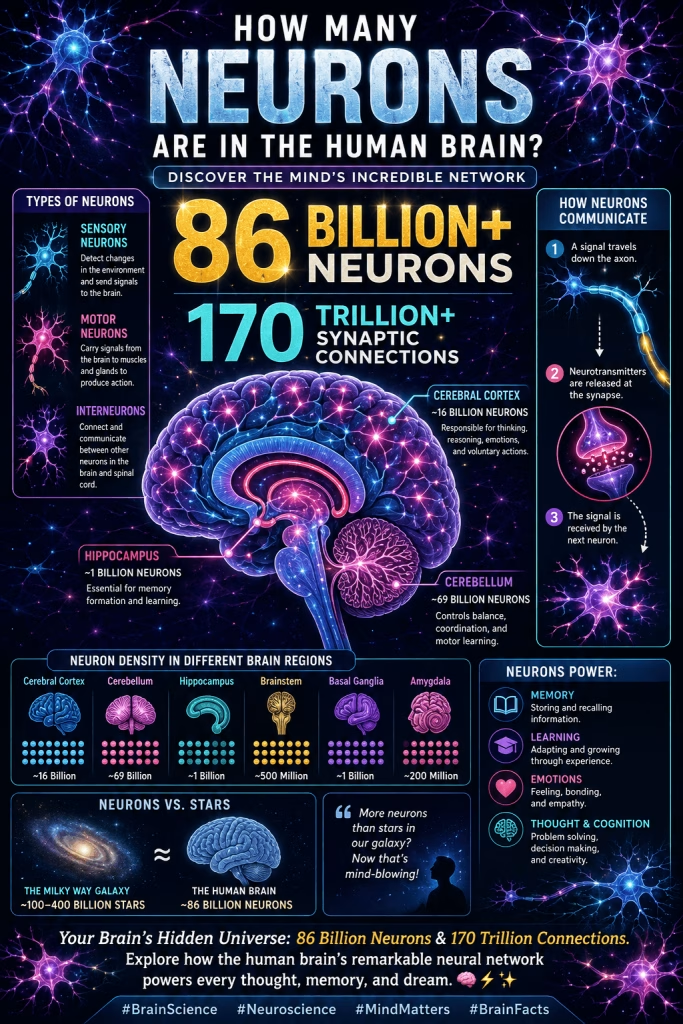
For many years, people commonly heard that the human brain contains approximately 100 billion neurons. This number became widely repeated in textbooks, documentaries, and popular science discussions. However, modern research has produced a more carefully measured estimate. The best-known current estimate is that the average adult human brain contains approximately 86 billion neurons.
The number 86 billion is an estimate rather than an exact count for every individual. Human brains differ in size, structure, and cellular composition, so the number of neurons varies from person to person. Nevertheless, the estimate provides an important scientific reference point for understanding the extraordinary complexity of the human nervous system.
This article explores how many neurons are in the brain, how scientists estimate their number, where these cells are located, how they communicate, and why having billions of them does not automatically explain human intelligence.
The Human Brain Contains About 86 Billion Neurons
The most widely accepted estimate is that the adult human brain contains about 86 billion neurons. This estimate comes from research that used a technique designed to count the number of cells in different parts of the brain.
The figure is considerably lower than the older claim of 100 billion. The difference does not mean that millions or billions of cells have suddenly disappeared. Instead, it reflects improvements in scientific measurement.
One important study compared the cellular composition of several human brains and found an average of approximately 86.1 billion neurons. The researchers also estimated that the human brain contains roughly a similar number of other cells, including glial cells.
The number should therefore be understood as an approximate average. A particular person’s brain may contain somewhat more or fewer neurons. Biological systems rarely have identical cell counts from one individual to another.
An interesting point is that brain size alone does not determine the number of neurons. Different species have different relationships between brain size, cellular density, and cognitive abilities. A larger brain can contain more cells without necessarily producing the same types of information-processing capabilities found in a smaller but differently organized brain.
Why Was the Number Once Said to Be 100 Billion?
The statement that the human brain contains 100 billion neurons became extremely popular during the twentieth century. It was repeated so frequently that it eventually became accepted as a common fact.
However, the figure was not originally based on a precise count of every cell in the human brain. Earlier estimates were often based on indirect measurements, assumptions about cellular density, or extrapolations from limited samples.
Counting individual neurons in an intact human brain is extraordinarily difficult. The brain is a dense three-dimensional structure containing billions of interconnected cells. Individual cells are microscopic, and their structures overlap extensively.
Modern neuroscience has developed more sophisticated methods for estimating cell populations. One particularly important approach involves turning brain tissue into a homogeneous suspension of cell nuclei and then counting representative cellular components.
This method reduces the difficulty of trying to identify and count every individual cell while it remains embedded in complex tissue.
As a result, scientists gained a more reliable estimate of the total number of neurons. The resulting figure of approximately 86 billion replaced the older 100-billion figure as the more scientifically supported estimate.
What Exactly Is a Neuron?
A neuron is a specialized cell capable of receiving, processing, and transmitting information through electrical and chemical signals. These cells form the basic communication network of the nervous system.
Although neurons share common features, they are not all identical. They differ greatly in shape, size, connections, chemical properties, and functions.
A typical neuron has several important components. The cell body, or soma, contains the nucleus and supports the cell’s basic metabolic activities. Dendrites receive signals from other cells, while the axon carries electrical signals away from the cell body.
At the end of an axon are structures that communicate with other cells. These connections are called synapses.
When a neuron receives enough excitatory input, it can generate an electrical event known as an action potential. This signal travels along the axon and can trigger the release of chemical messengers called neurotransmitters at synaptic connections.
This process allows information to move from one cell to another.
The extraordinary abilities of the human brain do not come from any single neuron. Instead, they emerge from the coordinated activity of billions of interconnected cells.
Where Are Most of the Brain’s Neurons Located?
The 86-billion estimate applies to the entire human brain, but the cells are not distributed evenly throughout it.
A surprisingly large proportion of the brain’s neurons is found in the cerebellum. The cerebellum is located at the back of the brain, underneath the cerebral hemispheres.
Although the cerebellum occupies only a relatively small fraction of the brain’s total volume, it contains a very large number of neurons. Estimates suggest that it contains roughly 69 billion neurons, or around four-fifths of the brain’s total neuronal population.
The cerebral cortex, which is responsible for many complex cognitive functions, contains a smaller proportion of the total number of neurons. Estimates place the cortical population at roughly 16 billion.
Other brain regions contain the remaining cells. These areas include structures involved in movement, sensory processing, emotion, memory, motivation, and automatic physiological regulation.
This distribution demonstrates why simply counting neurons does not provide a complete picture of brain function. The location, organization, connectivity, and properties of cells are equally important.
The Cerebral Cortex and Its Neurons
The cerebral cortex is the highly folded outer layer of the cerebrum. It plays a central role in perception, voluntary movement, language, reasoning, planning, attention, and many other complex processes.
Its neurons are organized into different regions and layers. Different cortical areas specialize in different types of information processing.
For example, parts of the occipital cortex are strongly involved in visual processing, while areas of the temporal cortex contribute to auditory processing, language, memory, and recognition. The frontal cortex participates in planning, decision-making, voluntary movement, and other higher-order functions.
The cortex contains billions of neurons, but these cells do not work independently. They form extensive networks connecting nearby and distant regions.
The folding of the cortex allows a large surface area to fit within the limited space of the skull. This arrangement provides room for an enormous number of interconnected cells without requiring an excessively large head.
The Cerebellum Contains an Extraordinary Number of Neurons
The cerebellum is one of the most fascinating parts of the brain when considering cell numbers.
It plays a major role in coordinating movement, maintaining balance, controlling posture, and refining motor skills. It also contributes to some forms of learning and cognitive processing.
Despite being much smaller than the cerebrum, the cerebellum contains most of the brain’s neurons. This is largely because its tissue contains extremely dense populations of small cells.
The high concentration of neurons in the cerebellum demonstrates that cell number and brain volume are not directly proportional.
A region can occupy a relatively small physical space while containing a remarkably large number of cells.
This is one reason neuroscientists examine cellular density and organization rather than relying only on overall brain size.
How Do Scientists Count Billions of Neurons?
Counting approximately 86 billion individual neurons one by one would be impractical. Instead, researchers use statistical and cellular techniques.
One influential method is sometimes described as the isotropic fractionator. The basic principle is relatively straightforward.
Brain tissue is processed so that the cells are broken apart and their nuclei become distributed throughout a uniform suspension. Scientists can then estimate the total number of cells by counting representative samples.
To determine the number of neurons, researchers use markers that distinguish neuronal nuclei from nuclei belonging to other types of cells.
The method does not require researchers to identify every cell individually. Instead, it allows them to estimate the total population from carefully sampled material.
This approach has helped scientists obtain more consistent estimates of the number of neurons in different brain regions.
Nevertheless, every measurement technique has limitations. Results can vary depending on the sample, preparation method, biological differences between individuals, and statistical procedures.
Therefore, 86 billion should be treated as a scientifically supported estimate rather than an exact universal number.
Are All Neurons the Same?
No. The human brain contains many different types of neurons. Their differences are essential to the brain’s functionality.
Some neurons are primarily responsible for transmitting signals from sensory systems. Others control muscles, communicate between different brain regions, or regulate the activity of other cells.
Their shapes can also vary dramatically. Some have short, branching structures, while others possess extremely long axons that transmit signals over considerable distances.
Researchers classify neurons using several characteristics, including their morphology, electrical behavior, molecular properties, neurotransmitters, and connections.
This diversity allows the nervous system to perform highly specialized tasks.
For example, a cell involved in visual processing does not necessarily behave like one involved in controlling muscle movement. Their differences reflect the specific computational and communication requirements of their circuits.
How Do Neurons Communicate?
Communication between neurons occurs through electrical and chemical mechanisms.
Within a neuron, electrical signals can travel along the axon. When the signal reaches a synaptic terminal, it can cause neurotransmitters to be released.
These chemical messengers cross a microscopic gap and bind to receptors on another cell.
The receiving cell can then become more or less likely to generate its own electrical signal.
This process happens repeatedly across enormous networks.
A single neuron can form thousands of synaptic connections. Consequently, the total number of connections in the brain is vastly greater than the number of cells themselves.
This enormous connectivity is one of the most important features of the human nervous system.
The brain’s capabilities depend not simply on having billions of neurons, but on how those cells are connected and how their activity changes over time.
How Many Connections Do Brain Cells Have?
The human brain contains an extraordinary number of synaptic connections. Estimates vary considerably because synapse counts depend on the brain region, developmental stage, measurement technique, and definition used.
A single neuron can have thousands of connections with other cells. Across approximately 86 billion cells, this creates an exceptionally complex communication network.
These connections are not fixed forever.
Synapses can strengthen, weaken, form, or disappear in response to experience and activity. This property is known as synaptic plasticity.
Plasticity is fundamental to learning and memory. When a person learns a new skill, studies a subject, or repeatedly practices a task, patterns of communication between neurons can change.
Therefore, the brain is not simply a static collection of billions of cells. It is a dynamic system that continuously modifies its internal networks.
Do More Neurons Mean Greater Intelligence?
Not necessarily.
It might seem logical that an animal with more neurons should automatically be more intelligent. However, intelligence is much more complicated than cell count.
Researchers consider factors such as the organization of brain regions, connectivity patterns, synaptic properties, processing efficiency, specialization, and communication between different areas.
Humans have approximately 86 billion neurons, but other animals also possess remarkable cognitive abilities despite having different numbers of brain cells.
For example, some birds have relatively small brains but display sophisticated problem-solving, memory, communication, and tool-use abilities. Their brains can have highly efficient cellular organization.
Therefore, the number of neurons is an important biological measurement, but it cannot by itself explain consciousness, intelligence, creativity, or behavior.
Do Brain Cells Increase or Decrease With Age?
The number of neurons does not simply increase continuously throughout life.
During early development, the nervous system produces enormous numbers of cells and connections. As the brain develops, some cells and connections are eliminated while others become strengthened and refined.
This process helps establish functional neural circuits.
In adulthood, many aspects of brain structure remain relatively stable, although the brain continues to change throughout life. Learning, experience, aging, injury, and disease can all affect neural circuits.
Importantly, the brain retains a capacity for plasticity. Adult neurons can participate in changing networks as people learn and adapt.
The idea that the brain simply loses large numbers of cells every day is an oversimplification. Normal aging involves many changes in brain structure and function, but it should not be described as a straightforward daily loss of massive numbers of neurons.
Can the Brain Produce New Neurons?
For a long time, scientists believed that the adult human brain could not produce new neurons. Modern neuroscience has shown that the situation is more complicated.
Adult neurogenesis, meaning the production of new neurons, has been clearly demonstrated in certain regions and animal species. Evidence for adult neurogenesis in humans has been particularly difficult to interpret.
The hippocampus has received substantial attention because it is associated with learning and memory. Some research has suggested that new neurons may be produced in the adult human hippocampus, while other studies have challenged the extent or significance of this process.
Consequently, scientists continue to investigate adult neurogenesis.
What is well established is that the brain can modify existing connections extensively. Synaptic plasticity, changes in dendritic structures, and alterations in network activity provide important mechanisms through which the adult brain adapts.
Why Are Billions of Neurons Necessary?
The brain performs an extraordinary range of tasks simultaneously.
It processes information from the eyes, ears, skin, muscles, and other sensory systems. It regulates movement, maintains internal physiological conditions, stores and retrieves memories, controls attention, supports language, and participates in emotional responses.
These functions require many specialized circuits.
Billions of neurons allow the brain to distribute information processing across different regions and networks.
Importantly, individual cells operate as components of larger systems. A single cell cannot understand a sentence, recognize a face, or solve a mathematical problem by itself.
Instead, such abilities emerge from coordinated patterns of activity involving many interconnected populations.
The huge number of neurons therefore provides the biological foundation for an extraordinarily complex information-processing system.
The Role of Glial Cells
Although neurons receive much of the attention, they are not the only important cells in the brain.
The nervous system also contains glial cells, which include astrocytes, oligodendrocytes, microglia, and other specialized populations.
Glial cells perform numerous functions. They help maintain the chemical environment around neurons, provide metabolic support, participate in immune responses, and contribute to the formation and maintenance of neural connections.
Oligodendrocytes produce myelin, a substance that surrounds many axons and improves the speed and efficiency of electrical signal transmission.
Astrocytes interact with neurons and blood vessels and contribute to maintaining the environment required for neural activity.
Microglia serve important immune and maintenance functions within the nervous system.
Therefore, understanding the brain requires studying both neurons and the many supporting cell types that help them function.
Why the 86-Billion Estimate Matters
The estimate of approximately 86 billion neurons provides a useful way to appreciate the scale of the human nervous system.
However, the number is valuable for more than creating an impressive statistic.
Knowing how cells are distributed across brain regions helps researchers investigate how different areas contribute to behavior and cognition.
It also allows scientists to compare human brains with those of other animals. Such comparisons can reveal relationships between cellular organization, brain size, behavior, and evolutionary history.
Researchers can also investigate how neurological conditions affect cellular populations and brain circuits.
The number of neurons is therefore one measurement within a much larger scientific picture.
How Brain Networks Create Complex Behavior
The brain’s remarkable abilities arise from networks rather than isolated cells.
Consider the simple act of recognizing a familiar person’s face. Visual information first enters through the eyes and is transmitted through several neural pathways. Different brain regions analyze features such as shape, color, spatial relationships, and identity.
Other systems may contribute memories and emotional associations.
Millions of neurons can participate in these processes, with different groups becoming active at different times.
Similar principles apply to language, movement, reading, music, and problem-solving.
The brain constantly combines information from different sources.
This network-based organization explains why counting neurons alone cannot reveal the full complexity of cognition. The arrangement and activity of the cells are just as important as their total number.
What Happens When Neurons Are Damaged?
Because neurons are essential components of neural circuits, damage to them can affect brain function.
Brain injuries, strokes, infections, tumors, and certain neurological diseases can disrupt neural networks.
The effects depend heavily on which brain region is affected and how extensive the damage is.
For example, damage to motor regions can interfere with movement, while injury to particular language-related areas can affect speaking or understanding language.
The nervous system has some capacity for adaptation after injury. Remaining cells and networks can sometimes reorganize their activity, a process associated with neural plasticity.
However, the ability to recover varies significantly depending on the type, location, and severity of the injury.
Understanding how neurons respond to damage is an important area of neuroscience research.
How Scientists Continue to Study Neurons
Modern neuroscience uses a wide range of technologies to study the brain.
Microscopy allows researchers to examine cells and their structures at extremely small scales. Electrophysiological techniques can measure electrical activity. Molecular methods can identify different cellular populations.
Brain imaging techniques allow scientists to study activity and structure in living people.
Computational neuroscience also plays an increasingly important role. Researchers use mathematical models and computer simulations to investigate how networks of neurons process information.
Artificial intelligence has further encouraged scientists to explore how biological neural systems perform computation.
Although artificial neural networks are inspired partly by biological neurons, they are much simpler abstractions. A modern machine-learning model does not reproduce the full complexity of a biological brain cell.
Frequently Asked Questions (FAQ)
How many neurons are in the human brain?
The human brain contains approximately 86 billion neurons on average. This is an estimate rather than an exact number that applies equally to every individual.
Is the 100-billion figure wrong?
The traditional figure of 100 billion is not considered the best-supported estimate today. Modern cellular counting methods have produced an average closer to 86 billion.
Which part of the brain has the most neurons?
The cerebellum contains the largest share of the brain’s neurons. Despite its relatively small size, it contains approximately 69 billion cells.
How many neurons are in the cerebral cortex?
Estimates suggest that the cerebral cortex contains approximately 16 billion neurons. The exact number can vary between individuals and depending on the measurement method.
Can neurons communicate with each other?
Yes. Neurons communicate through electrical signals within cells and chemical signals at many synapses between cells.
Do humans have more neurons than all other animals?
No. Different species have different numbers of neurons. Some animals have more total brain cells, while humans have distinctive patterns of organization and connectivity.
Does having more neurons make an animal smarter?
Not necessarily. Cognitive ability depends on many factors, including cellular organization, connectivity, brain structure, and the efficiency of neural networks.
Are neurons replaced throughout life?
The situation is complex. Some forms of adult neurogenesis have been demonstrated in certain contexts, but the extent of new neuron production in the adult human brain remains an active area of research.
What is the difference between neurons and glial cells?
Neurons specialize in information processing and communication, while glial cells provide support, regulation, insulation, immune functions, and other essential services. Both are necessary for healthy brain function.
Conclusion
So, how many neurons are in the human brain? The best-supported general estimate is approximately 86 billion.
This number is remarkable, but the real significance of the brain cannot be understood through cell count alone. The brain’s extraordinary abilities arise from the organization and interaction of billions of specialized cells, supported by an equally sophisticated biological environment.
The cerebellum contains the majority of the brain’s neurons, while the cerebral cortex contains a smaller but highly specialized population involved in many complex cognitive functions. Individual cells communicate through electrical and chemical signals, forming enormous networks connected by vast numbers of synapses.
The study of neurons has also changed our understanding of the brain. Scientists now recognize that neural circuits are dynamic rather than fixed. Connections can strengthen or weaken, networks can adapt to experience, and the brain can reorganize its activity in response to learning and injury.
Perhaps the most important lesson is that the human brain is not extraordinary simply because it contains billions of neurons. Its remarkable capabilities emerge from how those cells are arranged, connected, regulated, and coordinated.
The estimate of 86 billion gives us a sense of scale, but it is only the beginning of the story. Every thought, movement, memory, sensation, and decision depends on extraordinarily complex interactions among cells. As neuroscience continues to advance, researchers are gradually uncovering how this immense biological network transforms electrical and chemical activity into perception, learning, behavior, and the rich experience of being human.