
Adverb Clause: 9 Essential Rules, Types, Examples & Uses
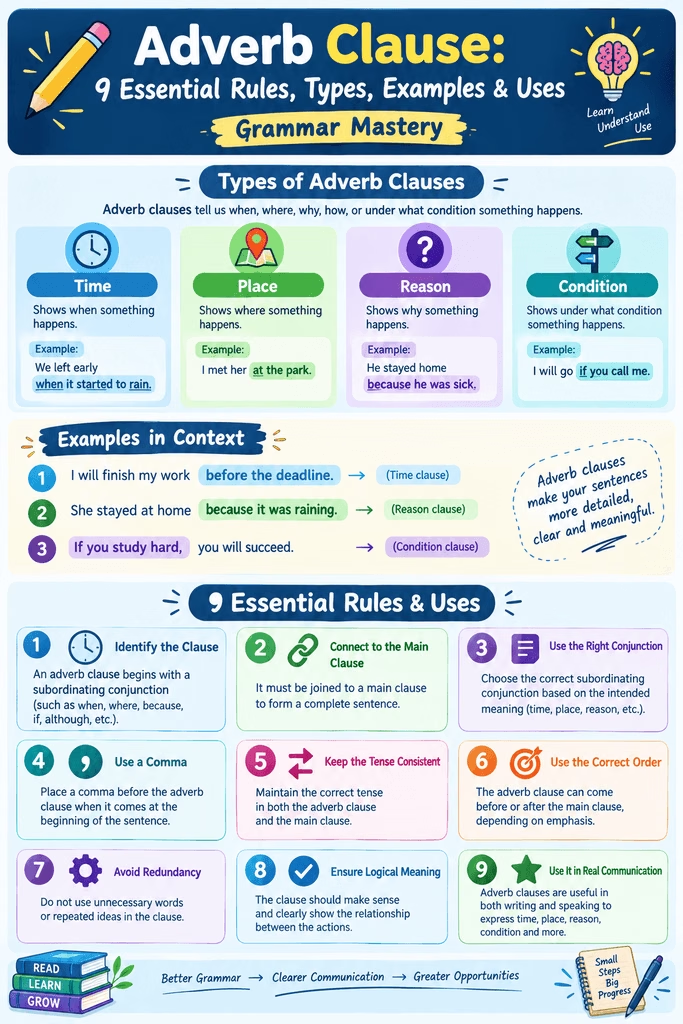
Understanding how words and groups of words function within a sentence is essential for mastering English grammar. Among the different types of clauses, one important structure helps explain when, where, why, how, or under what condition an action happens. This structure allows writers and speakers to connect ideas clearly and make sentences more detailed.
An adverb clause is a dependent clause that performs the function of an adverb. It modifies a verb, an adjective, or another adverb by providing information about circumstances such as time, place, reason, condition, purpose, contrast, or manner. Because it cannot normally express a complete thought by itself, it must be connected to an independent clause.
For example:
We stayed inside because it was raining.
In this sentence, “because it was raining” explains why we stayed inside. Therefore, it functions as an adverbial part of the sentence.
Learning this structure can improve sentence variety, writing accuracy, reading comprehension, and communication skills. This article explains its definition, structure, types, conjunctions, punctuation rules, examples, common mistakes, and practical uses.
Read More: What Is an Adverb?
What Is an Adverb Clause?
An adverb clause is a group of words that contains a subject and a verb and functions as an adverb within a sentence. It provides additional information about the action or state described in the main clause.
Consider this example:
She left early because she felt tired.
The main clause is “She left early.” The dependent clause is “because she felt tired.” The second part explains the reason for leaving early.
Compare it with a single adverb:
She left early.
The sentence is grammatically complete, but it provides less information. Adding a dependent clause makes the relationship between the ideas clearer.
Another example is:
I will call you when I arrive home.
The clause “when I arrive home” tells us when the action of calling will happen.
An important characteristic is that the dependent clause contains both a subject and a verb. It also begins with a subordinating conjunction or another word that establishes its relationship with the main clause.
Read More: What Is a Preposition?
Basic Structure
A common pattern is:
Subordinating conjunction + subject + verb
Examples include:
- because she was sick
- although he was tired
- when the class ended
- if you need help
- while they were working
- since we arrived
- before the sun rises
These clauses generally depend on an independent clause to form a complete sentence.
Read More: What Are Conjunctions?
How Does an Adverb Clause Work?
The primary purpose of this type of clause is to modify another part of a sentence by answering questions such as:
- When?
- Where?
- Why?
- How?
- Under what condition?
- For what purpose?
- Despite what circumstance?
For example:
We went home after the movie ended.
The clause “after the movie ended” answers the question “When did we go home?”
Similarly:
He studied hard because he wanted to pass.
The clause “because he wanted to pass” answers “Why did he study hard?”
This makes the relationship between two ideas explicit.
It Usually Modifies the Main Verb
Most often, the clause provides information about the verb in the independent clause.
They waited until the bus arrived.
The dependent clause “until the bus arrived” tells us how long they waited.
It Can Explain Circumstances
These clauses can also establish a logical relationship between two events or ideas.
Although it was raining, the children played outside.
Here, the dependent clause establishes contrast. The rain might normally discourage outdoor play, yet the children continued playing.
Types of Adverb Clauses
There are several major types. They are classified according to the kind of information they provide.
1. Clauses of Time
A clause of time indicates when an action occurs or how two events are related in time.
Common subordinating conjunctions include:
- when
- whenever
- while
- before
- after
- since
- until
- as soon as
- once
- as
Examples:
Call me when you reach the station.
She washed the dishes after everyone had eaten.
We waited until the teacher arrived.
As soon as the rain stopped, the children went outside.
These structures are particularly useful for describing sequences of events.
2. Clauses of Place
A clause of place indicates where an action happens or where something is located.
Common words include:
- where
- wherever
Examples:
Sit wherever you feel comfortable.
We followed the road where it became narrower.
I will meet you where the two streets intersect.
The clause beginning with “where” or “wherever” provides information about location.
3. Clauses of Reason or Cause
A clause of reason explains why something happens.
Common subordinating conjunctions include:
- because
- since
- as
Examples:
We stayed home because the weather was severe.
Since you are already here, you can join us.
As the store was closed, we returned the next day.
These clauses are useful when showing cause-and-effect relationships.
4. Clauses of Condition
A conditional clause describes a condition that must be met for something else to happen.
Common conjunctions include:
- if
- unless
- provided that
- provided
- as long as
- in case
Examples:
If you study regularly, you can improve your results.
We will go outside unless it starts raining.
You can borrow my book as long as you return it tomorrow.
You may attend the event provided that you register first.
Conditional clauses are especially important in academic writing, instructions, and everyday communication.
5. Clauses of Contrast or Concession
These clauses show an unexpected contrast between two ideas.
Common conjunctions include:
- although
- though
- even though
- whereas
- while
Examples:
Although he was tired, he continued working.
Even though the road was difficult, they completed the journey.
While my brother enjoys football, I prefer cricket.
The main clause and dependent clause present ideas that contrast with each other.
6. Clauses of Purpose
A purpose clause explains why an action is performed or what someone intends to achieve.
Common expressions include:
- so that
- in order that
Examples:
She spoke slowly so that everyone could understand her.
He saved money so that he could buy a new computer.
The teacher repeated the instructions in order that the students could follow them correctly.
Purpose clauses are useful when explaining intentions and goals.
7. Clauses of Result
A result clause shows the consequence of an action or situation.
Common structures include:
- so…that
- such…that
Examples:
The box was so heavy that I could not lift it.
She was so excited that she could not sleep.
It was such a difficult problem that several students needed help.
The result clause identifies what happened because of the degree or nature of something described in the main clause.
8. Clauses of Manner
A manner clause explains how something happens or describes the way an action is performed.
Common expressions include:
- as
- as if
- as though
Examples:
Do it as I showed you.
He behaved as though he knew everyone there.
She spoke as if she had prepared the speech herself.
These clauses are particularly useful for comparisons and descriptions of behavior.
9. Clauses of Comparison or Degree
Some dependent clauses express comparison or degree.
Common structures include:
- than
- as…as
- more…than
- less…than
Examples:
She is taller than I expected.
The test was easier than we thought.
He works as carefully as his supervisor does.
These structures help compare people, objects, actions, or qualities.
Common Subordinating Conjunctions
Subordinating conjunctions are essential because they establish the relationship between a dependent clause and the main clause.
Here are some frequently used conjunctions:
| Relationship | Common Conjunctions |
| Time | when, while, before, after, until, once |
| Reason | because, since, as |
| Condition | if, unless, provided that |
| Contrast | although, though, even though |
| Purpose | so that, in order that |
| Place | where, wherever |
| Manner | as, as if, as though |
| Result | so…that, such…that |
| Comparison | than, as…as |
Choosing the correct conjunction is important because it determines the logical relationship between the two clauses.
Independent Clause vs. Dependent Clause
Understanding the difference between independent and dependent clauses makes this topic much easier.
An independent clause can stand alone as a complete sentence.
The students completed their work.
A dependent clause cannot normally stand alone as a complete sentence.
Because the students completed their work
The second example leaves the reader expecting additional information. We naturally ask what happened because they completed their work.
When the two are combined:
Because the students completed their work, the teacher ended the lesson.
The dependent clause gives a reason, while the independent clause provides the main idea.
A Simple Test
To identify whether a clause is dependent, look for:
- A subject.
- A verb.
- A subordinating conjunction or similar dependent marker.
- An incomplete thought when the clause stands alone.
For example:
Although Maria was tired
It contains a subject (“Maria”) and a verb (“was”), but it does not express a complete thought. Therefore, it needs another clause.
Sentence Placement
A dependent adverbial clause can appear before or after the independent clause.
At the Beginning
Because it was raining, we canceled the picnic.
When the dependent clause comes first, it is generally followed by a comma.
At the End
We canceled the picnic because it was raining.
When the dependent clause follows the main clause, a comma is usually unnecessary when the relationship is closely connected.
Compare:
Although he was nervous, he gave the presentation.
He gave the presentation although he was nervous.
Both sentences are grammatically correct.
Changing the position can sometimes affect emphasis, but it does not change the basic relationship between the clauses.
Punctuation Rules
Punctuation is an important part of using these clauses correctly.
Use a Comma After an Introductory Dependent Clause
When the dependent clause comes before the independent clause, place a comma between them.
When the bell rang, the students left the classroom.
Although she was busy, she answered the phone.
If you need assistance, please contact the office.
Usually No Comma When It Follows the Main Clause
When the dependent clause comes after the independent clause, a comma is usually unnecessary.
The students left the classroom when the bell rang.
She answered the phone although she was busy.
Please contact the office if you need assistance.
However, punctuation can depend on emphasis and the specific construction, so writers should consider the intended meaning.
Adverb Clause vs. Adverb Phrase
An adverb clause and an adverb phrase can perform similar functions, but they have different grammatical structures.
An adverb clause contains a subject and a verb.
We left after the meeting ended.
“After the meeting ended” contains the subject “the meeting” and the verb “ended.”
An adverb phrase does not contain a complete subject-verb combination.
We left after the meeting.
“After the meeting” is a phrase rather than a clause.
Compare:
She studied hard because she wanted to succeed.
She studied hard to succeed.
The first contains a dependent clause with its own subject and verb. The second uses an infinitive phrase.
Adverb Clause vs. Adjective Clause
An adjective clause modifies a noun or pronoun, whereas an adverb clause generally modifies a verb, adjective, adverb, or the entire main clause.
Compare:
I remember the day when we first met.
Here, “when we first met” describes “the day,” so it functions adjectivally.
Now consider:
We celebrated when we first met.
Here, the clause provides information about when the celebration occurred, so it functions adverbially.
The same words can therefore have different grammatical functions depending on how they relate to the rest of the sentence.
Adverb Clause vs. Noun Clause
A noun clause functions as a noun. It can serve as a subject, object, or complement.
For example:
I know what she wants.
“What she wants” functions as the object of “know.”
An adverbial clause, by contrast, provides information about circumstances such as time, reason, condition, or contrast.
I left because she wanted me to.
“Because she wanted me to” explains the reason for leaving.
Identifying the function of the clause is more important than simply looking at its first word.
Common Mistakes to Avoid
Learners often make several mistakes when using dependent adverbial clauses.
1. Creating a Sentence Fragment
Incorrect:
Because I was tired.
This is incomplete when used as a standalone sentence.
Correct:
Because I was tired, I went to bed early.
2. Using an Incorrect Conjunction
Incorrect:
I stayed home although I was sick because I wanted to rest.
This sentence is not necessarily grammatically wrong, but multiple relationships can become unclear.
A clearer version might be:
I stayed home because I was sick and wanted to rest.
Choosing conjunctions carefully improves clarity.
3. Misusing Commas
Incorrect:
When the class ended the students left.
Correct:
When the class ended, the students left.
An introductory dependent clause should generally be separated from the main clause with a comma.
4. Confusing “Because” With “So”
“Because” introduces a reason, while “so” can introduce a result.
I stayed home because I was sick.
I was sick, so I stayed home.
These sentences express a similar relationship from different directions.
5. Creating a Comma Splice
A dependent clause cannot simply be joined to an independent clause with a comma in a way that creates an incorrect structure.
Instead of:
Although it was late, but we continued working.
Use:
Although it was late, we continued working.
The word “although” already establishes the contrast, so “but” is unnecessary in this construction.
How to Identify an Adverb Clause
You can use a simple step-by-step method.
Step 1: Find the Verbs
Look for groups containing subjects and verbs.
Example:
We stayed inside because the storm became stronger.
The sentence contains “stayed” and “became.”
Step 2: Identify the Main Clause
“We stayed inside” can stand alone, so it is the independent clause.
Step 3: Find the Dependent Clause
“Because the storm became stronger” cannot normally stand alone.
Step 4: Ask a Question
Ask:
Why did we stay inside?
The answer is:
Because the storm became stronger.
Therefore, the dependent clause gives a reason.
Step 5: Identify the Conjunction
“Because” introduces the dependent clause and establishes the cause-and-effect relationship.
This method works with many different sentence patterns.
Examples in Everyday English
These clauses appear constantly in ordinary communication.
Time
I will call you when I finish work.
Reason
She took an umbrella because it looked like rain.
Condition
We can go to the park if the weather improves.
Contrast
Although he was busy, he helped his friend.
Purpose
She whispered so that nobody else could hear.
Place
You can sit wherever you like.
Manner
He acted as though nothing had happened.
These examples demonstrate how dependent clauses make communication more precise.
Examples in Academic Writing
Academic writing frequently uses complex sentences to establish relationships between ideas.
For example:
Although the experiment produced unexpected results, the researchers continued their investigation.
Because temperature affects the rate of evaporation, the experiment must be carefully controlled.
If the pressure increases, the volume may decrease under appropriate conditions.
When the data were collected, the researchers compared the results.
Such structures allow writers to explain evidence, conditions, causes, limitations, and relationships without relying on many short sentences.
Why These Clauses Are Important
Using dependent adverbial clauses effectively offers several benefits.
They Add Detail
Instead of:
We left.
A writer can say:
We left after the meeting ended.
The second sentence provides a clear time relationship.
They Connect Ideas
Instead of writing:
The road was flooded. We could not continue.
A writer can combine them:
Because the road was flooded, we could not continue.
The relationship becomes explicit.
They Improve Sentence Variety
Writing that consists entirely of short sentences can become repetitive. Complex sentences allow writers to combine related ideas naturally.
They Improve Logical Clarity
Words such as “because,” “although,” “if,” and “when” tell readers exactly how ideas are connected.
Tips for Using Them Effectively
Here are several practical strategies.
Choose the Conjunction Carefully
Think about the relationship between the ideas before selecting a conjunction.
If you are explaining a reason, use “because,” “since,” or “as.” If you are presenting a condition, consider “if” or “unless.”
Avoid Unnecessary Complexity
A long sentence is not automatically better than a short one. Use dependent clauses when they genuinely improve clarity.
Check the Subject and Verb
Every clause should have an appropriate grammatical structure.
Watch the Tense
The tense of the dependent clause should accurately express the intended time relationship.
For example:
I will call you when I arrive.
Not:
I will call you when I will arrive.
In many future-time clauses introduced by “when,” “after,” “before,” “as soon as,” and similar expressions, English normally uses the present tense to refer to a future event.
Read the Sentence Aloud
Reading your sentence aloud can help reveal awkward connections, missing commas, or unclear relationships.
Advanced Examples and Analysis
Consider this sentence:
Although the experiment was difficult, the students completed it because they followed the instructions carefully.
There are two dependent relationships here.
“Although the experiment was difficult” expresses contrast.
“because they followed the instructions carefully” gives a reason.
The independent clause is:
The students completed it.
This example shows that a single sentence can contain more than one dependent adverbial clause.
Another example is:
If the weather improves tomorrow, we will visit the park after we finish our work.
“If the weather improves tomorrow” establishes a condition.
“after we finish our work” establishes time.
The main clause is:
We will visit the park.
Recognizing each function helps readers understand complex sentence structures.
Frequently Asked Questions (FAQ)
What is an adverb clause?
It is a dependent clause that functions like an adverb by providing information about time, place, reason, condition, purpose, contrast, manner, result, or comparison.
How can I recognize one?
Look for a dependent group of words containing a subject and a verb. It often begins with a subordinating conjunction such as “because,” “although,” “when,” “if,” or “while.”
Can it stand alone?
Normally, no. It depends on an independent clause to express a complete thought.
Does it always begin with a subordinating conjunction?
Most commonly, yes. Words such as “because,” “although,” “when,” “if,” and “while” frequently introduce these clauses.
Where can it appear in a sentence?
It can usually appear before or after the independent clause.
Because it was raining, we stayed inside.
We stayed inside because it was raining.
Do I always need a comma?
When the dependent clause comes before the independent clause, a comma is generally used. When it comes afterward, a comma is usually unnecessary if the relationship is closely connected.
What is the difference between an adverb and an adverbial clause?
A single adverb is usually one word, such as “quickly” or “yesterday.” An adverbial clause is a group of words containing a subject and a verb that performs an adverbial function.
What is the difference between an adjective clause and an adverb clause?
An adjective clause modifies a noun or pronoun, while an adverbial clause generally modifies a verb, adjective, adverb, or the main clause by providing information about circumstances.
Can one sentence contain two dependent clauses?
Yes. A sentence can contain multiple dependent clauses when the relationships between the ideas are clear.
Conclusion
An adverb clause is an important part of English grammar because it allows writers and speakers to express relationships between ideas with greater precision. It is a dependent clause that performs an adverbial function, commonly explaining when, where, why, how, under what condition, for what purpose, or despite what circumstance something happens.
The most common types include clauses of time, place, reason, condition, contrast, purpose, result, manner, and comparison. Recognizing the subordinating conjunction and identifying the function of the clause are useful ways to understand these structures.
Correct punctuation is also important. An introductory dependent clause is generally followed by a comma, while a closely connected dependent clause placed after the independent clause usually does not require one.
With regular practice, learners can use these structures to create clearer and more varied sentences. Instead of presenting every idea as a separate statement, writers can show exactly how events, causes, conditions, purposes, and contrasts are related. This makes communication more precise and helps readers understand complex information more easily.