
What Is Arithmatic? 4 Fundamental Arithmetic Operations, Rules, and Examples
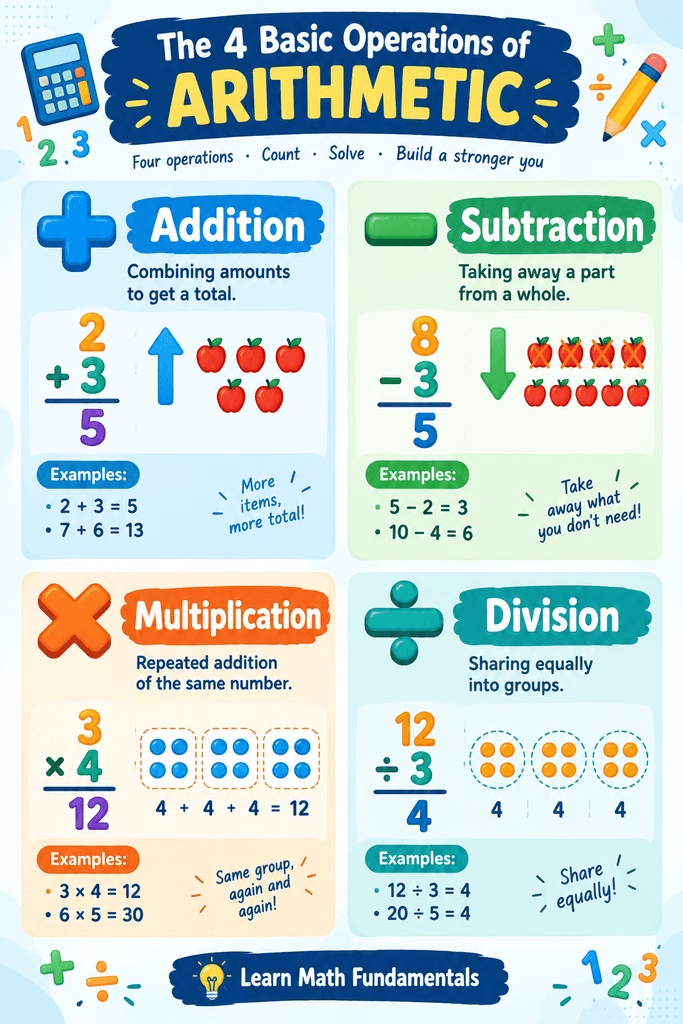
Mathematics begins with the ability to understand numbers and work with them accurately. One of the earliest and most important areas of mathematics is arithmatic, which deals with numbers, their relationships, and basic calculations. Although the spelling “arithmatic” is a common misspelling, the standard mathematical term is arithmetic.
Arithmetic provides the foundation for many mathematical skills used in school, science, engineering, finance, business, technology, and everyday life. Whenever you count objects, calculate a price, compare quantities, determine a distance, divide a bill, or work out a percentage, you are using arithmetic.
This article explains What Is Arithmatic? 4 Fundamental Arithmetic Operations, Rules, and Examples
Read More: What Is Interest?
What Is Arithmatic?
Arithmatic refers to the study and use of numbers and basic mathematical operations. The correct spelling of the mathematical term is arithmetic. It focuses primarily on operations such as addition, subtraction, multiplication, and division.
For example:
- 8 + 5 = 13
- 15 − 7 = 8
- 6 × 4 = 24
- 20 ÷ 5 = 4
These simple calculations are examples of arithmetic.
The subject also includes related ideas such as fractions, decimals, percentages, negative numbers, ratios, powers, and numerical comparisons. These concepts allow people to solve practical problems involving quantities.
Arithmetic is often considered one of the foundations of mathematics because more advanced areas frequently build upon numerical operations.
Read More: What Is the Median in Math?
Why Is Arithmetic Important?
Arithmetic is important because numerical calculations are part of everyday life. People use it when shopping, budgeting, cooking, traveling, measuring, studying, and working.
For example, suppose a notebook costs $4 and you buy three notebooks. You can calculate the total cost using multiplication:
3 × $4 = $12
Similarly, if you have $20 and spend $12, subtraction tells you how much remains:
$20 − $12 = $8
In education, arithmetic prepares students for algebra, geometry, statistics, calculus, and other mathematical subjects. Strong arithmetic skills can also improve problem-solving and numerical reasoning.
The Four Fundamental Arithmetic Operations
The four basic operations are addition, subtraction, multiplication, and division. Each operation has a particular purpose.
Addition
Addition combines two or more quantities to find their total.
The symbol for addition is +.
For example:
7 + 9 = 16
Here, 7 and 9 are called addends, while 16 is the sum.
Another example is:
125 + 275 = 400
Addition is useful when quantities are combined. If a student has 12 books and receives 5 more, the total number of books is:
12 + 5 = 17
Subtraction
Subtraction determines the difference between quantities or shows how much remains after something is removed.
The symbol for subtraction is −.
For example:
18 − 7 = 11
Here, 18 is the minuend, 7 is the subtrahend, and 11 is the difference.
Consider another example:
500 − 175 = 325
Subtraction is commonly used for finding remaining amounts, differences, decreases, and distances between numerical values.
Multiplication
Multiplication is a method of combining equal groups. It can also be understood as repeated addition.
The symbol for multiplication may be written as ×, ·, or sometimes simply by placing numbers next to parentheses.
For example:
5 × 6 = 30
This can be understood as:
6 + 6 + 6 + 6 + 6 = 30
The numbers being multiplied are called factors, and the result is called the product.
Multiplication is useful when the same quantity occurs repeatedly. If there are 8 boxes containing 12 pencils each, the total number of pencils is:
8 × 12 = 96
Division
Division separates a quantity into equal groups or determines how many times one number is contained in another.
The symbols for division include ÷ and /.
For example:
24 ÷ 6 = 4
Here, 24 is the dividend, 6 is the divisor, and 4 is the quotient.
If 24 apples are divided equally among 6 people, each person receives:
24 ÷ 6 = 4 apples
Division is closely related to multiplication. Since:
6 × 4 = 24
we know that:
24 ÷ 6 = 4
Arithmetic With Whole Numbers
Whole numbers are non-negative integers, including zero:
0, 1, 2, 3, 4, 5, …
Arithmetic operations can be performed on whole numbers.
For example:
35 + 24 = 59
72 − 18 = 54
9 × 7 = 63
81 ÷ 9 = 9
Whole-number calculations are among the first numerical skills students typically learn.
Arithmetic With Integers
Integers include positive numbers, negative numbers, and zero.
Examples include:
−5, −4, −3, −2, −1, 0, 1, 2, 3, 4, 5
When performing arithmetic with negative numbers, the signs must be handled carefully.
For addition:
5 + (−2) = 3
For subtraction:
5 − 8 = −3
For multiplication:
(−4) × 3 = −12
For division:
(−20) ÷ 5 = −4
A useful rule for multiplication and division is:
- Positive × positive = positive
- Negative × negative = positive
- Positive × negative = negative
- Negative × positive = negative
The same sign rules apply to division.
Arithmetic With Fractions
Fractions represent parts of a whole and are an important part of arithmetic.
A fraction has a numerator and a denominator.
For example:
3/5
Here, 3 is the numerator and 5 is the denominator.
Adding Fractions
Fractions with the same denominator can be added by adding their numerators.
For example:
2/7 + 3/7 = 5/7
When denominators are different, a common denominator is usually required.
For example:
1/2 + 1/3
The least common denominator is 6:
1/2 = 3/6
1/3 = 2/6
Therefore:
3/6 + 2/6 = 5/6
Subtracting Fractions
The same principle applies to subtraction.
For example:
5/8 − 2/8 = 3/8
For different denominators, convert the fractions to equivalent forms before subtracting.
Multiplying Fractions
To multiply fractions, multiply the numerators and denominators:
2/3 × 4/5 = 8/15
Dividing Fractions
To divide by a fraction, multiply by its reciprocal.
For example:
2/3 ÷ 4/5
becomes:
2/3 × 5/4 = 10/12 = 5/6
These operations are essential for solving problems involving measurements, recipes, proportions, and financial calculations.
Arithmetic With Decimals
Decimals provide another way of representing numbers and fractional quantities.
Examples include:
0.5, 2.75, 10.25, and 125.6
Addition and subtraction with decimals require careful alignment of decimal points.
For example:
12.50
+ 3.75
——-
16.25
Therefore:
12.50 + 3.75 = 16.25
Multiplication and division can also be performed with decimals.
For example:
2.5 × 4 = 10
and:
15.6 ÷ 3 = 5.2
Decimals are particularly useful when working with money, measurements, scientific data, and percentages.
Order of Operations
When a mathematical expression contains multiple operations, the operations should be performed in the correct order.
The commonly taught order is represented by PEMDAS:
- P – Parentheses
- E – Exponents
- M – Multiplication
- D – Division
- A – Addition
- S – Subtraction
Multiplication and division have equal priority and are evaluated from left to right. Addition and subtraction also have equal priority and are evaluated from left to right.
Consider:
8 + 3 × 4
Multiplication comes before addition:
3 × 4 = 12
Therefore:
8 + 12 = 20
The answer is 20, not 44.
Now consider:
(8 + 3) × 4
First solve the parentheses:
8 + 3 = 11
Then multiply:
11 × 4 = 44
Therefore, parentheses can significantly affect the result.
Important Properties of Arithmetic
Several properties help explain how numbers behave under different operations.
Commutative Property
The commutative property means that changing the order of numbers does not change the result for addition and multiplication.
For addition:
4 + 7 = 7 + 4
For multiplication:
3 × 8 = 8 × 3
However, subtraction and division are not generally commutative.
For example:
9 − 4 ≠ 4 − 9
Associative Property
The associative property means that changing the grouping of numbers does not change the result for addition and multiplication.
For addition:
(2 + 3) + 4 = 2 + (3 + 4)
Both equal 9.
For multiplication:
(2 × 3) × 4 = 2 × (3 × 4)
Both equal 24.
Subtraction and division do not generally have the associative property.
Distributive Property
The distributive property connects multiplication with addition or subtraction.
For example:
3 × (4 + 5)
can be rewritten as:
(3 × 4) + (3 × 5)
Therefore:
12 + 15 = 27
This property is particularly important when students begin studying algebra.
Identity Property
The additive identity is zero because adding zero does not change a number:
8 + 0 = 8
The multiplicative identity is one because multiplying by one does not change a number:
8 × 1 = 8
Zero Property of Multiplication
Any number multiplied by zero equals zero:
25 × 0 = 0
This is known as the zero property of multiplication.
Arithmetic and Negative Numbers
Negative numbers are used to represent values below zero, decreases, debt, temperatures below freezing, and other situations.
For example, a temperature of −5°C is five degrees below zero.
When adding numbers with different signs, compare their absolute values and use the sign of the number with the greater absolute value.
For example:
−8 + 3 = −5
When multiplying or dividing signed numbers, the sign rules are especially important.
For example:
−6 × −2 = 12
because two negative signs produce a positive result.
Arithmetic and Percentages
Percentages are closely connected to arithmetic and are widely used in finance, shopping, statistics, business, and education.
A percentage means a quantity per hundred.
For example:
25% = 25/100 = 0.25
To find 25% of 200:
0.25 × 200 = 50
Therefore, 25% of 200 is 50.
Percentages can also be used to calculate discounts.
Suppose an item costs $80 and has a 15% discount.
First calculate the discount:
15% of $80 = 0.15 × $80 = $12
Then subtract the discount:
$80 − $12 = $68
The sale price is therefore $68.
Arithmetic and Ratios
A ratio compares two or more quantities.
For example, if a class has 10 boys and 15 girls, the ratio of boys to girls is:
10:15
This can be simplified by dividing both numbers by 5:
2:3
Ratios are useful in cooking, maps, construction, science, finance, and many other areas.
Arithmetic and Estimation
Exact calculations are not always necessary. Estimation allows people to find an approximate answer quickly.
Suppose a product costs $19.75 and another costs $29.40. Instead of calculating the exact total immediately, you might estimate:
$20 + $30 = $50
The exact total is $49.15, so the estimate is reasonably close.
Estimation is useful for checking whether an exact answer is sensible. If a calculation that should be around 50 produces 500, estimation can help identify a possible error.
Arithmetic in Everyday Life
Arithmetic is used constantly outside the classroom.
Shopping
Customers calculate totals, discounts, taxes, and change.
Budgeting
People add income, subtract expenses, and compare available funds with planned spending.
Cooking
Recipes require measurements, fractions, ratios, and sometimes multiplication when serving sizes change.
Travel
Travelers calculate distances, travel times, fuel consumption, and costs.
Construction
Builders use measurements and numerical calculations to determine dimensions, materials, and quantities.
Business
Businesses use arithmetic for prices, sales, wages, expenses, profits, inventory, and financial planning.
Education
Students use numerical calculations in science, mathematics, economics, statistics, and other subjects.
Read More: What is Range in Math?
Common Mistakes in Arithmetic
Even simple calculations can produce incorrect answers when basic rules are overlooked.
Ignoring the Order of Operations
A common mistake is solving operations from left to right without considering their priority.
For example:
5 + 2 × 3
The correct answer is:
5 + 6 = 11
not 21.
Sign Errors
Negative numbers can cause mistakes.
For example:
−4 × −5 = 20
not −20.
Misaligning Decimal Points
When adding or subtracting decimals, decimal points should be aligned.
Incorrect alignment can lead to an incorrect answer.
Confusing Multiplication and Addition
For example:
4 + 4 + 4 = 12
while:
4 × 3 = 12
These expressions happen to produce the same result, but they represent different mathematical ideas.
Dividing by Zero
Division by zero is undefined.
For example:
10 ÷ 0
does not have a defined real-number result.
It is important not to treat zero as an ordinary divisor.
How to Improve Arithmetic Skills
Strong numerical skills develop through regular practice and careful reasoning.
Practice Regularly
Short, consistent practice sessions can be more useful than occasional long sessions.
Understand the Concept
Do not rely entirely on memorization. Understanding why an operation works makes it easier to apply in unfamiliar situations.
Check Your Work
After solving a problem, estimate the result or use an inverse operation to check it.
For example, if:
72 ÷ 8 = 9
you can verify it with:
9 × 8 = 72
Learn Multiplication Facts
Knowing basic multiplication facts can make more complicated calculations faster.
Work Carefully With Signs
Pay particular attention when negative numbers are involved.
Use Estimation
Estimate the answer before completing a calculation. This provides a useful way to identify unreasonable results.
Arithmetic vs. Algebra
Arithmetic and algebra are closely related, but they are not identical.
Arithmetic generally works directly with known numbers.
For example:
8 + 7 = 15
Algebra introduces symbols, usually letters, to represent unknown or variable quantities.
For example:
x + 7 = 15
The goal is to determine the value of x.
Therefore, arithmetic provides many of the numerical skills needed to understand algebra. Students who are comfortable with basic operations, fractions, decimals, negative numbers, and order of operations often have a stronger foundation for beginning algebra.
Arithmetic vs. Mathematics
Arithmetic is a branch of mathematics, whereas mathematics is a much broader field.
Mathematics includes areas such as:
- Arithmetic
- Algebra
- Geometry
- Trigonometry
- Calculus
- Statistics
- Probability
- Number theory
- Discrete mathematics
Arithmetic focuses primarily on numbers and basic numerical operations, while mathematics encompasses the study of quantity, structure, space, patterns, change, uncertainty, and logical relationships.
The Role of Arithmetic in Advanced Mathematics
Although arithmetic focuses on fundamental calculations, its importance extends into advanced mathematics.
Algebra requires numerical manipulation. Geometry often requires calculations involving lengths, areas, and angles. Statistics uses arithmetic to calculate averages, percentages, and other numerical measures. Physics relies heavily on numerical calculations involving quantities and units.
Even calculus depends on accurate numerical operations. For this reason, developing strong arithmetic skills early can provide a valuable foundation for more advanced mathematical study.
Examples of Basic Arithmetic Problems
Consider the following examples.
Example 1: Addition
A library has 125 fiction books and 175 nonfiction books.
125 + 175 = 300
The library has 300 books in these two categories.
Example 2: Subtraction
A tank contains 900 liters of water. If 250 liters are used:
900 − 250 = 650
There are 650 liters remaining.
Example 3: Multiplication
A school orders 15 boxes containing 20 pencils each:
15 × 20 = 300
The school receives 300 pencils.
Example 4: Division
A teacher has 96 worksheets and distributes them equally among 12 groups:
96 ÷ 12 = 8
Each group receives 8 worksheets.
Example 5: Percentage
A test contains 50 questions, and a student answers 45 correctly.
The percentage is:
45 ÷ 50 × 100 = 90%
The student scores 90%.
The Importance of Accuracy
Accuracy is one of the most important aspects of arithmetic. A small numerical error can affect the final result of a larger calculation.
For example, an incorrect multiplication result could lead to an incorrect total cost, measurement, or scientific value.
Accuracy can be improved by:
- Reading the problem carefully.
- Identifying the required operation.
- Writing calculations clearly.
- Following the correct order of operations.
- Checking signs and decimal points.
- Estimating the result.
- Using an inverse operation when appropriate.
These habits are useful for both students and professionals.
Frequently Asked Questions (FAQ)
What is arithmatic?
Arithmatic is a common misspelling of arithmetic, the branch of mathematics concerned with numbers and basic numerical operations such as addition, subtraction, multiplication, and division.
What are the four basic operations?
The four basic operations are addition, subtraction, multiplication, and division. They form the foundation of many numerical calculations.
Is arithmetic a branch of mathematics?
Yes. Arithmetic is one of the fundamental branches of mathematics. It focuses primarily on numbers and basic operations involving them.
Why is arithmetic important?
Arithmetic is important because numerical calculations are used in everyday activities, education, science, engineering, business, finance, and technology.
What is the difference between arithmetic and algebra?
Arithmetic generally involves known numerical values and basic operations. Algebra uses letters and symbols to represent unknown or variable quantities and relationships.
What is the order of operations?
The order of operations is a set of conventions used to determine which operations should be performed first in a mathematical expression. Parentheses and exponents generally come before multiplication, division, addition, and subtraction.
Can arithmetic include fractions and decimals?
Yes. Arithmetic includes calculations involving whole numbers, integers, fractions, decimals, percentages, and other numerical forms.
Is division by zero possible?
Division by zero is undefined in ordinary arithmetic. A nonzero number cannot be divided by zero.
How can students improve arithmetic skills?
Students can improve by practicing regularly, understanding mathematical concepts, learning basic multiplication facts, checking their answers, using estimation, and carefully handling negative numbers and decimals.
Conclusion
Arithmatic, more correctly spelled arithmetic, is a fundamental part of mathematics that focuses on numbers and basic operations. Addition, subtraction, multiplication, and division provide the foundation for numerical problem-solving, while fractions, decimals, percentages, ratios, negative numbers, and order of operations extend these basic ideas.
The importance of arithmetic goes far beyond classroom exercises. People use it when shopping, managing money, measuring ingredients, planning journeys, analyzing information, conducting scientific work, and solving practical problems.
A strong understanding of arithmetic also prepares learners for more advanced mathematical subjects such as algebra, geometry, statistics, and calculus. By practicing carefully, understanding the rules, checking calculations, and applying numerical concepts to real-world situations, students can build a reliable mathematical foundation that supports learning throughout their education and professional lives.