
How Far Is Saturn from the Sun? Distance, Orbit, and Fascinating Facts
Saturn is one of the most recognizable planets in the Solar System. Famous for its spectacular ring system, this giant world has fascinated astronomers for centuries. However, one of the most common questions about Saturn concerns its position in the Solar System: how far is it from the Sun?
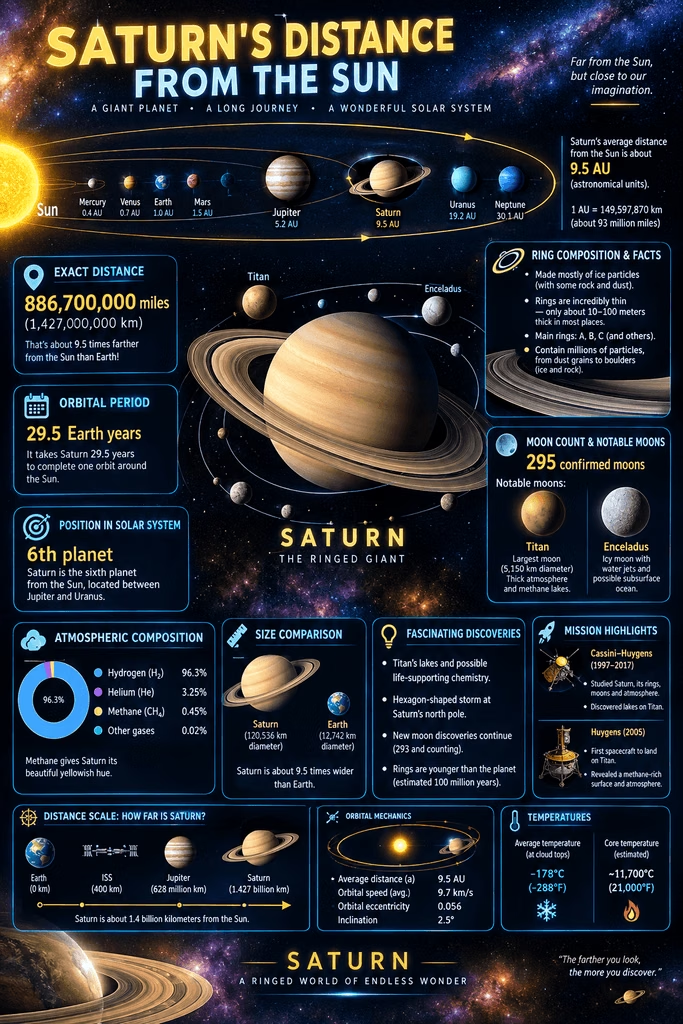
The average distance of saturn from the sun is about 1.43 billion kilometers, or approximately 886 million miles. In astronomical terms, this is about 9.58 astronomical units (AU). Because Saturn follows an elliptical orbit rather than a perfectly circular path, its actual distance from the Sun changes throughout its approximately 29.5-year journey around the star.
Understanding saturn from the sun involves more than remembering one number. Its orbital distance affects its year length, temperature, sunlight levels, seasons, visibility from Earth, and many other characteristics. Saturn’s enormous distance also helps explain why it takes sunlight more than an hour to reach the planet.
This article explains the average distance, minimum and maximum distances, orbital period, travel time for sunlight, comparison with Earth and other planets, and the scientific importance of Saturn’s position.
Read More: How Many Rings Does Saturn Have? 9 Fascinating Facts About Saturn’s Ring System.
What Is the Average Distance of Saturn from the Sun?
The average distance of saturn from the sun is approximately 1.43 billion kilometers.
In other units, this distance is approximately:
- 1.43 billion kilometers
- 886 million miles
- 9.58 astronomical units
- About 79 light-minutes
An astronomical unit, abbreviated as AU, is the average distance between Earth and the Sun. One AU is approximately 149.6 million kilometers. Therefore, Saturn orbits the Sun at an average distance more than nine times the Earth-Sun distance.
This does not mean that Saturn remains exactly 1.43 billion kilometers away from the Sun at all times. Its orbit is slightly elliptical, so its distance changes as it travels around the Sun.
The average value is useful because it provides a simple way to describe Saturn’s location within the Solar System.
Read More: How Many Moons Does Saturn Have? 293 Confirmed Moons and Their Fascinating World.
Why Is Saturn So Far from the Sun?
Saturn is the sixth planet from the Sun. Only Jupiter lies closer among the outer giant planets, while Uranus and Neptune are farther away.
The planets formed from a rotating disk of gas and dust surrounding the young Sun. The distribution of material within this disk influenced where different planets eventually formed. Saturn developed in the colder outer region of the Solar System, where volatile substances such as water, ammonia, and methane could exist in solid or icy forms during planetary formation.
Its great distance from the Sun is therefore closely connected to its formation and composition.
Read More: The Ultimate Guide To X-Ray Production And Modern Use In Diagnosis.
How Far Is Saturn from the Sun in Miles?
For readers who commonly use miles, the average saturn from the sun distance is approximately 886 million miles.
This number can be difficult to visualize because it is vastly larger than distances encountered in everyday life. For comparison, Earth’s average distance from the Sun is about 93 million miles. Saturn is therefore roughly 9.5 times farther from the Sun than Earth is on average.
Another way to understand this enormous distance is through light travel time. Light moves through space at approximately 299,792 kilometers per second. Even traveling at this extraordinary speed, sunlight takes roughly 80 minutes to reach Saturn when the planet is near its average orbital distance.
Thus, when sunlight reaches Saturn, it has already traveled for more than an hour through interplanetary space.
Read More: What Is a CT Scan? Understanding Its Uses, Benefits, and Risks.
Does Saturn Have a Fixed Distance from the Sun?
No. The distance of saturn from the sun changes continuously.
Saturn’s orbit is elliptical, meaning it is slightly stretched rather than being a perfect circle. As a result, Saturn has a point in its orbit where it is closest to the Sun and another where it is farthest away.
These two positions are called perihelion and aphelion.
Saturn at Perihelion
Perihelion is the point where a planet is closest to the Sun.
Saturn’s perihelion distance is approximately 1.35 billion kilometers, or about 9.02 AU.
At this point, Saturn is somewhat closer to the Sun than its average orbital distance.
Saturn at Aphelion
Aphelion is the point where a planet is farthest from the Sun.
Saturn’s aphelion distance is approximately 1.51 billion kilometers, or about 10.12 AU.
The difference between these distances demonstrates why a single number cannot describe Saturn’s position perfectly at every moment.
Read More: Stars The Cosmic Kitchen: Birth and Death Explained.
What Is Saturn’s Distance from the Sun in Astronomical Units?
Astronomers often use astronomical units when discussing distances within the Solar System.
The average saturn from the sun distance is approximately:
9.58 AU
Since:
1 AU ≈ 149.6 million km
we can calculate the average distance as:
9.58 × 149.6 million km ≈ 1.43 billion km
The astronomical-unit system makes planetary distances easier to compare.
For example:
| Planet | Average distance from Sun |
| Mercury | 0.39 AU |
| Venus | 0.72 AU |
| Earth | 1.00 AU |
| Mars | 1.52 AU |
| Jupiter | 5.20 AU |
| Saturn | 9.58 AU |
| Uranus | 19.2 AU |
| Neptune | 30.1 AU |
This table shows that Saturn occupies a position in the outer Solar System between Jupiter and Uranus.
How Long Does It Take Light to Reach Saturn?
One of the most interesting consequences of saturn from the sun distance is the amount of time required for sunlight to reach the planet.
Light travels at approximately 300,000 kilometers per second. Despite this incredible speed, the enormous distance between the Sun and Saturn means sunlight requires roughly 80 minutes to make the journey when Saturn is near its average orbital distance.
The actual travel time varies because Saturn’s distance from the Sun changes.
At its approximate closest orbital distance, sunlight takes around 75 minutes to reach Saturn. Near its farthest distance, the journey takes approximately 84 minutes.
This means that when we observe Saturn, we are seeing it as it existed in the past. Light reflected from Saturn must also travel from Saturn to Earth before reaching our telescopes.
How Far Is Saturn from Earth?
The distance between Saturn and Earth is different from the distance between Saturn and the Sun.
Both planets orbit the Sun, so their relative positions constantly change. When Earth and Saturn are on the same side of the Sun, they can be relatively close compared with times when they are positioned on opposite sides.
The distance between Earth and Saturn can range from roughly 1.2 billion kilometers to more than 1.6 billion kilometers, depending on their orbital positions.
Therefore, it is important to distinguish between these two questions:
- Distance from Saturn to the Sun: roughly 1.43 billion km on average.
- Distance from Saturn to Earth: constantly changing.
This distinction is especially important when discussing observations, spacecraft missions, and communication delays.
How Long Is a Year on Saturn?
The large distance of saturn from the sun is closely related to its long orbital period.
Saturn takes approximately 29.5 Earth years to complete one orbit around the Sun.
This means that a person who experiences one Saturnian year would wait almost three decades before Saturn returned to approximately the same position in its orbit.
The reason is straightforward: Saturn travels along a much larger orbit than Earth. Although its orbital speed is substantial, it must cover an enormous path around the Sun.
Saturn’s Orbital Speed
Saturn travels around the Sun at an average speed of approximately 9.7 kilometers per second.
This is slower than Earth’s average orbital speed of about 29.8 kilometers per second.
The difference is related to Saturn’s greater distance from the Sun. The Sun’s gravitational influence becomes weaker with increasing distance, and planets in more distant orbits generally move more slowly around the Sun.
Why Does Saturn Take So Long to Orbit the Sun?
Kepler’s laws of planetary motion help explain Saturn’s long year.
According to Kepler’s third law, the square of a planet’s orbital period is related to the cube of its average distance from the Sun.
In simplified form:
T² ∝ a³
where:
- T is the orbital period.
- a is the planet’s average orbital distance from the Sun.
As orbital distance increases, the orbital period increases significantly.
Because Saturn is much farther from the Sun than Earth, it needs considerably more time to complete one revolution.
This relationship applies throughout the Solar System and helps astronomers understand the movement of planets, dwarf planets, asteroids, and other orbiting bodies.
How Much Sunlight Does Saturn Receive?
The great distance of saturn from the sun also has a major effect on the amount of solar energy reaching the planet.
The intensity of sunlight decreases with the square of the distance from the source. This relationship is known as the inverse-square law.
It can be expressed as:
Intensity ∝ 1/r²
where r represents the distance from the Sun.
Because Saturn is approximately 9.58 times farther from the Sun than Earth, the sunlight it receives per unit area is only about:
1 / (9.58)² ≈ 1/92
of the sunlight received by Earth.
Therefore, Saturn receives roughly 1% of the solar energy per unit area that Earth receives, although the exact value varies with its orbital position.
This helps explain why Saturn’s environment is extremely cold compared with Earth’s.
What Is Saturn’s Temperature?
Saturn does not have a solid surface like Earth, so describing its temperature requires specifying which part of the atmosphere is being considered.
The planet’s upper atmosphere is extremely cold, with temperatures around −178°C (−288°F) near the visible cloud tops.
Saturn is far from the Sun, so it receives relatively little solar energy. However, Saturn also produces significant heat internally.
In fact, Saturn emits more energy into space than it receives from the Sun. Scientists believe this is partly related to heat left over from its formation and processes occurring within its interior.
The distance from the Sun is therefore an important factor in Saturn’s cold environment, but it is not the only factor determining its temperature.
Saturn’s Distance Compared with Jupiter
Jupiter is the fifth planet from the Sun, while Saturn is the sixth.
Jupiter’s average distance is approximately 5.2 AU, whereas Saturn’s average distance is approximately 9.58 AU.
This means Saturn is roughly 1.84 times farther from the Sun than Jupiter is, based on their average orbital distances.
Jupiter also has a shorter orbital period. It takes approximately 11.86 Earth years to orbit the Sun, compared with Saturn’s approximately 29.5 years.
Both planets are gas giants, but their different distances from the Sun contribute to differences in their environments, temperatures, orbital periods, and received solar energy.
Saturn’s Distance Compared with Uranus and Neptune
Saturn is closer to the Sun than both Uranus and Neptune.
Uranus has an average distance of approximately 19.2 AU, while Neptune averages approximately 30.1 AU from the Sun.
This means Saturn occupies an intermediate position among the outer planets.
The sequence is:
Jupiter → Saturn → Uranus → Neptune
As the planets move farther from the Sun, their orbital periods become progressively longer.
Uranus takes about 84 Earth years to complete one orbit, while Neptune requires about 165 years.
Saturn’s approximately 29.5-year orbital period therefore sits between Jupiter’s relatively short outer-planet year and the much longer years of Uranus and Neptune.
Does Saturn’s Distance Affect Its Rings?
Saturn’s famous rings are composed primarily of particles of water ice, along with rocky and dusty material.
The rings orbit Saturn itself, rather than orbiting the Sun independently. Their existence is therefore not simply determined by saturn from the sun distance.
However, Saturn’s location in the cold outer Solar System provides an environment where water ice remains stable as a major component of the rings.
The rings extend outward from Saturn for hundreds of thousands of kilometers, but they are remarkably thin compared with their enormous width.
When viewed from Earth through a telescope, the rings make Saturn one of the most distinctive objects in the night sky.
How Does Saturn’s Distance Affect Its Visibility from Earth?
Saturn is visible from Earth without a telescope when it is favorably positioned in the night sky.
Its apparent brightness depends on several factors, including its distance from Earth, its position relative to the Sun, the orientation of its rings, and atmospheric observing conditions.
Because Saturn is so distant, it appears as a point of light to the unaided eye. However, even a small telescope can reveal its rings under suitable conditions.
The changing distance between Earth and Saturn also affects the amount of light required to travel from Saturn to Earth. Astronomical observations therefore provide information about Saturn’s past state rather than its exact present state.
How Did Scientists Determine Saturn’s Distance?
Astronomers have developed increasingly accurate methods for determining planetary distances.
Early astronomers used geometric observations and models of planetary motion. Over time, improved telescopes allowed scientists to measure planetary positions more precisely.
Modern measurements can use techniques involving:
- Radar and radio observations
- Spacecraft tracking
- Precise orbital calculations
- Gravitational modeling
- Optical observations
- Radio signals exchanged with spacecraft
Space missions have been particularly valuable. By carefully tracking a spacecraft’s position and velocity, scientists can refine models of Saturn’s orbit and the gravitational environment of the Solar System.
These methods allow Saturn’s distance to be calculated with extraordinary precision.
Saturn and Space Exploration
Saturn’s enormous distance presents significant challenges for spacecraft missions.
A spacecraft cannot simply travel directly from Earth to Saturn at a constant speed. Mission planners use carefully calculated trajectories that take planetary positions and gravitational forces into account.
The spacecraft Cassini, a joint mission involving NASA, ESA, and the Italian Space Agency, spent more than 13 years studying Saturn and its system after entering orbit around the planet in 2004.
Cassini provided detailed information about Saturn’s atmosphere, rings, moons, magnetic environment, and complex interactions throughout the Saturnian system.
The mission demonstrated how important careful navigation is when exploring a planet more than a billion kilometers from the Sun.
Does Saturn’s Distance Change Its Seasons?
Yes, but Saturn’s seasons work differently from Earth’s in some respects.
Saturn has an axial tilt of approximately 26.7 degrees, which is similar to Earth’s tilt of about 23.4 degrees. This tilt produces seasonal changes as Saturn travels around the Sun.
However, Saturn’s seasons are extremely long because one Saturnian year lasts about 29.5 Earth years.
Each season lasts roughly 7 Earth years.
The amount and distribution of sunlight reaching different parts of Saturn therefore change gradually over many Earth years.
The rings can also appear different from Earth as Saturn’s orientation changes. At certain times, the rings are viewed more edge-on, making them appear much thinner.
A Simple Way to Remember Saturn’s Distance
A useful summary is:
Saturn ≈ 9.58 AU from the Sun
or:
Saturn ≈ 1.43 billion km from the Sun
For comparison:
Earth ≈ 1 AU from the Sun
Therefore:
Saturn ≈ 9.58 times Earth’s average distance from the Sun
Remembering these three values makes it easier to understand Saturn’s place in the Solar System.
Why Is Knowing Saturn’s Distance Important?
Knowing saturn from the sun distance is important for both basic astronomy and advanced planetary science.
First, it helps establish Saturn’s position within the Solar System. Second, it explains important characteristics such as its long orbital period and low level of received sunlight.
The distance is also essential for:
- Calculating spacecraft trajectories
- Predicting planetary positions
- Understanding Saturn’s climate
- Studying solar radiation
- Planning observations
- Modeling Saturn’s orbit
- Understanding seasonal changes
- Calculating communication delays
- Comparing planetary environments
Planetary distance is therefore more than a simple measurement. It is a fundamental parameter used in many areas of astronomy.
Key Facts About Saturn’s Distance from the Sun
Here are the most important facts to remember:
- Saturn is the sixth planet from the Sun.
- Its average distance from the Sun is approximately 1.43 billion kilometers.
- This equals approximately 886 million miles.
- Its average distance is about 9.58 AU.
- Its perihelion distance is approximately 9.02 AU.
- Its aphelion distance is approximately 10.12 AU.
- Sunlight takes roughly 80 minutes to travel from the Sun to Saturn at the average distance.
- Saturn takes approximately 29.5 Earth years to orbit the Sun.
- Saturn receives only about 1/92 of the solar energy per unit area received by Earth.
- Saturn’s large distance contributes to its cold atmospheric environment and long year.
Frequently Asked Questions (FAQ)
How far is Saturn from the Sun?
The average saturn from the sun distance is approximately 1.43 billion kilometers, or about 886 million miles. In astronomical units, this is approximately 9.58 AU.
Is Saturn always the same distance from the Sun?
No. Saturn follows a slightly elliptical orbit, so its distance changes. It is closest to the Sun at perihelion and farthest at aphelion.
How many AU is Saturn from the Sun?
Saturn’s average distance is approximately 9.58 astronomical units. Its distance varies from about 9.02 AU to 10.12 AU over its orbit.
How long does sunlight take to reach Saturn?
Sunlight takes approximately 80 minutes to travel from the Sun to Saturn when the planet is near its average orbital distance. The exact travel time varies because Saturn’s distance changes.
How far is Saturn from Earth?
The distance between Saturn and Earth changes continuously because both planets orbit the Sun. It can range from roughly 1.2 billion kilometers to more than 1.6 billion kilometers.
Why is Saturn so far from the Sun?
Saturn formed in the outer region of the protoplanetary disk surrounding the young Sun. Its present orbital position is the result of the gravitational and physical processes involved in Solar System formation and evolution.
How long is a year on Saturn?
A Saturnian year lasts approximately 29.5 Earth years. Saturn therefore takes nearly three decades to complete one orbit around the Sun.
Does Saturn receive sunlight?
Yes. Saturn receives sunlight, but much less than Earth because it is much farther from the Sun. At Saturn’s average orbital distance, the sunlight intensity is only about 1/92 of the intensity at Earth.
Is Saturn farther from the Sun than Jupiter?
Yes. Jupiter’s average distance is about 5.2 AU, while Saturn’s is about 9.58 AU. Saturn is therefore considerably farther from the Sun.
Is Saturn closer to the Sun than Uranus?
Yes. Saturn’s average distance is about 9.58 AU, while Uranus averages about 19.2 AU from the Sun.
Conclusion
The average saturn from the sun distance is approximately 1.43 billion kilometers, or 886 million miles. Expressed in astronomical units, Saturn is about 9.58 AU from the Sun.
However, Saturn does not maintain exactly the same distance throughout its orbit. Its elliptical path takes it from approximately 9.02 AU at perihelion to about 10.12 AU at aphelion. This changing distance affects the amount of sunlight the planet receives and contributes to variations in its environment.
Saturn’s great distance also helps explain its approximately 29.5-year orbital period. Because it travels around an enormous orbit at a relatively slower speed than Earth, Saturn needs nearly three decades to complete one revolution around the Sun.
The distance also creates a remarkable delay in sunlight. Light from the Sun takes roughly 80 minutes to reach Saturn. When astronomers observe Saturn, they are therefore observing light that began its journey well over an hour earlier.
Understanding saturn from the sun distance provides a useful foundation for learning about Saturn’s orbit, seasons, temperature, rings, visibility, and exploration. It also demonstrates how distance from the Sun influences the behavior and characteristics of planets throughout our Solar System.