
How Many Moons Does Saturn Have? 293 Confirmed Moons and Their Fascinating World
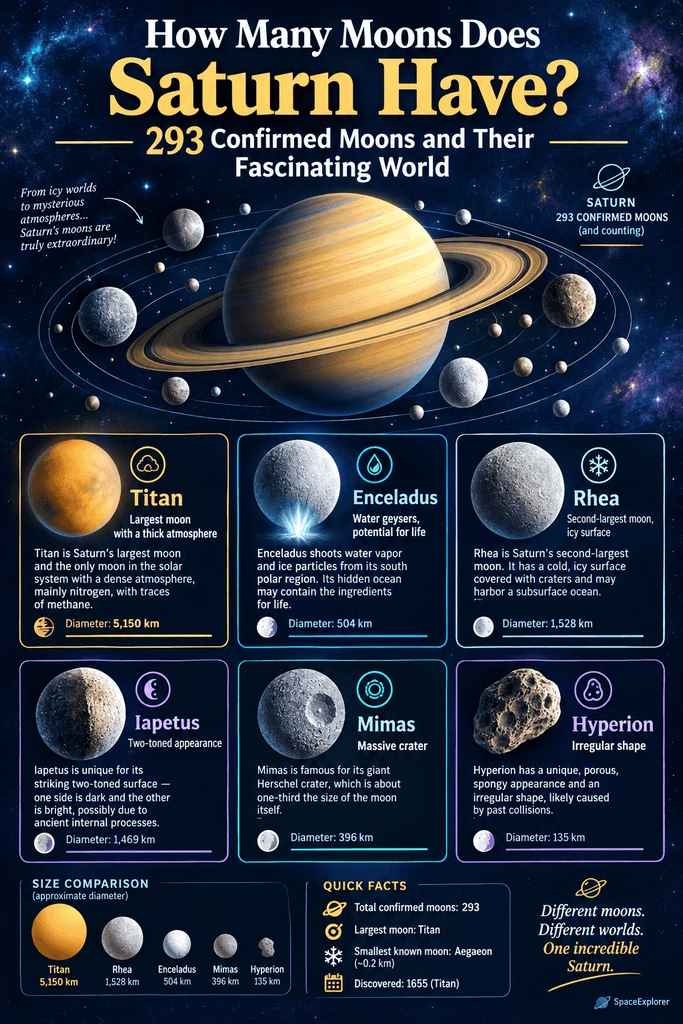
When people ask, “How many moons does Saturn have?”, the answer is surprisingly large. As of August 2026, NASA lists 293 confirmed natural satellites orbiting the ringed planet. This number has changed dramatically in recent years because astronomers have identified many tiny, distant moons that are extremely difficult to detect. (NASA Science)
The huge moon count is one of the reasons Saturn is such an important object of study. Its satellite system includes enormous worlds such as Titan, icy moons such as Enceladus, small ring moons such as Pan and Atlas, and hundreds of tiny irregular satellites.
However, the number of moons is not necessarily permanent. New observations can reveal previously unknown objects, while improved measurements can help scientists determine whether a suspected object is genuinely a moon. Therefore, the answer to “how many moons does Saturn have?” can change as astronomical research continues.
This article explains the current moon count, why the number has increased so quickly, the major moons worth knowing, how scientists discover new satellites, and what these fascinating worlds can teach us about the solar system.
Read More: Stars The Cosmic Kitchen: Birth and Death Explained
How Many Moons Does Saturn Have in 2026?
The current answer is 293 confirmed moons. NASA’s dedicated Saturn moons page states that the planet had 293 confirmed moons as of August 2026. NASA also notes that these satellites range enormously in size, from Titan, which is larger than the planet Mercury, to tiny objects comparable in size to a sports arena. (NASA Science)
This total includes officially recognized natural satellites that have sufficiently established orbits. It does not mean that all 293 moons are large, spherical worlds like Earth’s Moon. In fact, most of them are very small.
The International Astronomical Union’s Minor Planet Center plays an important role in confirming newly discovered satellites. In March 2026, the organization announced 11 additional moons, increasing the known total at that time from 274 to 285. (IAU)
NASA’s later update to 293 demonstrates how rapidly the census can change.
| Fact | Current information |
| Confirmed moons | 293 |
| Planet | Saturn |
| Current NASA count | August 2026 |
| Largest moon | Titan |
| Notable ocean moon | Enceladus |
| Previous major count | 274 in March 2025 |
| 2026 IAU-confirmed addition | 11 moons in March |
The important point is that 293 is a current confirmed count, not necessarily a final number.
Why Does Saturn Have So Many Moons?
The enormous moon population is related to the complex gravitational environment surrounding Saturn. As a massive gas giant, it has strong gravity that can maintain a large collection of natural satellites.
Its extensive ring system also contains countless particles of ice and rock. Some objects embedded within or near the rings are recognized as moons, while the countless smaller pieces of ring material are not classified as individual moons.
The satellite system includes several broad categories.
Large Regular Moons
These moons generally have relatively regular orbits and include some of the best-known satellites.
Examples include:
- Titan
- Rhea
- Iapetus
- Dione
- Tethys
- Enceladus
- Mimas
These objects are especially important because many have interesting geological histories.
Small Inner Moons
Several small moons orbit close to the planet and interact strongly with the rings.
Examples include:
- Pan
- Daphnis
- Atlas
- Prometheus
- Pandora
- Epimetheus
- Janus
Some of these satellites have unusual shapes and gravitational relationships with the rings.
Distant Irregular Moons
A large portion of the total consists of small, distant satellites with inclined or eccentric orbits.
Many are only a few kilometers across or even smaller. Because they are faint and far away, detecting them requires powerful telescopes and careful analysis of multiple observations.
Read More: What Is a CT Scan? Understanding Its Uses, Benefits, and Risks
The Moon Count Has Changed Rapidly
The answer to “how many moons does Saturn have?” was very different only a few years ago.
In March 2025, astronomers announced 128 new small satellites, bringing the recognized total to 274. The International Astronomical Union documented that discovery as a major addition to the Saturn satellite population. (IAU)
Then, in March 2026, another 11 moons were officially confirmed, raising the total to 285. (IAU)
NASA’s August 2026 update lists 293 confirmed moons. (NASA Science)
This sequence illustrates an important lesson in astronomy: a planet’s moon count can increase when better observations reveal small objects that were previously unknown or unconfirmed.
The moons were not necessarily created recently. Most existed for enormous periods of time before humans detected them. The changing number reflects improvements in observation and confirmation rather than a sudden increase in the actual population.
Read More: The Ultimate Guide To X-Ray Production And Modern Use In Diagnosis.
Titan: The Largest Moon of Saturn
Titan is the most famous moon of Saturn and the largest member of its satellite system.
With a diameter of about 5,150 kilometers, Titan is larger than the planet Mercury. NASA describes it as the second-largest moon in the solar system. (NASA Science)
Titan is particularly interesting because it has a thick atmosphere dominated by nitrogen. It is also the only known world besides Earth where stable liquids exist on the surface in the form of lakes and seas, although Titan’s surface liquids are hydrocarbons such as methane and ethane rather than water.
Its surface includes:
- Lakes and seas
- Rivers and channels
- Dunes
- Mountains
- Complex organic chemistry
Titan therefore provides scientists with a natural laboratory for studying planetary chemistry and environments that differ dramatically from Earth.
Enceladus: A Small Moon With a Hidden Ocean
Enceladus is much smaller than Titan, but it is scientifically extraordinary.
The icy moon has a global subsurface ocean beneath its frozen exterior. NASA identifies Enceladus as one of the high-priority worlds for future deep-space scientific investigation. (NASA Science)
One of its most remarkable features is the presence of water-rich plumes emerging from fractures near its south polar region.
These plumes make Enceladus particularly valuable to scientists because spacecraft can potentially sample material originating from the underground ocean without drilling through the entire ice shell.
The moon demonstrates why counting satellites alone does not tell the whole story. A small moon can be scientifically more intriguing than a much larger object.
Rhea: One of the Largest Moons
Rhea is another major satellite of Saturn. It is an icy world with a heavily cratered surface.
Rhea is substantially larger than many of the planet’s other satellites and is among the principal moons that can be discussed when studying the architecture of the system.
Its surface records impacts from the distant past, providing clues about the history of the outer solar system.
Like many icy satellites, Rhea is composed largely of water ice mixed with rocky material.
Iapetus and Its Dramatic Appearance
Iapetus is famous for its striking two-tone appearance.
One side is much darker than the other, creating a dramatic contrast when viewed from space. The moon also has an unusual equatorial ridge extending across part of its surface.
Its distinctive appearance has made Iapetus one of the most recognizable moons in the system.
The moon’s unusual characteristics demonstrate the extraordinary diversity found among the satellites. Not every moon follows the same geological pattern or has the same surface composition.
Mimas and Its Giant Crater
Mimas is relatively small, but its appearance has attracted enormous attention.
Its most famous feature is a massive impact crater called Herschel. The crater is so prominent that it gives Mimas a distinctive appearance.
This enormous impact scar provides evidence of the violent collisions that occurred throughout the early solar system.
Mimas is therefore an excellent example of how even a small satellite can preserve evidence about ancient cosmic events.
Tethys and Its Huge Canyon
Tethys is another icy moon with a remarkable surface.
One of its most important features is Ithaca Chasma, an enormous canyon system that stretches across a substantial portion of the moon.
Tethys also contains the huge Odysseus crater.
These geological features help scientists investigate how collisions, internal processes, and ice-rich compositions have shaped the moons over billions of years.
Dione: An Icy and Geologically Interesting Moon
Dione is a medium-sized icy satellite with a heavily cratered surface.
It also has bright streak-like features known as wispy terrain. These structures are associated with fractures and cliffs across parts of the moon.
Observations of Dione have helped scientists understand the diversity of icy bodies around gas giants.
Like other major moons, Dione contributes to the broader picture of how the Saturn system developed and evolved.
Janus and Epimetheus: Unusual Orbital Partners
Janus and Epimetheus are among the most fascinating moons because of their unusual orbital relationship.
They share nearly the same orbital region around Saturn. Instead of simply occupying identical paths, their gravitational interaction causes them to exchange orbital positions.
This arrangement is called a co-orbital relationship.
The two moons are therefore an excellent example of how gravity creates complex orbital dynamics.
Their relationship also demonstrates that moons are not simply passive objects moving independently around a planet. They can interact gravitationally with one another and with the rings.
The Small Moons That Changed the Count
Although Titan and Enceladus receive much of the public attention, tiny satellites are largely responsible for the enormous increase in the official moon count.
The 11 moons announced by the IAU in March 2026 were estimated to be approximately 1–2 kilometers in diameter. They were extremely faint—around 100 million times fainter than objects visible to the naked eye. (IAU)
This explains why discovering them is so difficult.
A small, dark object reflecting very little sunlight can be nearly invisible against the background of space. Astronomers therefore need:
- Powerful telescopes.
- Sensitive cameras.
- Repeated observations.
- Accurate measurements of position.
- Mathematical orbit calculations.
- Confirmation that the object is genuinely gravitationally bound to the planet.
The discovery process is much more complicated than simply taking a photograph and noticing a new dot.
How Are New Moons Discovered?
Astronomers search for faint moving objects around Saturn using large ground-based telescopes and advanced imaging systems.
A potential satellite is first detected as a faint point of light.
Researchers then compare images taken at different times. If the object moves consistently relative to background stars and follows a path compatible with an orbit around the planet, it becomes a candidate satellite.
However, one observation is not enough.
The object must be tracked repeatedly so scientists can determine its orbit.
The IAU’s Minor Planet Center explains that confirmation involves checking whether the observations correspond to an already catalogued object and determining whether the calculated path is consistent with a planetocentric orbit. (IAU)
Only after sufficient evidence is obtained can the object become part of the officially recognized moon population.
Why Are Saturn’s Tiny Moons So Difficult to See?
Distance is one major problem.
Many irregular moons orbit millions of kilometers from their parent planet. At those distances, even a kilometer-sized object can appear extremely faint.
Size is another challenge.
A moon only a few kilometers wide reflects very little sunlight. If its surface is dark, detecting it becomes even more difficult.
Motion creates another complication. A distant moon can move across the sky relative to background stars, but its movement may be slow and difficult to distinguish from image noise or other objects.
Scientists overcome these challenges through repeated observations and sophisticated computational techniques.
Are the Rings Made of Moons?
No.
This is an important distinction when discussing how many moons Saturn has.
The rings consist primarily of countless pieces of ice and rocky material. Individual ring particles can range from tiny grains to much larger chunks.
They are not all classified as moons.
However, several small moons exist within or near the ring system. These are sometimes called shepherd moons because their gravity influences nearby ring material.
For example, Prometheus and Pandora interact with the F ring, while other small satellites help shape gaps and structures within the rings.
Therefore, the beautiful rings should not be added to the moon count.
Why Does Saturn Have More Moons Than Jupiter?
For many years, Jupiter and Saturn competed closely for the title of the planet with the most known moons.
The answer changes as new satellites are confirmed.
NASA’s August 2026 information lists 293 confirmed moons for Saturn. NASA’s June 2026 astronomy article gave Jupiter 115 confirmed moons at that time, placing Saturn well ahead in the current count. (NASA Science)
One reason the counts can change quickly is that astronomers are still discovering very small irregular satellites around the giant planets.
The current leader, therefore, is determined by the latest officially confirmed observations rather than by a permanently fixed number.
Do All Saturn Moons Have Names?
No.
This is another common misunderstanding.
The best-known moons have individual names, including Titan, Enceladus, Rhea, Dione, Tethys, Iapetus, Mimas, Phoebe, Janus, and Epimetheus.
But many newly discovered small satellites initially receive temporary designations.
For example, the IAU’s 2026 announcement identified newly confirmed objects using designations such as S/2020 S 45 and S/2023 S 51. (IAU)
These temporary labels allow scientists to catalogue and study the objects before permanent names are assigned.
The IAU also notes that once their orbits are accurately determined, satellites can receive numerical designations, after which names may be proposed according to established naming conventions. (IAU)
Where Do Saturn’s Moon Names Come From?
The naming system reflects the mythology associated with the satellites.
Early moons were often given names connected with Greek and Roman mythology. As more irregular satellites were discovered, naming traditions expanded.
Different groups of moons have names associated with mythological traditions including:
- Norse mythology
- Inuit mythology
- Gallic mythology
- Greco-Roman mythology
This creates a fascinating connection between modern astronomy and ancient cultural traditions.
What Can Saturn’s Moons Teach Scientists?
The satellite system provides an enormous natural laboratory for planetary science.
Scientists can study:
Planetary Formation
The moons contain clues about the materials and processes that existed when the outer solar system formed.
Geological Activity
Worlds such as Enceladus show that icy moons can remain geologically interesting long after their formation.
Atmospheres
Titan provides an opportunity to study a dense atmosphere with complex organic chemistry.
Orbital Dynamics
Moons such as Janus and Epimetheus demonstrate the complicated gravitational interactions that can occur within a planetary system.
Ring Evolution
Small moons can interact with rings, creating gaps, waves, edges, and other structures.
Together, these subjects help scientists reconstruct the history of Saturn and its surroundings.
Could Saturn Have More Moons?
Yes.
The current number should not be considered the final total.
Astronomers continue to improve telescopes, cameras, image-processing techniques, and orbit-determination methods. As these technologies improve, additional tiny satellites may become detectable.
NASA explicitly notes that the total will likely continue to grow. (NASA Science)
This is especially true for small, distant irregular moons, which are among the hardest objects to detect.
Future observations could therefore change the answer again.
What Spacecraft Have Explored Saturn’s Moons?
Several spacecraft have visited the Saturn system, but NASA’s Cassini mission was particularly important.
Four spacecraft have visited the system, while Cassini was the only one to enter orbit around the planet. The mission operated for more than a decade and dramatically expanded scientific knowledge of the planet, rings, and moons. (NASA Science)
Cassini studied many satellites at close range and produced detailed observations of their surfaces, atmospheres, interiors, and interactions with the rings.
The mission also carried the Huygens probe, which descended through Titan’s atmosphere and reached its surface in 2005.
These missions transformed our understanding of the Saturnian system.
Saturn’s Moons Compared With Earth’s Moon
Earth has only one natural satellite: the Moon.
By contrast, Saturn has hundreds.
The difference is striking, but the satellites themselves are also dramatically different.
Earth’s Moon is a large rocky body with a relatively simple orbital relationship with Earth. The satellite system of Saturn contains objects ranging from enormous worlds such as Titan to tiny irregular bodies only a few kilometers across.
Some are icy, some are rocky, some have atmospheres, and some interact closely with the rings.
This diversity makes Saturn an especially valuable destination for planetary science.
Frequently Asked Questions (FAQ)
How many moons does Saturn have right now?
As of August 2026, NASA lists 293 confirmed moons orbiting Saturn. The number can change when additional satellites are discovered and officially confirmed. (NASA Science)
What is Saturn’s biggest moon?
Titan is the largest moon of Saturn. With a diameter of approximately 5,150 kilometers, it is even larger than the planet Mercury. (NASA Science)
Does Saturn have more moons than Jupiter?
According to NASA’s current 2026 figures, yes. NASA lists 293 confirmed moons for Saturn and 115 confirmed moons for Jupiter as of June/August 2026. (NASA Science)
Why does Saturn have so many moons?
Its enormous gravitational environment allows a large and complex satellite system to exist. Many of the recently confirmed moons are tiny, distant irregular satellites that require powerful telescopes to detect.
Are Saturn’s rings made of moons?
No. The rings are composed of enormous numbers of particles, mostly ice and rock. Some small moons exist within or near the rings, but ring particles themselves are not counted as moons.
Which moon of Saturn has an ocean?
Enceladus has a global subsurface ocean beneath its icy shell. Titan also has an internal ocean, while its surface contains lakes and seas of liquid methane and ethane. (NASA Science)
Are all 293 moons named?
No. Many small, recently discovered satellites have temporary designations rather than permanent names. Names can be assigned after their orbits are sufficiently established and the appropriate naming process is completed.
Can the number of moons increase again?
Yes. Astronomers continue searching for faint satellites, particularly small objects in distant orbits. Consequently, the official count may increase as additional moons are confirmed.
Conclusion
So, how many moons does Saturn have? The current answer is 293 confirmed moons as of August 2026, according to NASA. (NASA Science)
That number is remarkable, but the real story is even more fascinating. The Saturn system contains enormous worlds such as Titan, potentially ocean-bearing Enceladus, unusual satellites such as Iapetus and Hyperion, co-orbital companions such as Janus and Epimetheus, ring-interacting moons, and hundreds of tiny distant objects.
The recent history of moon discoveries also shows why astronomical numbers can change. In 2025, 128 additional satellites were recognized, and another 11 were confirmed by the IAU in March 2026. (IAU)
As telescopes become more sensitive and researchers develop better ways to detect faint objects, the satellite population may continue to grow.
For that reason, the most accurate way to answer the question is not simply to memorize a number. It is to remember that 293 is the current confirmed count, based on the latest available observations and official astronomical records. The next discovery could make the number larger, giving scientists yet another small world to investigate in one of the most diverse planetary systems in our solar system.