
Saturn from Earth: Distance, Closest Approach, Farthest Point & Complete Guide
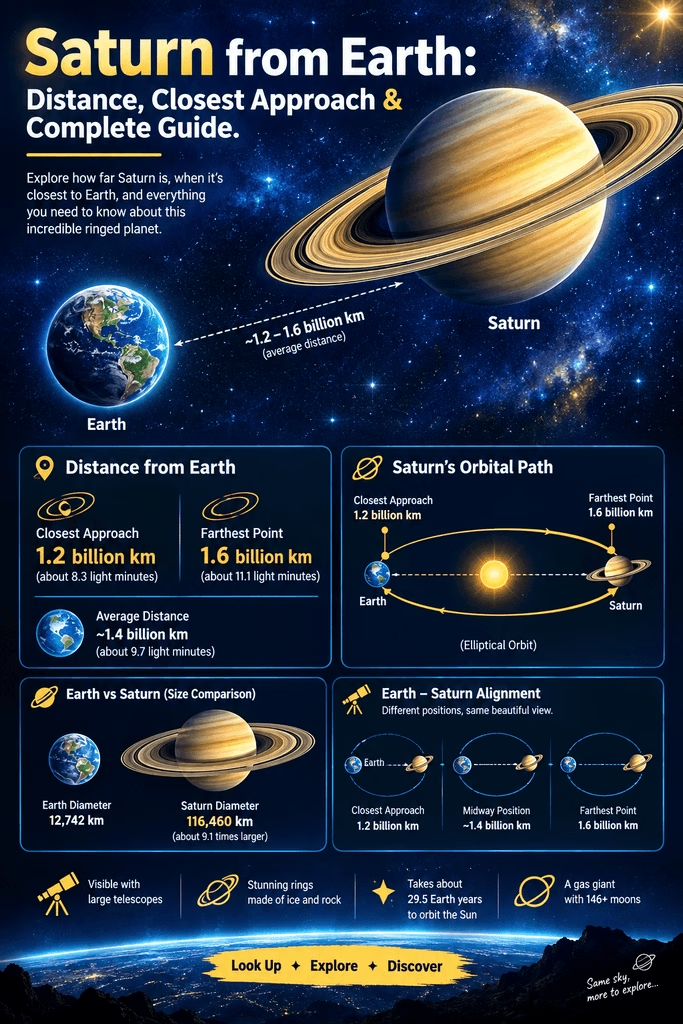
Saturn is one of the most fascinating planets in our Solar System. Famous for its spectacular ring system, numerous moons, and enormous size, Saturn has fascinated astronomers for centuries. Although it is one of the outer planets, its distance from Earth is not always the same. Both planets continuously orbit the Sun, so the distance between them changes throughout their journeys.
Understanding the distance of saturn from earth requires more than giving one fixed number. At certain times, Saturn can be relatively close to Earth, while at other times, it can be much farther away. The average distance is roughly 1.3 billion kilometers (about 800 million miles), but the actual distance can vary considerably.
This article explains how far Saturn is from Earth, why its distance changes, how astronomers measure it, when Saturn comes closest to Earth, how long light takes to travel between the two planets, and what this distance means for space exploration and observation.
Read More: How Far Is Saturn from the Sun? Distance, Orbit, and Fascinating Facts.
How Far Is Saturn from Earth?
The distance between Earth and Saturn changes because both planets orbit the Sun at different speeds and distances. Therefore, there is no single permanent value for the saturn from earth distance.
On average, Saturn is approximately:
- 1.43 billion km from the Sun
- 1.3 billion km from Earth
- About 800 million miles from Earth
- Roughly 8.7 astronomical units (AU) from the Sun
However, the actual Earth-Saturn distance can range from approximately 1.2 billion km to 1.7 billion km, depending on the positions of the planets in their respective orbits.
The variation is substantial because Earth is much closer to the Sun than Saturn. Earth completes one orbit in about 365.25 days, whereas Saturn takes approximately 29.5 Earth years to complete one orbit.
As both planets move, their relative positions constantly change. Consequently, the saturn from earth distance is different from one month or year to another.
Read More: How Many Rings Does Saturn Have? 9 Fascinating Facts About Saturn’s Ring System.
Why Does the Distance of Saturn from Earth Change?
The changing distance is primarily caused by orbital motion.
Earth travels around the Sun at an average distance of about 150 million km. Saturn, meanwhile, travels around the Sun at an average distance of about 1.43 billion km.
Imagine the Sun at the center of two enormous circular tracks. Earth moves along the inner track, while Saturn moves along the much larger outer track. Sometimes Earth and Saturn are positioned on the same general side of the Sun. At other times, the Sun lies approximately between them.
This changing geometry affects the distance between the two planets.
When Earth and Saturn are relatively close together, the saturn from earth distance decreases. When they are positioned on opposite sides of the Sun, the distance increases.
The orbits are also not perfect circles. They are slightly elliptical. This means that the distance of each planet from the Sun changes somewhat during its orbit, adding another factor to the changing Earth-Saturn distance.
Average Distance of Saturn from Earth
A commonly quoted average for the Earth-Saturn distance is approximately 1.3 billion kilometers, or around 800 million miles.
However, it is important to understand what an average means in astronomy. It does not mean that Saturn remains exactly 1.3 billion km away from Earth.
Instead, it provides a useful approximate value for understanding the enormous scale of the Solar System.
For comparison:
| Object or distance | Approximate distance |
| Earth to Moon | 384,400 km |
| Earth to Sun | 150 million km |
| Earth to Mars | Varies greatly |
| Earth to Jupiter | Varies greatly |
| Earth to Saturn | About 1.2–1.7 billion km |
| Saturn to Sun | About 1.43 billion km |
The enormous saturn from earth distance explains why Saturn appears relatively small in the night sky even though the planet itself is enormous.
Read More: How Many Moons Does Saturn Have? 293 Confirmed Moons and Their Fascinating World.
Saturn’s Distance in Astronomical Units
Astronomers frequently use the astronomical unit (AU) when describing distances within the Solar System.
One astronomical unit is approximately the average distance between Earth and the Sun:
1 AU ≈ 149.6 million km
Saturn’s average distance from the Sun is about 9.5 AU.
This means Saturn is approximately 9.5 times farther from the Sun than Earth is on average.
The Earth-Saturn distance is therefore naturally measured in several astronomical units. Depending on their positions, Earth and Saturn can be separated by roughly 8 to 11 AU.
Using AU makes the scale easier to understand. Saying that Saturn is about eight or more AU from Earth immediately communicates that the planet is several times farther away than the Sun is from Earth.
Read More: The Ultimate Guide To X-Ray Production And Modern Use In Diagnosis.
Closest Possible Distance Between Earth and Saturn
The closest distance between Earth and Saturn occurs when their orbital positions produce a favorable alignment.
At such times, the saturn from earth distance can be approximately 1.2 billion km, although the exact value depends on the positions of both planets and the geometry of their orbits.
This is still an enormous distance.
Even at its closest, Saturn is more than 3,000 times farther from Earth than the Moon.
This comparison demonstrates why traveling to Saturn requires advanced spacecraft, careful navigation, and many years of planning.
A close approach also provides excellent opportunities for astronomers. Saturn can appear brighter and more prominent in the night sky when it is relatively near Earth.
Read More: Stars The Cosmic Kitchen: Birth and Death Explained.
Farthest Distance Between Earth and Saturn
The distance becomes much greater when Earth and Saturn are located on opposite sides of the Sun.
Under such circumstances, the saturn from earth distance can approach approximately 1.7 billion km.
This difference between the closest and farthest distances is hundreds of millions of kilometers.
The Sun’s position between the two planets is important because the planets’ distances from the Sun must effectively be combined to understand the maximum separation.
For a simplified calculation:
Earth-Sun distance + Sun-Saturn distance ≈ Earth-Saturn distance
Using approximate average orbital distances:
150 million km + 1,430 million km ≈ 1,580 million km
The actual maximum can differ because planetary orbits are elliptical and their orientations are not identical.
Read More: What Is a CT Scan? Understanding Its Uses, Benefits, and Risks.
How Long Does Light Take to Travel from Saturn to Earth?
The enormous distance between the two planets also affects communication and observation.
Light travels through space at approximately:
299,792 km/s
Because the saturn from earth distance varies, the time required for light to travel between the planets also changes.
At a typical distance of around 1.3 billion km, light requires approximately:
1,300,000,000 ÷ 299,792 ≈ 4,337 seconds
That is approximately:
72 minutes
Therefore, light from Saturn can take roughly about 67 to 95 minutes to reach Earth, depending on the planets’ positions.
This means that when you observe Saturn through a telescope, you are not seeing the planet exactly as it exists at the moment you look at it. You are seeing Saturn as it appeared roughly an hour or more earlier.
The same principle applies to spacecraft communication. Commands sent from Earth to a spacecraft near Saturn cannot arrive instantly.
Why the Distance Matters for Spacecraft
The enormous saturn from earth distance creates significant challenges for space missions.
A spacecraft traveling toward Saturn must cross hundreds of millions of kilometers of space. It cannot simply travel in a straight line at a constant speed and arrive at the destination.
Mission planners must account for:
- Orbital mechanics
- Planetary positions
- Spacecraft velocity
- Fuel requirements
- Gravity assists
- Communication delays
- Navigation accuracy
- Mission duration
Spacecraft can use the gravity of planets to change their trajectories and gain or redirect momentum. This technique, known as a gravity assist, can significantly reduce the amount of fuel required for certain missions.
The distance also means that spacecraft missions to Saturn usually take several years.
How Long Does It Take to Travel to Saturn?
There is no single travel time because spacecraft use different trajectories, speeds, and mission designs.
Several spacecraft have traveled to the Saturn system, demonstrating that the journey can take years.
For example, NASA’s Cassini-Huygens mission took approximately seven years to reach Saturn after launching in 1997. Cassini entered orbit around Saturn in 2004.
The long journey demonstrates how significant the saturn from earth distance is from an engineering perspective.
A spacecraft cannot simply accelerate continuously toward Saturn. It must follow a carefully calculated trajectory that accounts for the movement of the planets and the spacecraft’s own orbital path.
Saturn’s Distance Compared With Jupiter
Jupiter is the fifth planet from the Sun, while Saturn is the sixth.
Because Saturn is farther from the Sun than Jupiter, it is generally farther from Earth as well, although the exact distances change as the planets orbit.
Jupiter’s average distance from the Sun is about 5.2 AU, whereas Saturn’s average distance is approximately 9.5 AU.
This difference helps explain why the saturn from earth distance is generally greater than the distance to Jupiter.
Both planets, however, can come considerably closer to Earth during favorable orbital alignments.
Saturn’s Distance Compared With the Moon
The Moon is Earth’s natural satellite and has an average distance of approximately 384,400 km.
Saturn, by comparison, is more than a billion kilometers away.
A rough comparison shows the extraordinary scale involved:
1.3 billion km ÷ 384,400 km ≈ 3,400
Thus, a typical saturn from earth distance is thousands of times greater than the Earth-Moon distance.
This is one reason Saturn appears as a tiny point of light to the unaided eye despite its enormous physical size.
The Moon, being much closer, appears large in Earth’s sky. Saturn is vastly larger than the Moon, but its enormous distance makes it appear much smaller.
Can You See Saturn From Earth?
Yes. Saturn can be seen from Earth without a telescope when observing conditions are favorable.
It usually appears as a bright, relatively steady point of light in the night sky. Unlike stars, planets generally do not twinkle as strongly because they appear as tiny disks rather than essentially point-like sources.
However, seeing Saturn’s famous rings requires optical equipment.
A small telescope can reveal Saturn’s ring system under suitable conditions. Larger telescopes can reveal more detail, including the planet’s atmospheric bands and some of its brighter moons.
The changing saturn from earth distance affects its apparent brightness and angular size. When Saturn is closer, it can appear somewhat larger and brighter.
Can You See Saturn’s Rings From Earth?
Yes, but not with the unaided eye.
Saturn’s rings are one of the most spectacular sights available to amateur astronomers. Even a modest telescope can sometimes show the planet as a small disk surrounded by a clearly separated ring structure.
The rings are composed primarily of particles of water ice mixed with rocky material and dust. Their sizes range from tiny grains to larger pieces.
The rings are enormous in diameter but relatively thin compared with their width.
Their visibility from Earth also depends on the angle at which we view them. Because Saturn’s axis is tilted, the rings appear to change their orientation over time.
This changing view is unrelated to large changes in the saturn from earth distance. Instead, it is primarily caused by Saturn’s position in its orbit and the orientation of its tilted rotational axis relative to Earth and the Sun.
How Astronomers Measure the Distance to Saturn
Astronomers use precise observations and mathematical models to determine planetary distances.
Modern planetary distance measurements rely heavily on:
- Radar and radio observations
- Spacecraft tracking
- Orbital calculations
- Radio signals
- Precise timing
- Optical observations
- Planetary ephemerides
Spacecraft provide particularly valuable information because their positions can be tracked using radio signals.
Scientists can determine how long a radio signal takes to travel between Earth and a spacecraft. Because radio waves travel at approximately the speed of light, this information provides an extremely accurate measurement of distance.
These methods allow scientists to calculate the changing saturn from earth distance with remarkable precision.
Does Saturn Move Closer to Earth Every Year?
No.
Saturn does not follow a simple yearly cycle in which it gets closer and then farther away from Earth at exactly the same time each year.
Earth completes an orbit in about one year, while Saturn takes nearly 29.5 years.
Because their orbital periods are different, their relative positions continuously change.
Saturn reaches opposition approximately once every year, when Earth lies roughly between the Sun and Saturn. Around opposition, Saturn is generally relatively close to Earth and well placed for observation.
However, the exact distance at opposition varies because Saturn’s orbit and Earth’s orbit are not perfectly circular.
Saturn at Opposition
Opposition occurs when a planet outside Earth’s orbit appears opposite the Sun in Earth’s sky.
For Saturn, opposition is particularly important to amateur astronomers.
Around opposition:
- Saturn is visible for much of the night.
- It rises around sunset.
- It reaches its highest point around midnight.
- It sets around sunrise.
- It is relatively close to Earth.
- It can appear brighter than at many other times.
Because of these factors, opposition is generally an excellent period for observing Saturn.
The saturn from earth distance around opposition is not necessarily the absolute minimum possible distance, but it is typically much more favorable for observation than when Saturn is on the far side of the Sun.
Does the Sun Ever Come Between Earth and Saturn?
Yes.
Because Earth and Saturn orbit the Sun at different distances, there are periods when the Sun lies approximately between them.
When this happens, the saturn from earth distance becomes large.
More importantly, the Sun can interfere with direct communication between Earth and spacecraft operating in the Saturn system. During certain mission configurations, spacecraft can experience periods when communication is restricted because the spacecraft is positioned near the Sun from Earth’s perspective.
Space agencies carefully plan communication schedules around these conditions.
Saturn’s Distance and Space Communication
Communication across the Solar System is fundamentally limited by the speed of light.
Suppose a spacecraft near Saturn receives a command from Earth. The command does not arrive instantly. Depending on the current saturn from earth distance, the signal may take more than an hour to travel one way.
A response then requires another comparable amount of time.
Consequently, a complete command-and-response cycle can take several hours.
This creates a major difference between operating spacecraft near Earth and operating spacecraft near Saturn. Near-Earth spacecraft can sometimes be controlled almost interactively, whereas distant spacecraft must often operate with carefully planned sequences of commands.
Why Saturn Looks Small Despite Its Size
Saturn is the second-largest planet in the Solar System after Jupiter.
Its equatorial diameter is approximately 120,500 km, which is nearly ten times Earth’s diameter.
Yet Saturn looks like a small object from Earth because of its enormous distance.
This illustrates an important astronomical concept: apparent size depends on both physical size and distance.
An enormous object can appear tiny if it is far away. Conversely, a relatively small nearby object can appear large.
The changing saturn from earth distance therefore affects Saturn’s apparent angular diameter in our sky.
Saturn’s Distance From Earth in Miles
People who use the imperial system may prefer to express the distance in miles.
A typical Earth-Saturn separation of approximately 1.3 billion km corresponds to around:
800 million miles
The possible distance range of approximately 1.2 to 1.7 billion km corresponds roughly to:
746 million to 1.06 billion miles
These figures are approximations because the actual distance changes continuously.
Using kilometers is common in scientific discussions, while miles may be more familiar to some readers. Astronomers often prefer astronomical units for Solar System distances because they provide a convenient scale.
A Simple Way to Understand Saturn’s Distance
One useful way to understand the saturn from earth distance is to compare it with familiar distances.
Earth is approximately 150 million km from the Sun.
Saturn is approximately 1.43 billion km from the Sun.
Therefore, Saturn’s orbit is roughly 9.5 times farther from the Sun than Earth’s orbit.
If the Earth-Sun distance were represented by a short unit on a scale model, Saturn would need to be placed nearly ten times farther away.
This gives a much clearer picture of how widely separated the planets are.
Frequently Asked Questions (FAQ)
1. How far is Saturn from Earth?
The distance varies continuously. Saturn is typically about 1.2 to 1.7 billion km from Earth, with an approximate average of around 1.3 billion km, or about 800 million miles.
2. What is the closest distance between Earth and Saturn?
Under favorable orbital geometry, Earth and Saturn can be separated by roughly 1.2 billion km. The precise distance depends on the positions of both planets.
3. What is the farthest distance between Earth and Saturn?
The separation can approach approximately 1.7 billion km when the planets are positioned on opposite sides of the Sun.
4. How long does sunlight take to reach Saturn?
Sunlight takes roughly 80 minutes to travel from the Sun to Saturn on average, although the exact time varies with Saturn’s distance from the Sun.
5. How long does light from Saturn take to reach Earth?
Depending on their positions, light can take approximately 67 to 95 minutes to travel from Saturn to Earth.
6. Can Saturn be seen without a telescope?
Yes. Saturn can be visible to the unaided eye as a bright point of light under suitable observing conditions. However, a telescope is needed to see its rings.
7. Why does Saturn’s distance from Earth change?
The distance changes because Earth and Saturn orbit the Sun at different speeds and distances. Their relative positions are constantly changing.
8. Is Saturn farther away than Jupiter?
Generally, yes. Saturn’s average distance from the Sun is approximately 9.5 AU, compared with about 5.2 AU for Jupiter. Therefore, Saturn is generally farther from Earth, although exact distances vary.
9. How long would a spacecraft take to reach Saturn?
Travel time depends on the spacecraft’s trajectory, velocity, launch conditions, and mission objectives. Past missions have taken several years to reach Saturn.
10. Why is Saturn important to astronomers?
Saturn provides a natural laboratory for studying giant planets, planetary atmospheres, ring systems, moons, magnetospheres, and the formation and evolution of planetary systems.
Conclusion
The saturn from earth distance is not a fixed number. Because Earth and Saturn continuously orbit the Sun, their separation changes throughout time. Saturn can be approximately 1.2 billion km away at a relatively close approach and nearly 1.7 billion km away when the planets are widely separated. A useful average figure is around 1.3 billion km, or roughly 800 million miles.
This enormous distance affects nearly every aspect of our relationship with Saturn. It determines how large and bright the planet appears in Earth’s sky, how long light takes to reach us, how long spacecraft require to travel to the Saturn system, and how long radio communications take between Earth and distant spacecraft.
Despite being more than a billion kilometers away, Saturn remains accessible to observers on Earth. Under favorable conditions, it can be seen without optical equipment, while a telescope can reveal its magnificent rings and some of its moons.
The changing saturn from earth distance is also a powerful reminder of the immense scale of the Solar System. Earth and Saturn may appear relatively close together on a diagram of the planets, but in reality, hundreds of millions of kilometers separate them. Studying this distance helps us better understand planetary motion, orbital mechanics, astronomical measurement, and the extraordinary distances involved in exploring our cosmic neighborhood.