
What Does Saturn Look Like? 9 Fascinating Features of the Ringed Planet
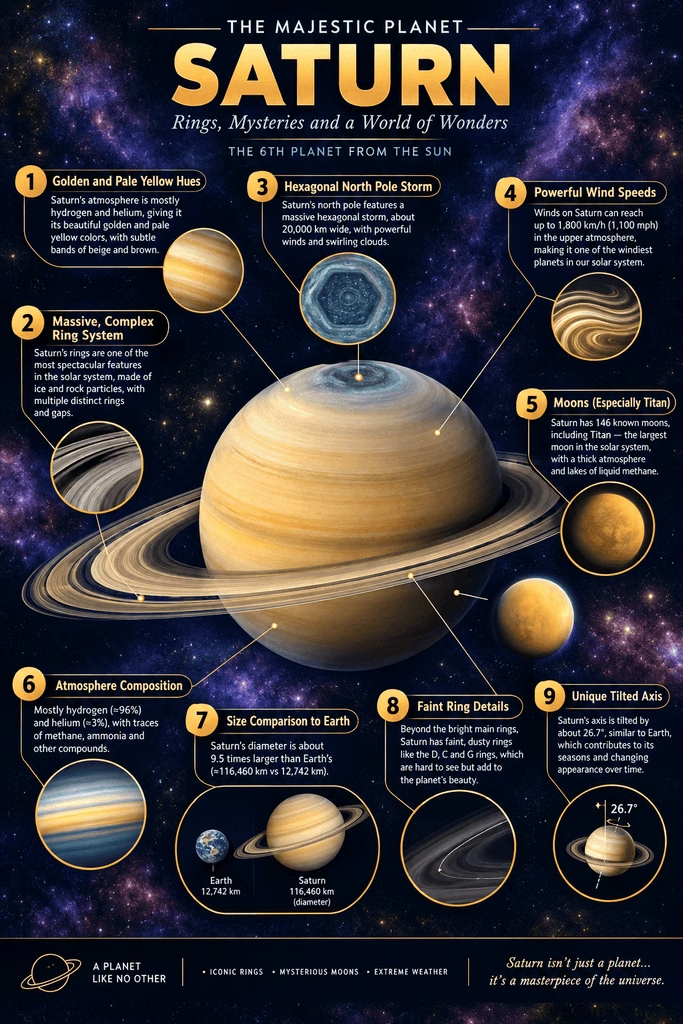
When people ask what saturn look like, they are usually thinking of one of the most recognizable sights in the Solar System: a large, pale-golden planet surrounded by a spectacular system of bright rings. Saturn is the sixth planet from the Sun and the second-largest planet in the Solar System. Its appearance is very different from that of rocky planets such as Earth or Mars because Saturn is a gas giant with no solid surface that we could stand on.
From a distance, Saturn looks like a smooth, yellowish or golden sphere crossed by subtle horizontal bands. Its magnificent rings make it especially distinctive. When viewed through a telescope, the rings can appear remarkably sharp, while Saturn’s atmosphere reveals additional details, including cloud bands, storms, and changing shades of cream, yellow, brown, and gray.
Understanding what saturn look like also means looking beyond a simple picture. Its visible appearance is influenced by its atmosphere, rapid rotation, clouds, seasonal changes, rings, moons, and the angle from which we observe it. Images from spacecraft have revealed details that cannot be seen clearly from Earth.
Read More: How Far Is Saturn from the Sun? Distance, Orbit, and Fascinating Facts.
Saturn at a Glance
Before examining its appearance in detail, it helps to understand a few basic facts about Saturn.
- Planet type: Gas giant
- Position from the Sun: Sixth planet
- Color: Predominantly pale yellow, gold, cream, and gray
- Main atmospheric gases: Hydrogen and helium
- Average radius: About 58,200 kilometers
- Diameter: About 116,500 kilometers
- Ring system: Extensive and made mainly of ice particles and rocky material
- Number of confirmed moons: More than 270, with the total changing as new moons are confirmed
- Rotation period: About 10.5 hours, depending on the measurement method
- Shape: Oblate spheroid, meaning it is noticeably flattened at the poles
These characteristics explain why Saturn looks so different from Earth and the other terrestrial planets.
Read More: Saturn from Earth: Distance, Closest Approach, Farthest Point & Complete Guide.
What Does Saturn Look Like From Earth?
To understand what saturn look like from Earth, imagine a bright, relatively small, golden point of light in the night sky. Saturn is far too distant to appear as a large disk to the naked eye. Without magnification, it generally looks like a steady, yellowish star-like object.
A telescope changes the view dramatically. Even a modest telescope can reveal that Saturn is not simply a point of light. It appears as a small disk with its famous rings extending around it. Under good observing conditions, the rings can be clearly separated from the planet’s disk.
The apparent size of Saturn changes as Earth and Saturn move through their respective orbits. When Saturn is closer to Earth, it can appear larger and brighter through a telescope. At greater distances, its apparent disk becomes smaller.
The angle at which we see the rings also changes. Sometimes they are presented at a relatively wide angle, making them particularly easy to see. At other times, they appear more edge-on and become much harder to observe. This changing perspective is an important part of understanding what saturn look like during different periods.
Saturn Has a Pale Golden Color
One of the first things people notice about Saturn is its color. Unlike the deep blue appearance associated with Neptune or the reddish appearance of Mars, Saturn usually has a soft yellow, cream, or golden appearance.
This coloration comes primarily from the way sunlight interacts with Saturn’s upper atmosphere. The atmosphere contains mostly hydrogen and helium, along with smaller quantities of other substances. Trace compounds and atmospheric particles affect how sunlight is absorbed, scattered, and reflected.
Saturn’s color is not perfectly uniform. Different atmospheric layers can have slightly different shades. Images may show pale yellow, beige, cream, brown, gray, or subtle golden tones.
Spacecraft photography can make these differences particularly noticeable. However, the exact colors in photographs depend on the camera, filters, image processing, lighting conditions, and the purpose for which the image was created.
Therefore, when considering what saturn look like, it is better to picture a softly colored golden-beige planet rather than a completely bright yellow sphere.
Read More: How Many Rings Does Saturn Have? 9 Fascinating Facts About Saturn’s Ring System.
Saturn’s Atmosphere Has Horizontal Bands
Saturn’s atmosphere is not completely smooth. It contains broad horizontal bands that circle the planet.
These bands are associated with differences in atmospheric temperature, composition, cloud structure, and wind patterns. Some are darker than their surroundings, while others appear brighter. Compared with Jupiter’s highly contrasting bands, Saturn’s atmospheric stripes are often more subtle.
Through a powerful telescope, observers may notice several belts and zones. These can appear as faint lines running approximately parallel to Saturn’s equator.
Saturn’s rapid rotation contributes to its banded appearance. The planet completes one rotation in roughly ten and a half hours, although determining the exact rotation period is more complicated because Saturn has no solid surface. Rapid rotation influences atmospheric circulation and helps organize the planet’s clouds into broad patterns.
These horizontal features make Saturn appear more dynamic than a simple photograph might suggest.
Read More: How Many Moons Does Saturn Have? 293 Confirmed Moons and Their Fascinating World.
Saturn Is Not a Perfect Sphere
Another important feature of what saturn look like is its unusual shape.
At first glance, Saturn appears round. However, it is noticeably flattened at its poles and wider around its equator. This shape is called an oblate spheroid.
The main reason is Saturn’s extremely rapid rotation. As the planet spins, its equatorial region experiences a stronger outward effect than regions closer to the poles. Because Saturn is made primarily of gases and fluids rather than solid rock, its shape can respond significantly to this rapid rotation.
The difference between Saturn’s equatorial and polar dimensions is substantial. As a result, photographs taken from suitable angles can show that the planet is slightly squashed rather than perfectly spherical.
This is one reason Saturn looks particularly wide when its rings are viewed from an angle close to the planet’s equatorial plane.
Read More: The Ultimate Guide To X-Ray Production And Modern Use In Diagnosis.
Saturn’s Rings Are Its Most Famous Feature
No discussion of what saturn look like would be complete without its rings.
Saturn’s ring system is the most visually famous ring system in the Solar System. The rings stretch far beyond the planet’s visible disk and create the appearance of a spectacular cosmic disk surrounding Saturn.
Despite their enormous width, the main rings are remarkably thin compared with their overall diameter. They are composed of countless particles, ranging from tiny grains to larger pieces of ice and rock.
Most of the material in Saturn’s rings is water ice, which makes the rings highly reflective. This is one reason they can appear bright and almost white when sunlight illuminates them.
From Earth, the rings may look like a solid structure. They are not. A telescope with sufficient resolution can reveal divisions and gaps between different ring sections.
The major ring groups are commonly designated with letters, including the A, B, and C rings. There are also fainter rings and additional structures.
Read More: What Is a CT Scan? Understanding Its Uses, Benefits, and Risks.
The Cassini Division Makes the Rings Look More Detailed
One of the most famous structures in Saturn’s ring system is the Cassini Division.
The Cassini Division is a broad gap between the A and B rings. It is not completely empty, but it contains significantly less ring material than the surrounding regions.
Under good observing conditions, the Cassini Division can sometimes be seen through a sufficiently powerful amateur telescope. Its visibility depends on telescope quality, atmospheric conditions, Saturn’s position in the sky, and the angle of the rings.
Seeing this division can make Saturn’s appearance especially impressive because it demonstrates that the rings are made up of separate structures rather than one continuous solid disk.
Read More: Stars The Cosmic Kitchen: Birth and Death Explained.
Why Saturn’s Rings Change Their Appearance
Saturn’s rings do not always look the same from Earth.
As Saturn travels around the Sun and Earth changes position relative to Saturn, our viewing angle changes. Saturn’s rings are tilted relative to the planet’s orbital plane, so we see different portions of their orientation over time.
When the rings are opened toward Earth, they are easy to see. Saturn may then look as though it has a broad, bright disk extending from both sides.
When the rings become more edge-on to Earth, their apparent width decreases dramatically. During particularly edge-on configurations, the rings can become extremely difficult to see through small telescopes.
This changing perspective helps explain why images of Saturn taken in different years can look surprisingly different even though the planet itself has not undergone a major transformation.
Saturn Has a North Polar Hexagon
One of Saturn’s strangest atmospheric features is a huge hexagon-shaped pattern around its north pole.
The feature is a persistent six-sided jet-stream pattern in Saturn’s upper atmosphere. Each side of the hexagon is thousands of kilometers long, making the structure enormous compared with Earth.
It was first noticed in images from the Voyager spacecraft and later studied in much greater detail by the Cassini mission.
The hexagon is not a solid object or a giant structure attached to Saturn. It is an atmospheric pattern created by complex fluid dynamics and high-speed winds.
This feature adds another layer to understanding what saturn look like. Although Saturn often appears smooth and peaceful in photographs, its atmosphere is actually extremely active.
Saturn’s Clouds and Storms
Saturn’s atmosphere contains clouds at different altitudes. These clouds are associated with substances such as ammonia and water, along with other atmospheric compounds.
Most visible cloud structures are relatively subtle compared with those of Jupiter. Nevertheless, Saturn experiences powerful storms.
Large atmospheric disturbances can develop and spread around portions of the planet. Some storms become so extensive that they can be observed by telescopes and spacecraft.
Saturn also experiences seasonal changes because its axis is tilted relative to its orbit around the Sun. As Saturn moves through its long year, different hemispheres receive different amounts of sunlight. These seasonal changes can influence atmospheric conditions and coloration.
Consequently, Saturn’s appearance can change gradually over time.
Saturn Has a Darker Shadowed Side
Saturn’s appearance depends strongly on lighting.
Like Earth, Saturn has a day side illuminated by the Sun and a night side facing away from it. From certain viewing positions, spacecraft can photograph Saturn with part of the planet brightly illuminated and another part in darkness.
The rings can also cast shadows across Saturn’s atmosphere. At the same time, Saturn can cast a shadow onto portions of its rings.
These interactions between sunlight, the planet, and the rings create striking patterns.
Photographs taken by spacecraft from unusual angles can therefore make Saturn look very different from the familiar bright images seen in textbooks.
What Do Saturn’s Rings Look Like Up Close?
From far away, Saturn’s rings look like smooth, continuous bands. Up close, they are far more complicated.
The rings contain an enormous number of individual particles. Their sizes vary from extremely tiny grains to objects that can be much larger. Most of the particles consist largely of water ice, although rocky and dusty material is also present.
The particles orbit Saturn at different distances and speeds. Their collective movement produces the broad ring structures visible from Earth.
Spacecraft observations have revealed waves, gaps, spokes, narrow ringlets, and other intricate patterns. Some features are influenced by Saturn’s moons, whose gravity can disturb nearby ring material.
This means that the rings are not static decorations. They are a dynamic system that responds to gravity and orbital motion.
Saturn’s Moons Add to Its Appearance
Saturn is surrounded by a remarkable collection of moons. Several of its larger moons can be seen with telescopes under suitable conditions, while spacecraft have provided detailed images of many others.
Titan is Saturn’s largest moon and has a thick atmosphere. Enceladus is famous for its bright icy surface and water-rich plumes. Rhea, Dione, Iapetus, Mimas, and other moons have distinctive appearances of their own.
When photographed by spacecraft, Saturn and its moons can appear together as a complex planetary system rather than a single isolated planet.
Some moons also influence the rings. Their gravity can create gaps, waves, and other structures within the ring system.
Thus, Saturn’s visual identity is closely connected to the many objects that orbit it.
What Does Saturn Look Like Through a Telescope?
For amateur astronomers, Saturn is one of the most rewarding planets to observe.
Through a small telescope, Saturn may appear as a small golden disk surrounded by rings. With better equipment and favorable conditions, observers can often see more detail.
Depending on the telescope and atmospheric conditions, observers may be able to identify:
- The main planetary disk
- Saturn’s ring system
- The Cassini Division
- Subtle atmospheric bands
- Saturn’s shadow on the rings
- Some of Saturn’s brighter moons
The quality of the view depends on several factors. Atmospheric turbulence can blur planetary details, while light pollution can affect the visibility of nearby stars and faint moons.
Magnification is also important. Increasing magnification does not always produce a better image. If atmospheric conditions are poor, very high magnification may simply make the planet appear larger and blurrier.
How Spacecraft Have Changed Our View of Saturn
Human understanding of what saturn look like changed dramatically with spacecraft exploration.
The Pioneer and Voyager missions provided valuable observations, while the Cassini-Huygens mission transformed our knowledge of Saturn and its surroundings.
Cassini spent more than a decade studying Saturn, its rings, atmosphere, and moons. It photographed the planet from many angles and observed changes in its atmosphere and ring system.
The spacecraft also observed Saturn during different seasons and investigated unusual features such as the northern polar hexagon.
Because spacecraft can approach Saturn closely, they can observe details that are impossible to resolve from Earth with ordinary telescopes.
Images from space therefore reveal Saturn as a complex world with layered clouds, intricate rings, atmospheric storms, and an extensive family of moons.
Does Saturn Have a Solid Surface?
Although photographs make Saturn look like a solid sphere, it does not have a solid surface like Earth.
Saturn is a gas giant composed primarily of hydrogen and helium. Its atmosphere becomes increasingly dense as depth increases.
If a spacecraft could descend into Saturn, it would not encounter a normal rocky surface at a clearly defined boundary. Instead, pressure and temperature would increase dramatically with depth, and the hydrogen would gradually transition into denser states.
This distinction is important when considering Saturn’s appearance. The visible “surface” is actually the upper part of a deep atmosphere.
The clouds we see are therefore atmospheric layers rather than landforms.
How Big Does Saturn Look Compared With Earth?
Saturn is vastly larger than Earth.
Its diameter is roughly nine times Earth’s diameter, although its low average density makes it much less massive than a simple comparison of size might suggest.
The difference becomes even more striking when considering volume. Hundreds of Earths could fit inside Saturn by volume.
Despite its enormous size, Saturn is extremely far from Earth. Therefore, it appears relatively small in our night sky.
A telescope solves part of this problem by magnifying Saturn’s apparent size. This is why an object that appears star-like to the naked eye can become a recognizable ringed planet through a telescope.
Why Does Saturn Look So Bright?
Saturn does not produce visible light through nuclear fusion. Like other planets, it shines primarily by reflecting sunlight.
Its rings also reflect a considerable amount of sunlight because they contain large quantities of bright water ice.
The combination of Saturn’s atmosphere and reflective rings makes the planet visible as a bright object in the night sky when it is favorably positioned for observation.
Its brightness varies depending on its distance from Earth, its position relative to the Sun, and the orientation of its rings.
When the rings are presented at a favorable angle, Saturn can appear especially striking through a telescope.
Saturn Compared With Other Gas Giants
Comparing Saturn with Jupiter, Uranus, and Neptune provides another way to understand what saturn look like.
Jupiter generally displays stronger and more dramatic atmospheric bands, along with its famous Great Red Spot. Saturn’s bands are often softer and less strongly contrasted.
Uranus has a much more uniform blue-green appearance because of methane in its atmosphere. Neptune also appears blue, with a more dynamic atmosphere and strong winds.
Saturn stands apart because of its prominent ring system. Jupiter, Uranus, and Neptune also have rings, but Saturn’s rings are much more visually prominent from Earth.
Its pale golden color combined with its extensive rings gives Saturn its distinctive appearance.
Saturn’s Appearance Changes With the Seasons
Saturn takes about 29.5 Earth years to complete one orbit around the Sun. This long orbital period means its seasons are also lengthy.
Because Saturn’s axis is tilted, its northern and southern hemispheres experience different seasonal illumination as the planet travels around the Sun.
These changes can influence atmospheric activity and the appearance of certain regions.
The angle at which we see Saturn’s rings also changes over the course of its orbit. Therefore, observers on Earth can watch the planet’s ring orientation gradually change over many years.
A series of photographs taken over a long period can reveal this changing geometry clearly.
What Would Saturn Look Like From Its Moons?
The appearance of Saturn would be very different from the surface of one of its moons.
For example, an observer on a suitable moon would see Saturn as an enormous object in the sky. Its rings would appear as a vast structure stretching across the surrounding sky.
The exact appearance would depend on the moon’s position, orbit, atmosphere, and viewing location.
From Titan, Saturn would be an impressive sight, although Titan’s thick atmosphere would affect visibility. From moons with little or no substantial atmosphere, the view could be much clearer.
Spacecraft images taken near Saturn provide some idea of how dramatic such a perspective can be.
Is Saturn Always Golden?
No. Saturn’s appearance can vary depending on lighting, observation equipment, image processing, and atmospheric conditions.
It is generally described as pale yellow, cream, beige, or golden, but photographs may show different shades.
Some images are captured using filters that emphasize particular atmospheric features. Others are processed to make subtle structures easier to study.
Therefore, there is no single color that perfectly represents Saturn under every observing condition.
For the human eye through a telescope, Saturn commonly appears as a relatively pale yellowish planet with bright rings.
Why Is Saturn So Recognizable?
Saturn is easily recognized because several features work together to create its distinctive appearance.
First, it is a large gas giant with a pale golden color. Second, it has a broad and highly visible ring system. Third, its rapid rotation gives it a slightly flattened shape. Fourth, its atmosphere contains subtle horizontal bands and changing storm patterns.
The combination is unique enough that even a relatively small telescope can reveal an unmistakable planetary form.
When people search for what saturn look like, they often expect the famous ringed planet seen in photographs. That basic image is accurate, but the real Saturn is considerably more detailed.
Frequently Asked Questions (FAQ)
What does Saturn look like to the naked eye?
To the naked eye, Saturn usually appears as a bright, steady, yellowish point of light. Its disk and rings cannot normally be seen without optical assistance.
What does Saturn look like through a telescope?
Through a telescope, Saturn appears as a pale golden disk surrounded by its bright ring system. With suitable equipment and atmospheric conditions, observers may also see atmospheric bands and some moons.
What color is Saturn?
Saturn is generally pale yellow, cream, beige, or golden. Its exact apparent color varies with lighting, observation conditions, filters, and image processing.
Does Saturn really have rings?
Yes. Saturn has an extensive ring system made primarily of water ice, along with rocky and dusty material. The rings contain numerous divisions, gaps, and smaller structures.
Is Saturn perfectly round?
No. Saturn is noticeably flattened at its poles and wider at its equator. Its rapid rotation contributes significantly to this shape.
Can you see Saturn’s rings from Earth?
Yes. Saturn’s rings can be seen with a suitable telescope. The rings may be especially easy to observe when their angle is favorable relative to Earth.
Does Saturn have a solid surface?
No. Saturn is a gas giant and does not have a solid surface like Earth. Its atmosphere becomes progressively denser and hotter with increasing depth.
Why are Saturn’s rings so bright?
Saturn’s rings are highly reflective because they contain a large amount of water ice. Sunlight reflected by these icy particles makes the rings appear bright.
What makes Saturn different from Jupiter?
Both are gas giants, but Saturn is especially famous for its extensive and easily visible ring system. Saturn’s atmosphere also tends to have softer, less strongly contrasting bands than Jupiter’s.
Can Saturn’s moons be seen?
Some of Saturn’s brighter moons can be observed from Earth using a suitable telescope. Titan is the easiest Saturnian moon to observe because of its relatively large size and brightness.
Conclusion
So, what does saturn look like? It looks like a huge, pale-golden gas giant surrounded by one of the most spectacular ring systems in the Solar System. Its atmosphere contains subtle horizontal bands, clouds, storms, and remarkable structures such as the northern polar hexagon. Its rapid rotation makes it visibly flattened at the poles, while its icy rings create the distinctive appearance that has made the planet famous.
From Earth, Saturn appears as a small yellowish point without optical aid. Through a telescope, however, its disk and rings become visible, transforming a tiny point of light into a recognizable planetary world.
Spacecraft observations reveal an even more fascinating Saturn. Its rings contain countless particles and intricate divisions, its atmosphere is constantly changing, and its many moons form a complex system around the planet.
The familiar image of Saturn as a golden sphere with brilliant rings is therefore only the beginning. The more closely we examine the planet, the more complex and dynamic its appearance becomes. Saturn is not simply a beautiful ringed planet; it is a vast atmospheric world whose colors, clouds, rings, shadows, and moons create an ever-changing view across the Solar System.