
What Is the Temperature of Saturn? 9 Essential Facts, Layers, Causes & Complete Guide
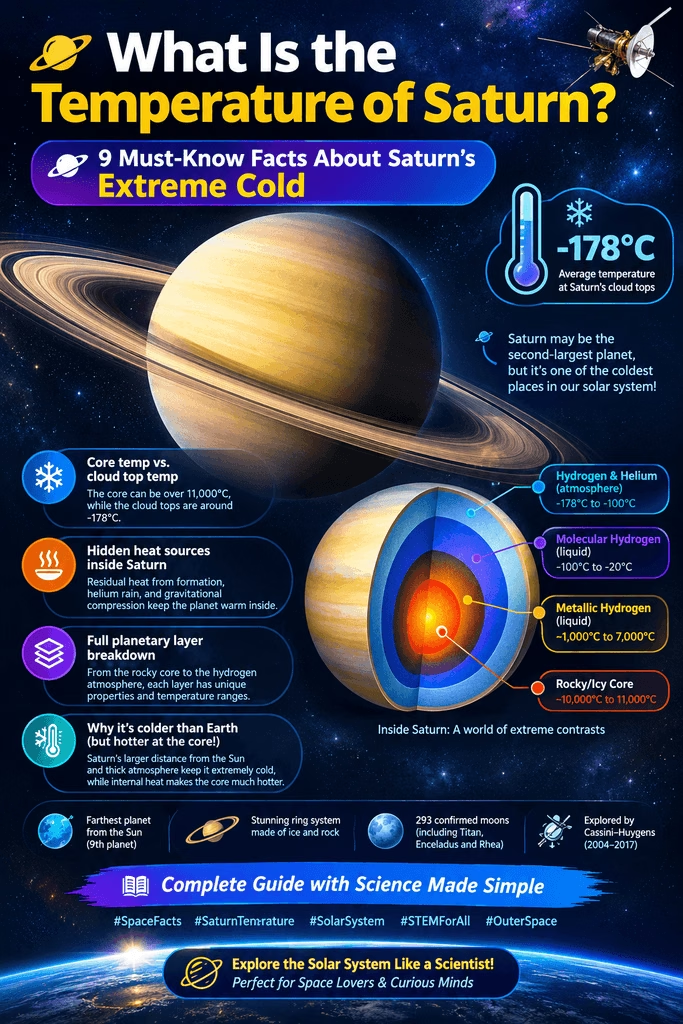
Saturn is one of the most fascinating planets in the Solar System. Known for its spectacular ring system, enormous size, and many moons, Saturn is also an unusual world when it comes to temperature. Unlike Earth, Saturn does not have a solid surface where scientists can record a single surface temperature. Instead, its atmosphere extends through different layers, and temperatures change significantly with altitude and depth.
The temperature of Saturn is extremely cold in its upper atmosphere, while deeper regions become progressively warmer because of increasing pressure and the planet’s internal heat. At the cloud tops, temperatures can fall to approximately −178°C (−288°F). However, this value represents conditions near the visible cloud layer rather than a solid planetary surface.
Saturn’s atmospheric temperature is influenced by several factors, including its enormous distance from the Sun, atmospheric composition, internal heat, pressure, altitude, and seasonal changes. Understanding these factors helps scientists learn more about Saturn’s structure and the behavior of giant planets.
In this article, we will explore how cold Saturn is, why it has such low temperatures, how temperature changes through its atmosphere, how Saturn compares with other planets, and what spacecraft observations have revealed about this distant gas giant.
Read More: Saturn from Earth: Distance, Closest Approach, Farthest Point & Complete Guide
What Is the Temperature of Saturn?
The temperature of Saturn varies depending on the location and atmospheric depth being measured. Near the visible cloud tops, the temperature is approximately −178°C (−288°F). Because Saturn is a gas giant, however, it does not have a conventional solid surface like Earth or Mars.
The temperature increases as you move deeper into Saturn’s atmosphere. Pressure also rises dramatically with depth. Eventually, gases become compressed into extremely dense fluids, and conditions become vastly different from those near the upper clouds.
Scientists often refer to the temperature near Saturn’s cloud tops when discussing the planet’s general temperature. These upper atmospheric temperatures are exceptionally low because Saturn receives only a small amount of sunlight compared with planets closer to the Sun.
An important point is that Saturn is not simply a cold planet. It also produces and releases considerable internal heat. In fact, Saturn emits more energy into space than it receives from the Sun. This internal energy plays an important role in its atmospheric temperature and weather.
Read More: How Far Is Saturn from the Sun? Distance, Orbit, and Fascinating Facts
1. Why Is Saturn So Cold?
Saturn is located approximately 1.4 billion kilometers (886 million miles) from the Sun on average. Because sunlight becomes weaker as distance from the Sun increases, Saturn receives much less solar energy than Earth.
The amount of solar radiation reaching a planet decreases according to the inverse-square relationship:
I∝1r2I \propto \frac{1}{r^2}
where:
- II represents the intensity of sunlight.
- rr represents the distance from the Sun.
Because Saturn is much farther from the Sun than Earth, the sunlight available to warm its atmosphere is considerably weaker.
Earth receives abundant solar radiation, allowing its surface and atmosphere to maintain temperatures suitable for liquid water and life. Saturn, by contrast, receives only a fraction of that energy.
However, distance from the Sun is only part of the explanation. Saturn also has a thick atmosphere composed mainly of hydrogen and helium. The atmosphere contains trace amounts of methane, ammonia, water vapor, and other compounds. These gases influence how energy is absorbed, transported, and emitted.
Saturn’s internal heat is therefore an essential part of the overall temperature story.
Read More: How Many Rings Does Saturn Have? 9 Fascinating Facts About Saturn’s Ring System
2. Saturn Has No Solid Surface Temperature
When people ask about the temperature of Saturn, they may imagine a thermometer measuring the ground of the planet. That comparison does not work for Saturn because the planet is a gas giant.
Saturn consists primarily of hydrogen and helium. There is no solid surface similar to Earth’s continents or Mars’s rocky terrain.
Instead, atmospheric pressure and density gradually increase as you descend. The distinction between atmosphere and deeper material becomes increasingly complex.
Scientists therefore describe Saturn’s temperature at specific pressure levels or atmospheric altitudes rather than referring to one universal surface temperature.
The visible clouds provide a useful reference point. These clouds are located high in Saturn’s atmosphere, where temperatures are extremely low.
Deeper inside the planet, pressure rises enormously and temperatures increase substantially. Eventually, hydrogen enters unusual physical states under the extreme pressure and temperature found inside Saturn.
This means that saying “Saturn is −178°C” is useful as a general description of its upper cloud temperatures, but it does not describe the temperature throughout the entire planet.
Read More: How Many Moons Does Saturn Have? 293 Confirmed Moons and Their Fascinating World
3. Temperature at Saturn’s Cloud Tops
The visible upper atmosphere of Saturn is extremely cold. Temperatures around −178°C are commonly associated with the planet’s cloud-top region.
These clouds are not necessarily made of the same substances at every altitude. Saturn’s atmosphere contains several layers of clouds, with ammonia ice clouds occurring high in the atmosphere and other compounds appearing deeper down.
The low temperature allows ammonia and other substances to exist in condensed or frozen forms at appropriate atmospheric levels.
Saturn’s cloud tops also display enormous weather systems. Winds can reach speeds of approximately 1,800 km/h (1,100 mph) in some regions, making Saturn one of the windiest planets in the Solar System.
Temperature differences across the atmosphere contribute to atmospheric circulation. Energy is transported through convection, radiation, and large-scale atmospheric movements.
These processes create bands, storms, jet streams, and other features that can be observed from Earth and by spacecraft.
Read More: The Ultimate Guide To X-Ray Production And Modern Use In Diagnosis
4. Temperature Increases Deeper Inside Saturn
One of the most important characteristics of Saturn is that its temperature rises significantly with depth.
As you move downward through the atmosphere:
- Pressure increases.
- Gas becomes increasingly compressed.
- Density rises.
- Temperature increases.
- Hydrogen undergoes changes in its physical behavior.
The exact temperature at a particular depth depends on pressure and the physical model used to describe Saturn’s interior.
Deep inside the planet, temperatures can reach thousands of degrees Celsius. These extreme temperatures are very different from the frigid conditions at the cloud tops.
The increase is partly related to compression and partly to Saturn’s internal energy.
Imagine descending into an enormous atmosphere. The material above you becomes heavier, producing increasing pressure. The gases are compressed, and the environment becomes hotter.
Eventually, the simple description of hydrogen and helium as ordinary gases no longer applies.
Read More: What Is a CT Scan? Understanding Its Uses, Benefits, and Risks
5. Saturn Produces Internal Heat
One of the most interesting facts about Saturn is that it radiates more energy than it receives from the Sun.
This means that sunlight alone cannot explain all of the energy Saturn emits into space.
A major source of Saturn’s internal heat is believed to be gravitational contraction. As Saturn slowly contracts under its own gravity, gravitational potential energy is converted into thermal energy.
Another important process is called helium rain.
Saturn’s interior contains hydrogen and helium under enormous pressure. Under certain conditions, helium can separate from hydrogen and form droplets that sink deeper into the planet. As these helium droplets move downward through Saturn’s interior, gravitational energy is released as heat.
This process contributes to Saturn’s internal energy budget.
The presence of internal heat helps explain why the planet continues to radiate substantial energy despite receiving relatively weak sunlight.
Read More: Stars The Cosmic Kitchen: Birth and Death Explained
6. How Does Saturn’s Distance From the Sun Affect Its Temperature?
Distance from the Sun has a major effect on Saturn’s external energy supply.
Saturn orbits the Sun at an average distance of approximately 9.5 astronomical units (AU). One astronomical unit is the average distance between Earth and the Sun.
Because Saturn is so far away, sunlight reaching it is much weaker than sunlight reaching Earth.
The amount of solar energy received by Saturn varies throughout its orbit because its orbit is slightly elliptical. Saturn is somewhat closer to the Sun at perihelion and farther away at aphelion.
However, Saturn’s atmosphere and internal heat make its temperature behavior more complicated than simply calculating the amount of sunlight received.
Solar radiation warms the upper atmosphere, while internal energy moves outward from the planet’s interior.
The balance between these energy sources affects Saturn’s atmospheric structure.
7. Saturn’s Atmospheric Composition and Temperature
Saturn’s atmosphere is composed primarily of hydrogen and helium.
Hydrogen makes up the largest portion, while helium is the second-largest component. Smaller quantities of methane, ammonia, water vapor, phosphine, and other compounds are also present.
These gases influence Saturn’s appearance and thermal behavior.
Methane, for example, absorbs particular wavelengths of light and contributes to Saturn’s atmospheric appearance. Ammonia contributes to the formation of high-altitude clouds.
The atmosphere also plays a major role in transporting energy.
Warm material can rise through convection, while cooler material can descend. Radiation allows energy to escape into space.
Together, these processes create a complex thermal environment.
Because the atmosphere is so deep, temperature cannot be described with one number. Instead, scientists construct temperature profiles showing how temperature changes with altitude and pressure.
These profiles provide important information about atmospheric dynamics and planetary structure.
8. Saturn’s Temperature Compared With Earth
Comparing Saturn with Earth demonstrates how dramatically different planetary environments can be.
Earth has a solid or liquid surface, while Saturn does not have a conventional solid surface. Earth’s average surface temperature is roughly 15°C (59°F), although actual temperatures vary enormously from place to place.
Saturn’s visible cloud tops are far colder, reaching approximately −178°C.
The reasons for this difference include:
- Saturn’s much greater distance from the Sun.
- Its lack of a solid surface.
- Its hydrogen-helium atmosphere.
- Its weak solar energy input.
- Its significant internal heat.
- Its enormous atmospheric depth.
Earth’s atmosphere also contains greenhouse gases that help regulate surface temperatures. Saturn’s atmosphere behaves differently because its composition, pressure, structure, and energy sources are fundamentally different.
Therefore, comparing an Earth surface temperature directly with Saturn’s cloud-top temperature should be done carefully.
9. How Does Saturn Compare With Other Giant Planets?
Saturn is one of four giant planets in the Solar System. The others are Jupiter, Uranus, and Neptune.
All four are significantly different from the terrestrial planets, but they also have important differences among themselves.
Jupiter
Jupiter is closer to the Sun than Saturn and receives more solar energy. Its upper atmosphere is also extremely cold, although internal heat contributes significantly to its energy output.
Uranus
Uranus is much farther from the Sun and has very cold upper atmospheric temperatures. Its atmosphere can reach temperatures below −200°C in some regions.
Neptune
Neptune is even farther from the Sun, yet it also emits significant internal heat. Its atmosphere is extremely cold and contains some of the fastest winds known in the Solar System.
Saturn
Saturn lies between Jupiter and Uranus in distance from the Sun. Its cloud tops are around −178°C, but temperatures rise dramatically toward its interior.
These comparisons show why distance alone cannot determine a planet’s complete thermal environment.
Temperature of Saturn at Different Atmospheric Levels
Scientists study temperature at different pressure levels rather than treating Saturn as having a single temperature.
A simplified description looks like this:
| Region | General Thermal Condition |
| Upper atmosphere | Extremely cold |
| Visible cloud region | Around −178°C |
| Deeper atmosphere | Temperature increases |
| High-pressure interior | Thousands of degrees Celsius |
| Deep interior | Extremely hot and highly compressed |
These values should be considered approximate because Saturn does not have sharply defined boundaries between atmospheric layers.
The deeper scientists go, the more extreme pressure and temperature become.
Does Saturn Have Seasons?
Yes. Saturn experiences seasons because its rotational axis is tilted by approximately 26.7 degrees relative to the plane of its orbit.
This tilt is similar to Earth’s axial tilt, although Saturn takes much longer to complete one orbit around the Sun.
A Saturnian year lasts approximately 29.5 Earth years.
As Saturn travels around the Sun, different hemispheres receive different amounts of sunlight at different times. This produces seasonal changes in atmospheric conditions.
However, Saturn’s enormous atmosphere responds differently from Earth’s surface environment.
Seasonal changes can affect cloud patterns, temperatures, circulation, and atmospheric chemistry.
Because Saturn’s year is so long, scientists can observe only a limited portion of a complete seasonal cycle during relatively short spacecraft missions.
Long-term observations are therefore especially valuable for understanding Saturn’s climate.
How Scientists Measure Saturn’s Temperature
Scientists cannot simply place a conventional thermometer on Saturn. Instead, they use remote sensing, spectroscopy, radio measurements, spacecraft instruments, and atmospheric models.
One important technique is infrared observation.
Every object with a temperature above absolute zero emits electromagnetic radiation. The characteristics of this radiation provide information about temperature.
Saturn’s thermal emission can therefore be observed using infrared instruments.
Spacecraft have provided particularly valuable measurements. The Cassini spacecraft, operated by NASA, ESA, and the Italian Space Agency, spent more than 13 years studying Saturn and its system.
Cassini carried instruments capable of examining Saturn’s atmosphere, temperature structure, clouds, storms, and thermal radiation.
Scientists combine spacecraft observations with Earth-based telescopic observations and computer models.
This approach allows them to construct detailed atmospheric temperature profiles.
Saturn’s Polar Regions and Unusual Atmospheric Temperatures
Saturn’s poles contain some remarkable atmospheric features.
The north pole is famous for its hexagonal jet stream, a persistent six-sided atmospheric pattern surrounding the polar region.
This structure is not a solid object. It is a massive atmospheric wave associated with Saturn’s powerful winds.
Saturn’s polar atmosphere also exhibits unusual temperature patterns.
Infrared observations have revealed thermal differences associated with the polar regions and seasonal changes.
Saturn’s south pole contains a large, persistent storm system. The polar atmosphere is therefore an important area for studying how temperature, pressure, winds, and chemistry interact.
These phenomena demonstrate that temperature is closely connected with Saturn’s atmospheric dynamics.
Why Is Saturn’s Interior So Hot?
The enormous temperature inside Saturn results from several physical processes.
First, Saturn contains a tremendous amount of mass. Its powerful gravity compresses material toward the center.
Second, gravitational contraction releases energy.
Third, helium separation and helium rain may release additional gravitational energy.
As material moves deeper into the planet, pressure increases enormously. The interior therefore becomes a region of extremely high pressure and temperature.
Scientists believe Saturn has a dense central region surrounded by layers of metallic and molecular hydrogen.
Under sufficiently high pressures, hydrogen can behave very differently from hydrogen gas at Earth’s surface.
The interior is therefore one of the most extreme environments in the Solar System.
Does Saturn Have the Coldest Temperature in the Solar System?
No.
Saturn is extremely cold in its upper atmosphere, but it is not the planet with the lowest recorded atmospheric temperatures.
Uranus has some of the coldest planetary atmospheric temperatures measured in the Solar System, with temperatures dropping to approximately −224°C (−371°F) in parts of its atmosphere.
Saturn’s cloud-top temperatures are generally warmer than those extreme values.
Interestingly, Uranus and Neptune are both farther from the Sun than Saturn, while their atmospheric behavior also depends strongly on internal heat and atmospheric circulation.
This demonstrates that planetary temperature cannot be determined by distance from the Sun alone.
What Is the Temperature of Saturn’s Rings?
Saturn’s rings are not part of the planet’s atmosphere. They consist primarily of particles of water ice, with smaller amounts of rocky and dusty material.
Because the rings are exposed to sunlight and Saturn’s environment, their temperatures vary depending on location, illumination, particle size, and other factors.
Ring particles can become extremely cold when they are not illuminated by sunlight.
Measurements from spacecraft have helped scientists understand the thermal behavior of these particles.
The rings therefore have their own temperature environment, separate from the atmosphere of Saturn itself.
Saturn’s Temperature and Atmospheric Storms
Temperature differences are important for understanding Saturn’s powerful storms.
The planet experiences enormous atmospheric disturbances, including long-lived storms and periodic giant storms known as Great White Spots.
These storms can spread across large portions of the planet.
Energy released from deeper atmospheric layers can help drive convection. Rising material interacts with surrounding gases, producing clouds and turbulent structures.
Temperature variations therefore influence the movement of gases and the development of storms.
Saturn’s powerful winds and atmospheric bands are evidence that energy is constantly being redistributed through its atmosphere.
The Role of Infrared Radiation
Infrared radiation is especially important when scientists study Saturn’s temperature.
Visible-light images show the planet’s clouds and atmospheric patterns, but infrared observations can reveal thermal information that is invisible to the human eye.
Different infrared wavelengths can probe different atmospheric depths.
By analyzing these wavelengths, researchers can determine how temperature varies across Saturn.
Infrared observations can also reveal thermal anomalies associated with storms, seasonal changes, and polar atmospheric features.
This makes infrared astronomy an essential tool for planetary science.
What Did the Cassini Mission Teach Scientists?
The Cassini mission dramatically expanded scientific knowledge of Saturn.
Cassini entered orbit around Saturn in 2004 and continued its mission until 2017, when it deliberately entered Saturn’s atmosphere.
During its mission, Cassini studied the planet’s atmosphere, rings, moons, magnetosphere, and internal structure.
The spacecraft observed enormous storms, atmospheric waves, seasonal changes, and thermal patterns.
Its observations helped scientists investigate how Saturn transports energy from its interior to its atmosphere.
Cassini also provided information about Saturn’s rings and moons, making the mission one of the most important planetary exploration projects ever conducted.
The spacecraft’s final phase, known as the Grand Finale, involved repeated dives between Saturn and its innermost rings.
These measurements provided additional information about Saturn’s gravity field, atmosphere, rings, and interior.
Why Understanding Saturn’s Temperature Matters
Studying Saturn’s thermal environment is not simply about determining whether the planet is cold or hot.
Temperature provides clues about the planet’s formation, composition, atmospheric circulation, and internal structure.
Scientists can use temperature measurements to investigate:
- Atmospheric composition.
- Cloud formation.
- Wind patterns.
- Internal heat.
- Seasonal changes.
- Storm development.
- Planetary evolution.
- Interior structure.
- Energy transport.
These investigations also help scientists understand giant exoplanets orbiting other stars.
Many exoplanets are gas giants, and researchers can compare them with Jupiter and Saturn to better understand how large planets form and evolve.
Frequently Asked Questions (FAQ)
What is the average temperature of Saturn?
The commonly cited temperature near Saturn’s visible cloud tops is approximately −178°C (−288°F). However, Saturn does not have a solid surface, so there is no single average surface temperature comparable to Earth’s.
Why is Saturn so cold?
Saturn is cold near its cloud tops primarily because it is far from the Sun and receives relatively little solar energy. Its upper atmosphere is also affected by atmospheric composition and energy balance.
Is Saturn colder than Earth?
Yes. The visible cloud tops of Saturn are vastly colder than Earth’s average surface temperature. Saturn’s upper atmosphere is approximately −178°C in the cloud-top region.
Is Saturn completely cold?
No. Although the upper atmosphere is extremely cold, Saturn’s interior is extraordinarily hot. Temperatures increase dramatically with depth because of pressure, compression, and internal energy.
Does Saturn have a solid surface?
No. Saturn is a gas giant and does not have a conventional solid surface. Its atmosphere gradually becomes denser and more compressed as you move toward the interior.
What is the temperature inside Saturn?
The deep interior of Saturn reaches temperatures of thousands of degrees Celsius. Exact values vary according to the depth and the interior model being considered.
Why does Saturn produce internal heat?
Saturn releases internal heat partly because of gravitational contraction. The separation of helium from hydrogen and the resulting downward movement of helium may also contribute to its internal energy.
Does Saturn have seasons?
Yes. Saturn has seasons because its rotational axis is tilted by approximately 26.7 degrees. Its long orbital period means that each season lasts several Earth years.
Which is colder, Saturn or Uranus?
Uranus has lower atmospheric temperatures in some regions. Temperatures there can fall below −200°C, making its atmosphere colder than Saturn’s cloud tops.
Can humans survive on Saturn?
No. Saturn has no solid surface suitable for humans, and its atmosphere contains no breathable oxygen. The planet also has extreme cold, enormous pressure at depth, powerful winds, and increasingly intense temperatures farther inside.
Key Takeaways About Saturn’s Temperature
The temperature of Saturn is much more complicated than a single number.
Here are the most important facts to remember:
- Saturn is a gas giant, so it has no conventional solid surface.
- Its visible cloud tops have temperatures of approximately −178°C (−288°F).
- Saturn receives much less sunlight than Earth because it is about 9.5 AU from the Sun.
- Temperature increases substantially as you descend into the atmosphere.
- Saturn’s deep interior reaches thousands of degrees Celsius.
- The planet releases more energy than it receives from sunlight.
- Gravitational contraction contributes to Saturn’s internal heat.
- Helium separation and helium rain may provide additional internal energy.
- Saturn’s axial tilt produces long seasonal changes.
- Infrared observations and spacecraft measurements help scientists study its thermal structure.
- The Cassini mission provided extensive information about Saturn’s atmosphere and internal processes.
- Saturn’s temperature profile helps scientists understand gas giants throughout the Solar System and beyond.
Conclusion
The temperature of Saturn reveals much more than simply how cold the planet appears from Earth. Its cloud tops are extraordinarily cold, with temperatures around −178°C, but this represents only a small portion of a much larger and more complex thermal system.
Unlike Earth, Saturn has no solid surface. Its atmosphere becomes progressively denser and hotter with increasing depth, eventually reaching thousands of degrees Celsius in the deep interior. At the same time, Saturn emits substantial internal heat, which cannot be explained by sunlight alone.
Its enormous distance from the Sun explains why its upper atmosphere receives relatively little solar energy, while gravitational contraction and other internal processes help supply energy from within. Seasonal changes, atmospheric circulation, storms, clouds, and powerful winds further complicate Saturn’s thermal environment.
Spacecraft such as Cassini have allowed scientists to examine these processes in remarkable detail. By studying Saturn’s temperature structure, researchers can better understand how giant planets form, evolve, and transport energy.
Ultimately, Saturn demonstrates that a planet can be both extremely cold near its cloud tops and extraordinarily hot deep inside. Its temperature profile is a fascinating example of how distance from a star, atmospheric composition, gravity, pressure, internal heat, and planetary dynamics work together to shape a world.