
What Is Inorganic Chemistry? 11 Essential Concepts, Types, Reactions & Applications
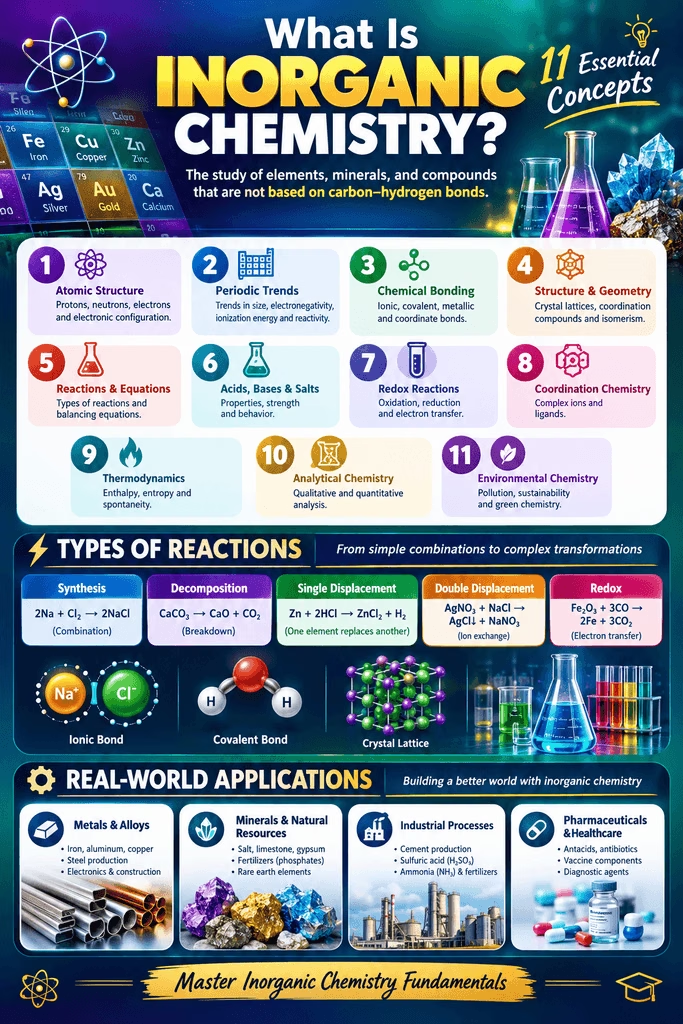
Inorganic chemistry is a major branch of chemistry that focuses on the study of inorganic substances, their structures, properties, reactions, preparation, and applications. It covers an enormous range of materials, from simple salts and minerals to metals, coordination compounds, catalysts, ceramics, semiconductors, and many industrially important substances.
Although the name may suggest that this field deals only with substances that are not associated with living organisms, its scope is much broader. In reality, there is considerable overlap between inorganic chemistry, biology, materials science, environmental science, medicine, physics, and engineering.
Understanding this subject provides a foundation for explaining how metals react, why crystals have particular structures, how catalysts work, why certain compounds display vivid colors, and how materials used in electronics, construction, energy storage, and medicine are produced.
Read More: What Is Organic Chemistry? 11 Essential Concepts, Types, Reactions & Applications
What Is Inorganic Chemistry?
Inorganic chemistry is the branch of chemistry concerned primarily with elements and compounds that are not classified as organic compounds. It traditionally includes metals, minerals, salts, coordination compounds, acids, bases, oxides, and many other substances.
Organic chemistry traditionally emphasizes carbon-containing compounds, particularly those containing carbon–hydrogen bonds. In contrast, inorganic chemistry covers most of the remaining elements and a vast range of compounds.
However, the distinction is not completely absolute. Some carbon-containing substances, such as carbon dioxide, carbon monoxide, carbonates, bicarbonates, carbides, and cyanides, are generally studied within inorganic chemistry despite containing carbon.
The field therefore cannot be defined simply as the “chemistry without carbon.” Instead, it is better understood as the systematic study of the chemistry of the elements and their compounds, especially substances outside the conventional scope of organic chemistry.
Read More: How to Calculate Moles in Chemistry: Formula, Methods, Examples & Tips
Why Is Inorganic Chemistry Important?
The importance of this subject comes from the extraordinary variety of substances it examines. Many materials used in everyday life depend directly on inorganic compounds.
For example, common table salt is sodium chloride, a simple ionic compound. Cement contains several important inorganic materials, while glass is primarily made from inorganic substances based on silicates. Metals such as iron, copper, aluminum, and titanium are studied extensively because of their chemical and physical properties.
Inorganic compounds are also essential in:
- Agriculture and fertilizers
- Medicine and pharmaceuticals
- Construction materials
- Batteries and energy storage
- Electronics and semiconductors
- Catalysis
- Water treatment
- Environmental protection
- Metallurgy
- Nanotechnology
- Industrial manufacturing
The field also helps scientists design new materials with specific electrical, magnetic, optical, mechanical, or catalytic properties.
Read More: The Powerful Role of Conjugate Acid-Base Pairs in Chemistry
Historical Development of Inorganic Chemistry
The roots of this field extend back thousands of years because humans have always interacted with minerals, metals, salts, and other inorganic materials.
Ancient civilizations learned to extract metals from ores and use substances such as copper, iron, gold, silver, and mercury. They also developed methods for producing glass, ceramics, pigments, and building materials.
Modern chemistry developed rapidly during the eighteenth and nineteenth centuries. Scientists began identifying elements, determining their atomic masses, studying chemical reactions, and developing systematic ways to classify substances.
The development of the periodic table provided an especially important framework. It revealed relationships between elements and helped chemists predict their properties and reactions.
During the twentieth century, the field expanded dramatically. Scientists developed coordination chemistry, solid-state chemistry, organometallic chemistry, bioinorganic chemistry, and materials chemistry. Modern research now includes advanced computational methods, nanomaterials, renewable energy technologies, and molecular design.
Major Areas of Inorganic Chemistry
The subject contains several specialized areas. Each focuses on particular types of substances, structures, or chemical behavior.
1. Coordination Chemistry
Coordination chemistry studies compounds in which a central metal atom or ion is surrounded by molecules or ions called ligands.
A typical coordination compound can be represented as:
[M(L)ₙ]
Here, M represents the central metal, L represents a ligand, and n indicates the number of ligands attached to the metal.
For example, the complex ion [Cu(NH₃)₄]²⁺ contains a copper ion coordinated with ammonia molecules.
Coordination compounds are important because their structures can strongly influence their color, magnetic behavior, stability, and chemical reactivity.
They have applications in medicine, catalysis, analytical chemistry, pigments, and industrial processes.
2. Organometallic Chemistry
Organometallic chemistry examines compounds containing direct bonds between metal atoms and carbon atoms.
These compounds occupy an interesting position between inorganic and organic chemistry. Examples include metal carbonyls and various transition-metal complexes used in catalysis.
Organometallic compounds are particularly important in industrial chemistry because many of them act as catalysts.
They are involved in processes used to manufacture polymers, pharmaceuticals, fuels, and other valuable chemicals.
3. Solid-State Chemistry
Solid-state chemistry focuses on the structures and properties of solid materials.
Scientists study substances such as ionic crystals, metals, ceramics, semiconductors, superconductors, and magnetic materials.
The arrangement of atoms or ions within a solid can determine its properties. A small change in crystal structure may produce significant differences in conductivity, hardness, color, or magnetic behavior.
Solid-state chemistry is therefore closely connected with materials science and modern technology.
4. Bioinorganic Chemistry
Bioinorganic chemistry explores the role of inorganic elements and compounds in biological systems.
Many biological processes depend on metal ions. Iron is essential for oxygen transport in hemoglobin, magnesium is important in chlorophyll, and zinc participates in the function of numerous enzymes.
Other metals, including copper, manganese, cobalt, and molybdenum, also play important biological roles.
Bioinorganic chemistry helps scientists understand these processes and contributes to the development of medicines, diagnostic methods, and nutritional treatments.
5. Descriptive Inorganic Chemistry
Descriptive chemistry focuses on the properties, structures, reactions, and compounds of the elements.
Scientists examine periodic trends and investigate how elements behave across the periodic table.
Important topics include atomic size, ionization energy, electronegativity, oxidation states, bonding, acidity, basicity, and chemical reactivity.
This area provides much of the foundation required for understanding more specialized branches.
Read More: A Beginner’s guide to the Periodic Table: Importance, Application, present days and history
Important Classes of Inorganic Compounds
A wide range of compounds falls within this field. Some of the most important classes are described below.
Acids
Acids are substances capable of donating protons in the Brønsted–Lowry model.
Hydrochloric acid, nitric acid, sulfuric acid, and phosphoric acid are important inorganic acids.
For example:
HCl → H⁺ + Cl⁻
Acids have applications in laboratories, industry, mineral processing, fertilizer production, and chemical manufacturing.
Bases
Bases can accept protons or produce hydroxide ions in aqueous solution, depending on the definition being used.
Sodium hydroxide and calcium hydroxide are common inorganic bases.
A familiar neutralization reaction is:
HCl + NaOH → NaCl + H₂O
This reaction produces salt and water.
Salts
Salts are ionic compounds formed from positively and negatively charged ions.
Sodium chloride is one of the most familiar examples.
Other important salts include potassium nitrate, calcium carbonate, copper sulfate, and ammonium chloride.
Salts are widely used in agriculture, food processing, medicine, water treatment, and industrial chemistry.
Oxides
Oxides are compounds containing oxygen combined with another element.
Examples include:
- Magnesium oxide
- Calcium oxide
- Aluminum oxide
- Silicon dioxide
- Iron oxides
Their properties vary greatly. Some oxides are basic, some are acidic, and others are amphoteric.
Silicon dioxide, for instance, is an important component of glass and many mineral materials.
Hydroxides
Hydroxides contain the hydroxide ion, OH⁻.
Examples include sodium hydroxide, potassium hydroxide, and calcium hydroxide.
These compounds are important in industrial manufacturing, cleaning products, construction, water treatment, and chemical synthesis.
Read More: Is AP Chemistry Hard? 7 Encouraging Facts That Make It Easier to Master
Chemical Bonding in Inorganic Compounds
Chemical bonding is central to understanding the structure and behavior of inorganic substances.
Ionic Bonding
Ionic bonding generally occurs when electrons are transferred between atoms, producing positively and negatively charged ions.
For example, sodium can lose one electron to form Na⁺, while chlorine can gain one electron to form Cl⁻.
The electrostatic attraction between these ions produces sodium chloride.
Ionic compounds often have high melting points and form crystalline solids.
Covalent Bonding
Covalent bonding involves the sharing of electrons between atoms.
Many inorganic molecules contain covalent bonds. Water, ammonia, carbon dioxide, and sulfur dioxide are examples of compounds containing covalent bonding.
Covalent bonding can produce molecules, networks, or extended structures depending on the arrangement of atoms.
Metallic Bonding
Metallic bonding is associated with metals. In the simplified model, metal atoms contribute electrons to a delocalized system that allows electrons to move throughout the structure.
This helps explain properties such as electrical conductivity, thermal conductivity, and malleability.
Read More: What Is an Ideal Gas? 10 Remarkable Comprehensive Insights
The Role of the Periodic Table
The periodic table is one of the most important tools for understanding inorganic substances.
Elements arranged in the same group often display related chemical behavior because they have similar valence-electron configurations.
For example, alkali metals such as lithium, sodium, and potassium tend to form +1 ions. Halogens such as fluorine, chlorine, and bromine commonly form −1 ions.
Transition metals show more complex behavior. Many can exhibit multiple oxidation states and form numerous coordination compounds.
Periodic trends also help chemists predict atomic size, ionization energy, electronegativity, and reactivity.
Read More: What is Organic Chemistry? 10 Fascinating and Powerful Insights into Carbon-Based Science
Oxidation States and Redox Reactions
Oxidation states are extremely useful when analyzing inorganic compounds and reactions.
An oxidation state represents the apparent charge assigned to an atom under a particular bookkeeping convention.
For example, iron commonly occurs in the +2 and +3 oxidation states.
Redox reactions involve the transfer of electrons.
Oxidation refers to the loss of electrons, while reduction refers to the gain of electrons.
A useful memory aid is:
OIL RIG
- Oxidation Is Loss
- Reduction Is Gain
Redox chemistry is important in corrosion, batteries, metallurgy, electrochemistry, biological systems, and industrial processes.
Transition Metals
Transition metals form one of the most fascinating areas of inorganic chemistry.
Elements such as iron, copper, nickel, cobalt, chromium, manganese, and titanium can form a wide variety of compounds.
Many transition-metal compounds are colorful. Their colors often arise from electronic transitions involving partially filled d orbitals.
Transition metals can also exhibit multiple oxidation states.
For example, iron commonly occurs as Fe²⁺ and Fe³⁺, while manganese can exist in several oxidation states.
These characteristics make transition metals particularly useful in catalysis and materials science.
Read More: What is a Base in Chemistry: 15 Fascinating Insights That Make This a Powerful Guide
Catalysis and Inorganic Chemistry
Catalysts increase the rate of chemical reactions without being permanently consumed by the overall reaction.
Many important industrial catalysts are inorganic or contain metal centers.
Transition metals are particularly valuable because they can interact with reactants in different oxidation states and provide alternative reaction pathways.
Catalysts are used to produce:
- Fertilizers
- Fuels
- Plastics
- Pharmaceuticals
- Industrial chemicals
- Hydrogen
- Fine chemicals
For example, iron-based catalysts are used in ammonia production through the Haber–Bosch process.
Catalysis is one of the clearest examples of how fundamental chemical principles can be translated into large-scale industrial technology.
Applications in Medicine
Inorganic compounds have important medical applications.
Certain metal-containing compounds are used in cancer treatment, imaging, diagnostics, antimicrobial treatments, and nutritional supplementation.
Platinum-containing compounds, for example, have played a major role in cancer chemotherapy.
Metal ions are also essential biological nutrients. Iron is necessary for oxygen transport, while zinc is involved in numerous enzymes and biological processes.
However, metals can also become toxic at excessive concentrations. Understanding their chemical behavior is therefore essential for both medicine and environmental safety.
Applications in Agriculture
Agriculture depends on numerous inorganic substances.
Fertilizers supply essential nutrients such as nitrogen, phosphorus, and potassium.
Examples include:
- Ammonium compounds
- Nitrate salts
- Phosphate fertilizers
- Potassium salts
Plants require several mineral nutrients for healthy growth. If soil lacks a particular nutrient, appropriate fertilizers can help restore productivity.
Inorganic chemistry also contributes to soil analysis, water quality assessment, micronutrient management, and agricultural research.
Applications in Environmental Science
Environmental chemistry uses principles from inorganic chemistry to understand pollutants, minerals, water systems, and atmospheric substances.
Scientists study inorganic contaminants such as heavy metals, nitrates, phosphates, and certain metal ions.
For example, excessive phosphate and nitrate levels can contribute to eutrophication in aquatic ecosystems.
The chemical behavior of metals in soil and water also determines whether they remain immobilized or become available to organisms.
Understanding these processes helps scientists develop methods for pollution control and environmental remediation.
Applications in Energy Technology
Modern energy technology depends heavily on inorganic materials.
Batteries contain materials involving metals and metal ions. Lithium-ion batteries, for example, rely on the movement of lithium ions between electrode materials.
Fuel cells, solar cells, hydrogen technologies, and thermoelectric materials also involve important inorganic compounds.
Researchers are developing new electrode materials, catalysts, electrolytes, and semiconductor materials to improve energy efficiency and storage capacity.
As the world seeks cleaner energy technologies, the importance of advanced inorganic materials continues to increase.
Read More: What Is a Mole in Chemistry? 6 Mind-Blowing Facts & Easy Calculations
Inorganic Chemistry and Nanotechnology
Nanotechnology involves materials and structures with dimensions commonly measured on the nanometer scale.
Inorganic nanoparticles can possess properties that differ significantly from their bulk materials.
Examples include nanoparticles based on:
- Gold
- Silver
- Iron oxides
- Titanium dioxide
- Zinc oxide
Their optical, electrical, magnetic, catalytic, or antimicrobial properties can make them useful in medicine, electronics, environmental applications, coatings, and sensors.
The ability to control particle size and surface properties is therefore an important area of modern research.
Difference Between Organic and Inorganic Chemistry
Organic and inorganic chemistry are closely related but traditionally focus on different groups of substances.
| Feature | Organic Chemistry | Inorganic Chemistry |
| Main focus | Carbon-based compounds | Elements and compounds outside traditional organic chemistry |
| Common substances | Hydrocarbons, alcohols, polymers | Salts, metals, minerals, oxides |
| Important bonding | Covalent bonding | Ionic, covalent, metallic, and coordinate bonding |
| Major applications | Fuels, polymers, medicines | Materials, metals, catalysts, fertilizers |
| Key concepts | Functional groups and reaction mechanisms | Periodicity, oxidation states, coordination, crystal structures |
This distinction should not be considered absolute because the two fields overlap extensively.
For example, organometallic chemistry combines features of both areas, while biological systems contain both organic molecules and inorganic ions.
Inorganic Chemistry in Everyday Life
Although the subject may seem highly theoretical, it is present throughout everyday life.
Consider some familiar materials:
Table salt: Sodium chloride is an ionic compound.
Glass: Many types of glass are primarily based on silicate materials.
Cement: Its production involves several important inorganic compounds.
Metal objects: Iron, aluminum, copper, and other metals are central to modern infrastructure.
Fertilizers: Many agricultural fertilizers contain inorganic salts.
Batteries: Electrochemical cells depend on the behavior of ions and electrode materials.
Ceramics: Their properties arise from inorganic structures and bonding.
These examples demonstrate that the subject is closely connected with ordinary materials and technologies.
Experimental Techniques
Scientists use numerous techniques to investigate inorganic substances.
X-Ray Diffraction
X-ray diffraction can reveal the arrangement of atoms within crystalline materials.
It is particularly useful for determining crystal structures.
Spectroscopy
Different forms of spectroscopy provide information about electronic structures, bonding, molecular vibrations, and chemical environments.
Electron Microscopy
Electron microscopy can provide detailed information about the morphology and structure of materials at very small scales.
Thermal Analysis
Thermal techniques help researchers determine how substances behave when heated or cooled.
Together, these techniques allow scientists to understand the relationship between composition, structure, and properties.
Careers Related to Inorganic Chemistry
Students who develop an interest in this field can pursue careers in numerous areas.
Potential career paths include:
- Materials scientist
- Chemist
- Metallurgist
- Chemical engineer
- Environmental scientist
- Pharmaceutical researcher
- Nanotechnology researcher
- Battery scientist
- Academic researcher
- Industrial chemist
- Analytical chemist
Industries involving energy, pharmaceuticals, electronics, mining, construction, agriculture, and advanced materials all require professionals with strong chemical knowledge.
How to Study Inorganic Chemistry Effectively
Students can make this subject easier by developing a systematic approach.
First, learn the periodic table and understand important periodic trends. Memorization alone is less effective than understanding why properties change across periods and groups.
Second, become comfortable with oxidation states and chemical formulas.
Third, study chemical bonding carefully because bonding explains many physical and chemical properties.
Fourth, practice balancing equations and identifying oxidation and reduction.
Fifth, learn common ions, acids, bases, salts, and coordination compounds.
Finally, connect theoretical concepts with real-world examples. Understanding why a particular material is useful is often more memorable than simply memorizing its formula.
Future of Inorganic Chemistry
The future of this field is closely connected with technological development.
Researchers are investigating new materials for renewable energy, carbon capture, hydrogen production, advanced batteries, semiconductors, catalysts, sensors, and medical applications.
One important direction is the development of materials that use abundant and environmentally friendly elements rather than scarce or expensive resources.
Another major area is sustainable chemistry. Scientists are working to reduce energy consumption, minimize waste, improve catalytic efficiency, and develop recyclable materials.
Artificial intelligence and computational chemistry are also increasingly helping researchers predict material properties and identify promising compounds.
These developments are likely to expand the boundaries of the field even further.
Frequently Asked Questions (FAQ)
What is inorganic chemistry in simple words?
Inorganic chemistry is the branch of chemistry that studies elements and compounds that are generally outside the traditional scope of organic chemistry. It includes metals, salts, minerals, oxides, coordination compounds, and many other materials.
What are examples of inorganic compounds?
Common examples include sodium chloride, calcium carbonate, magnesium oxide, sulfuric acid, sodium hydroxide, copper sulfate, silicon dioxide, and many metal oxides.
Is carbon studied in inorganic chemistry?
Yes. Although carbon is strongly associated with organic chemistry, several carbon-containing substances are commonly treated as inorganic compounds. Examples include carbon dioxide, carbon monoxide, carbonates, bicarbonates, carbides, and cyanides.
What are the main branches of inorganic chemistry?
Important areas include coordination chemistry, organometallic chemistry, solid-state chemistry, bioinorganic chemistry, descriptive chemistry, and materials chemistry.
Why is inorganic chemistry important?
It helps scientists understand and develop metals, minerals, catalysts, ceramics, semiconductors, batteries, fertilizers, medicines, and many other materials essential to modern society.
What is the difference between organic and inorganic chemistry?
Organic chemistry primarily studies carbon-based compounds, especially those containing carbon–hydrogen bonds. Inorganic chemistry focuses mainly on metals, minerals, salts, coordination compounds, and other substances outside the traditional organic category.
What are coordination compounds?
Coordination compounds contain a central metal atom or ion surrounded by molecules or ions called ligands. Their structures and electronic properties give them many applications in medicine, catalysis, pigments, and industrial chemistry.
How does inorganic chemistry relate to biology?
Biological systems depend on many inorganic elements and ions. Iron, magnesium, zinc, copper, manganese, cobalt, and other elements participate in essential biological processes.
What industries use inorganic chemistry?
The principles are used in agriculture, pharmaceuticals, energy, electronics, mining, metallurgy, construction, environmental science, materials manufacturing, and chemical production.
Is inorganic chemistry difficult to study?
It can seem challenging because it covers many elements, compounds, structures, reactions, and trends. However, understanding periodic patterns, bonding, oxidation states, and chemical principles makes the subject much easier to organize and remember.
Conclusion
Inorganic chemistry is a broad and essential branch of chemistry that explores the properties, structures, reactions, and applications of elements and their compounds. From simple salts and minerals to advanced catalysts, semiconductors, nanoparticles, batteries, and medical compounds, its influence extends across science, technology, industry, and everyday life.
The subject provides a framework for understanding why metals display particular properties, how ionic and covalent compounds form, why transition-metal compounds can have different colors, how catalysts accelerate reactions, and how advanced materials can be designed for specific purposes.
Its importance is likely to grow as scientists search for cleaner energy technologies, sustainable materials, improved medicines, efficient catalysts, and environmentally responsible industrial processes.
For students, learning the periodic table, chemical bonding, oxidation states, coordination chemistry, and major classes of compounds provides a strong foundation. Once these concepts are connected with real-world applications, the subject becomes much more understandable and meaningful.
Ultimately, the study of substances is not limited to laboratories or textbooks. It helps explain many of the materials and technologies that make modern life possible, making this field one of the fundamental pillars of chemistry.