
What Is Organic Chemistry? 11 Essential Concepts, Types, Reactions & Applications
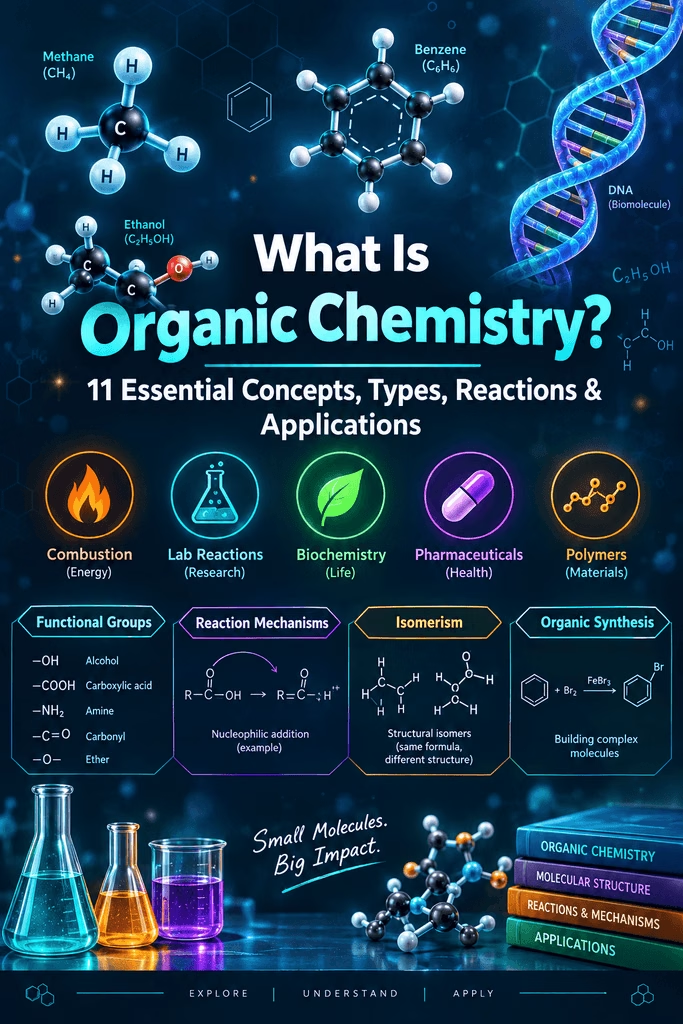
Organic chemistry is the branch of chemistry that studies carbon-containing compounds, particularly their structures, properties, reactions, preparation, and applications. Carbon is an extraordinary element because it can form strong covalent bonds with itself and with many other elements, including hydrogen, oxygen, nitrogen, sulfur, phosphorus, and halogens. This ability allows carbon to produce an enormous variety of compounds, ranging from simple molecules such as methane to complex substances such as proteins, carbohydrates, polymers, medicines, dyes, and DNA.
Understanding organic chemistry is essential for students of chemistry, biology, medicine, pharmacy, environmental science, materials science, and many engineering disciplines. It also helps explain many substances encountered in everyday life, including fuels, plastics, detergents, cosmetics, food components, medicines, and natural products.
Although the subject contains many structures and reactions, its fundamental ideas are logical. Once students understand carbon bonding, functional groups, nomenclature, isomerism, and reaction mechanisms, more advanced topics become much easier to understand.
This article explains what organic chemistry is, why carbon is so important, its major branches, important functional groups, types of reactions, applications, and practical examples.
Read More: How to Calculate Moles in Chemistry: Formula, Methods, Examples & Tips
What Is Organic Chemistry?
The simplest definition is that organic chemistry is the study of carbon-based compounds and the chemical reactions they undergo.
The term “organic” originally referred to substances obtained from living organisms. Early scientists believed that compounds produced by living organisms possessed a special “vital force” that could not be reproduced from inorganic substances.
This idea changed dramatically in the nineteenth century when Friedrich Wöhler synthesized urea from inorganic starting materials. His experiment demonstrated that a compound associated with living organisms could be produced from substances that were not obtained from a living organism.
Today, the definition is based primarily on chemical structure rather than biological origin. Most carbon-containing compounds are considered organic, although several simple carbon compounds are generally classified as inorganic. Examples include carbon monoxide, carbon dioxide, carbonates, bicarbonates, and certain metal carbides.
The field therefore covers an enormous range of molecules with different sizes, structures, and properties.
Read More: The Powerful Role of Conjugate Acid-Base Pairs in Chemistry
Why Is Carbon So Important?
Carbon is the central element of this field because of its unique chemical properties.
1. Carbon Forms Four Covalent Bonds
A carbon atom has four valence electrons. It can therefore form four covalent bonds with other atoms.
For example, methane has the formula:
CH4\mathrm{CH_4}
The carbon atom forms four single covalent bonds with four hydrogen atoms.
This ability gives carbon enormous structural flexibility.
2. Carbon Bonds With Other Carbon Atoms
Carbon can form strong carbon–carbon bonds. These bonds allow atoms to join together into chains, branches, and rings.
For example, propane contains three carbon atoms:
CH3CH2CH3\mathrm{CH_3CH_2CH_3}
Longer molecules can contain hundreds or even thousands of carbon atoms.
3. Carbon Forms Single, Double, and Triple Bonds
Carbon can form different types of covalent bonds.
A single bond contains one shared pair of electrons:
C−C\mathrm{C-C}
A double bond contains two shared pairs:
C=C\mathrm{C=C}
A triple bond contains three shared pairs:
C≡C\mathrm{C\equiv C}
These different bonding arrangements strongly influence the physical and chemical properties of compounds.
4. Carbon Forms Chains and Rings
Carbon atoms can connect to form straight chains, branched chains, and cyclic structures.
For example, hydrocarbons can have structures such as:
- Straight-chain structures
- Branched structures
- Ring structures
- Aromatic structures
This structural diversity is one of the main reasons millions of carbon compounds are known.
Read More: A Beginner’s guide to the Periodic Table: Importance, Application, present days and history
The Scope of Organic Chemistry
The subject is much broader than simply studying hydrocarbons. It includes compounds containing carbon together with many other elements.
Important areas include:
- Hydrocarbons
- Alcohols
- Ethers
- Aldehydes
- Ketones
- Carboxylic acids
- Esters
- Amines
- Amides
- Aromatic compounds
- Polymers
- Biomolecules
- Pharmaceuticals
- Natural products
A single molecule can contain several functional groups and may participate in multiple chemical reactions.
Read More: Is AP Chemistry Hard? 7 Encouraging Facts That Make It Easier to Master
Major Classes of Organic Compounds
Carbon compounds can be classified in several ways. One of the most useful methods is based on their structure and functional groups.
Hydrocarbons
Hydrocarbons contain only carbon and hydrogen.
They are divided into several major groups.
Alkanes
Alkanes contain only carbon–carbon single bonds.
The general formula for an open-chain alkane is:
CnH2n+2\mathrm{C_nH_{2n+2}}
Examples include:
- Methane, CH₄
- Ethane, C₂H₆
- Propane, C₃H₈
- Butane, C₄H₁₀
Alkanes are generally less reactive than compounds containing multiple bonds or reactive functional groups.
Alkenes
Alkenes contain at least one carbon–carbon double bond.
Their general formula for a compound with one double bond and no rings is:
CnH2n\mathrm{C_nH_{2n}}
Ethene is the simplest alkene:
CH2=CH2\mathrm{CH_2=CH_2}
Alkenes commonly undergo addition reactions.
Alkynes
Alkynes contain at least one carbon–carbon triple bond.
Their general formula for an acyclic compound containing one triple bond is:
CnH2n−2\mathrm{C_nH_{2n-2}}
Ethyne is the simplest alkyne:
HC≡CH\mathrm{HC\equiv CH}
The triple bond gives alkynes distinctive chemical behavior.
Aromatic Hydrocarbons
Aromatic compounds contain special cyclic systems with delocalized electrons. Benzene is the classic example:
C6H6\mathrm{C_6H_6}
Aromatic compounds are particularly important in pharmaceuticals, dyes, polymers, and industrial chemicals.
Read More: What Is an Ideal Gas? 10 Remarkable Comprehensive Insights
What Are Functional Groups?
A functional group is a specific group of atoms within a molecule that determines many of its characteristic chemical properties and reactions.
Functional groups allow chemists to classify compounds and predict how they are likely to react.
Some important functional groups are shown below.
| Functional group | General representation | Example |
| Hydroxyl | –OH | Ethanol |
| Carbonyl | >C=O | Aldehydes and ketones |
| Carboxyl | –COOH | Ethanoic acid |
| Amino | –NH₂ | Amines |
| Ester | –COOR | Ethyl ethanoate |
| Ether | –O– | Diethyl ether |
| Amide | –CONH₂ | Ethanamide |
| Halogen | –X | Chloroethane |
Alcohols
Alcohols contain a hydroxyl group attached to a carbon atom.
A common example is ethanol:
CH3CH2OH\mathrm{CH_3CH_2OH}
Ethanol is used as a solvent, fuel additive, disinfectant, and component of alcoholic beverages.
Aldehydes
Aldehydes contain a terminal carbonyl group.
Their general structure can be represented as:
R−CHO\mathrm{R-CHO}
Formaldehyde and ethanal are examples of aldehydes.
Ketones
Ketones contain a carbonyl group bonded to two carbon-containing groups.
Their general structure is:
R−CO−R′\mathrm{R-CO-R’}
Propanone, commonly called acetone, is a familiar ketone.
Carboxylic Acids
Carboxylic acids contain the carboxyl group:
−COOH\mathrm{-COOH}
Ethanoic acid, which is present in vinegar, is an important example.
Amines
Amines contain nitrogen atoms bonded to carbon and/or hydrogen.
A simple primary amine can be represented as:
R−NH2\mathrm{R-NH_2}
Amines are important in pharmaceuticals, dyes, biological molecules, and industrial chemicals.
Homologous Series
A homologous series is a family of organic compounds with the same functional group and general chemical formula, where successive members differ by a −CH2−\mathrm{-CH_2-} unit.
For example, the first four members of the alkane series are:
- Methane — CH₄
- Ethane — C₂H₆
- Propane — C₃H₈
- Butane — C₄H₁₀
Each successive member differs from the previous one by:
−CH2−\mathrm{-CH_2-}
Members of a homologous series generally have similar chemical properties but show gradual changes in physical properties such as boiling point and melting point.
Read More: What is Organic Chemistry? 10 Fascinating and Powerful Insights into Carbon-Based Science
Nomenclature in Organic Chemistry
Because carbon compounds can have extremely complicated structures, scientists need a systematic naming system.
The International Union of Pure and Applied Chemistry (IUPAC) provides internationally accepted rules for naming compounds.
For many simple compounds, naming involves several steps:
- Identify the longest carbon chain.
- Number the chain appropriately.
- Identify substituents.
- Identify the principal functional group.
- Assign appropriate prefixes and suffixes.
- Assemble the name according to IUPAC conventions.
For example, a two-carbon alcohol is named ethanol.
A three-carbon ketone is propanone.
Correct nomenclature is important because the name should communicate the structure of the compound.
Isomerism
Isomerism occurs when compounds have the same molecular formula but different arrangements of atoms.
For example, compounds may have the same molecular formula but different structures.
There are two broad categories:
- Structural isomerism
- Stereoisomerism
Structural Isomerism
Structural isomers have the same molecular formula but different atom-to-atom connections.
Types include:
- Chain isomerism
- Position isomerism
- Functional-group isomerism
For example, butane and 2-methylpropane have the same molecular formula:
C4H10\mathrm{C_4H_{10}}
However, their carbon skeletons are different.
Stereoisomerism
Stereoisomers have the same connectivity but differ in the three-dimensional arrangement of atoms.
Important types include:
- Geometrical isomerism
- Optical isomerism
Stereochemistry is particularly important in pharmaceutical science because two molecules with the same molecular formula and connectivity can interact differently with biological systems.
Important Types of Organic Reactions
Chemical reactions are central to organic chemistry. They allow one compound to be transformed into another.
Addition Reactions
Addition reactions commonly occur with alkenes and alkynes.
In an alkene addition reaction, atoms or groups are added across a carbon–carbon double bond.
For example:
CH2=CH2+H2→CH3CH3\mathrm{CH_2=CH_2 + H_2 \rightarrow CH_3CH_3}
Ethene reacts with hydrogen to form ethane.
Substitution Reactions
In substitution reactions, one atom or group is replaced by another.
For example, a halogenoalkane may undergo substitution with a nucleophile.
These reactions are important for preparing a wide range of organic compounds.
Elimination Reactions
Elimination reactions remove atoms or groups from a molecule and often produce a double bond.
For example, an alcohol can undergo dehydration to produce an alkene.
A simplified representation is:
Alcohol→Alkene+H2O\mathrm{Alcohol \rightarrow Alkene + H_2O}
Oxidation Reactions
Oxidation in carbon chemistry often involves increasing the number of bonds between carbon and oxygen or decreasing the number of carbon–hydrogen bonds.
For example, a primary alcohol can be oxidized to an aldehyde and, under suitable conditions, further to a carboxylic acid.
Primary alcohol→Aldehyde→Carboxylic acid\mathrm{Primary\ alcohol \rightarrow Aldehyde \rightarrow Carboxylic\ acid}
Reduction Reactions
Reduction generally involves increasing carbon–hydrogen bonding or decreasing carbon–oxygen bonding.
For example, an aldehyde can be reduced to a primary alcohol.
Aldehyde→Primary alcohol\mathrm{Aldehyde \rightarrow Primary\ alcohol}
Reaction Mechanisms
A reaction equation tells us what substances react and what products are formed. A reaction mechanism explains how the transformation occurs.
Mechanisms often involve the movement of electrons and the formation or breaking of chemical bonds.
Some important concepts include:
- Nucleophiles
- Electrophiles
- Free radicals
- Carbocations
- Curved-arrow notation
- Bond formation
- Bond cleavage
Understanding mechanisms allows chemists to predict products instead of simply memorizing reactions.
Nucleophiles and Electrophiles
A nucleophile is an electron-rich species that can donate an electron pair to form a covalent bond.
Examples include:
OH−\mathrm{OH^-}
and
NH3\mathrm{NH_3}
An electrophile is an electron-deficient species that can accept an electron pair.
Understanding the interaction between nucleophiles and electrophiles is essential for many substitution and addition reactions.
Acids and Bases in Organic Chemistry
Acid–base chemistry is also important in carbon-based reactions.
The Brønsted–Lowry definition describes:
- An acid as a proton donor
- A base as a proton acceptor
The acidity of an organic compound depends strongly on its molecular structure.
For example, carboxylic acids are generally more acidic than alcohols because their conjugate bases are stabilized by resonance.
Understanding acidity and basicity helps explain reaction pathways, product formation, and reaction conditions.
The Role of Resonance
Resonance describes situations where a molecule or ion cannot be adequately represented by a single Lewis structure.
Instead, several contributing structures can be drawn to represent electron delocalization.
Benzene is a classic example. Its electrons are delocalized over the ring, which contributes to its unusual stability.
Resonance is also important when explaining:
- Acidity
- Basicity
- Stability of intermediates
- Aromaticity
- Reaction mechanisms
Organic Chemistry and Biochemistry
There is a close relationship between organic chemistry and biochemistry.
Living organisms contain enormous numbers of carbon-based molecules.
Major biological molecules include:
Carbohydrates
Carbohydrates include glucose, fructose, starch, and cellulose.
Glucose has the molecular formula:
C6H12O6\mathrm{C_6H_{12}O_6}
Carbohydrates provide energy and contribute to structural materials in living organisms.
Lipids
Lipids include fats, oils, phospholipids, and steroids.
They are important for:
- Energy storage
- Cell membranes
- Hormone production
- Thermal insulation
Proteins
Proteins are polymers made from amino acids.
They perform numerous functions, including:
- Enzyme catalysis
- Transport
- Structural support
- Immune defense
- Cell signaling
Nucleic Acids
DNA and RNA are complex carbon-containing molecules that store and transmit biological information.
Their structures depend on interactions among nucleotides, sugars, phosphate groups, and nitrogen-containing bases.
Applications of Organic Chemistry
The knowledge developed through organic chemistry has applications in almost every major scientific and industrial field.
Medicine and Pharmaceuticals
Modern medicines depend heavily on carbon-based molecules.
Organic chemists help design, synthesize, modify, and analyze pharmaceutical compounds.
Examples of pharmaceutical applications include:
- Antibiotics
- Pain relievers
- Antiviral medicines
- Antihistamines
- Anesthetics
- Cancer treatments
Small changes to molecular structure can significantly alter the effectiveness, stability, absorption, or side effects of a drug.
Agriculture
Agricultural chemicals often depend on carbon-based molecules.
These include:
- Herbicides
- Insecticides
- Fungicides
- Plant-growth regulators
Organic chemistry helps scientists develop compounds that target pests while minimizing unwanted environmental effects.
Petroleum and Fuels
Crude oil contains many hydrocarbons.
Refining separates and processes these compounds into useful products such as:
- Petrol
- Diesel
- Kerosene
- Lubricants
- Petrochemical feedstocks
Understanding hydrocarbon structure and reactions is essential for fuel processing.
Plastics and Polymers
Many plastics are polymers made from organic molecules.
Examples include:
- Polyethylene
- Polypropylene
- Polyvinyl chloride
- Polystyrene
- Polyethylene terephthalate
Polymer chemistry allows scientists to design materials with particular properties, such as flexibility, strength, heat resistance, or chemical resistance.
Cosmetics and Personal-Care Products
Organic compounds are found in many cosmetics and personal-care products.
They may function as:
- Fragrances
- Solvents
- Emollients
- Preservatives
- Surfactants
- Colorants
The molecular properties of these ingredients influence texture, stability, odor, and performance.
Food Science
Many components of food are carbon-based compounds.
Organic chemistry helps explain:
- Flavor
- Aroma
- Food preservation
- Cooking reactions
- Fermentation
- Nutritional composition
The Maillard reaction, for example, involves complex chemical reactions between reducing sugars and amino compounds during heating. It contributes to the color and flavor of many cooked foods.
Organic Chemistry in Everyday Life
You encounter carbon compounds throughout the day.
The fuel used in a vehicle contains hydrocarbons. The plastic in a water bottle is made from polymers. Soap and detergents contain carbon-based molecules. Medicines contain organic compounds. Food contains carbohydrates, proteins, lipids, vitamins, and other carbon-containing substances.
Even the human body is largely built from carbon-based molecules.
This means the subject is not limited to laboratories. It provides a molecular explanation for many familiar materials and processes.
How to Study Organic Chemistry Effectively
Many students initially find this subject difficult because it involves numerous structures, names, reactions, and mechanisms. A systematic approach can make learning much easier.
Learn Bonding First
Before memorizing reactions, understand:
- Valence electrons
- Covalent bonding
- Electronegativity
- Bond polarity
- Molecular geometry
- Hybridization
These concepts provide the foundation for understanding molecular structure.
Master Functional Groups
Learn to recognize functional groups quickly.
When you see a structure, identify whether it contains an alcohol, alkene, carbonyl, carboxylic acid, amine, ester, or another functional group.
Practice Drawing Structures
Do not rely exclusively on molecular formulas.
Practice drawing:
- Structural formulas
- Condensed formulas
- Skeletal formulas
- Lewis structures
- Three-dimensional representations
Being able to move between different representations is an important skill.
Understand Reactions Instead of Memorizing Them
Rather than memorizing hundreds of isolated reactions, ask:
- Which functional group is reacting?
- Which bond is being broken?
- Which bond is being formed?
- Is the reaction an addition, substitution, elimination, oxidation, or reduction?
- Which species acts as the nucleophile or electrophile?
- What conditions are required?
This approach makes reaction patterns much easier to remember.
Practice Regularly
Regular practice is particularly important for nomenclature, structural formulas, isomerism, and reaction mechanisms.
Start with simple examples and gradually increase the difficulty.
Difference Between Organic and Inorganic Chemistry
Although the two areas overlap in some places, they have different primary focuses.
| Feature | Organic Chemistry | Inorganic Chemistry |
| Main focus | Carbon-based compounds | Compounds of most other elements |
| Common compounds | Hydrocarbons, alcohols, acids, polymers | Metals, salts, minerals, coordination compounds |
| Bonding | Often covalent | Ionic, covalent, and metallic |
| Major applications | Drugs, fuels, polymers, biological molecules | Materials, catalysts, minerals, metals |
| Key element | Carbon | Broad range of elements |
The distinction is not absolute because some carbon-containing compounds, such as carbonates and carbon dioxide, are generally studied as inorganic compounds.
Importance of Laboratory Techniques
Laboratory work is an important part of organic chemistry.
Chemists need to prepare compounds and determine whether the desired product has been obtained.
Common techniques include:
- Distillation
- Recrystallization
- Extraction
- Filtration
- Chromatography
- Melting-point determination
- Spectroscopy
Chromatography
Chromatography separates components of a mixture based on differences in their interactions with stationary and mobile phases.
Thin-layer chromatography, or TLC, is commonly used to monitor reactions.
Spectroscopy
Spectroscopic techniques provide information about molecular structure.
Important methods include:
- Infrared spectroscopy
- Nuclear magnetic resonance spectroscopy
- Mass spectrometry
- Ultraviolet-visible spectroscopy
These techniques allow chemists to identify functional groups, determine molecular structures, and analyze mixtures.
Green Organic Chemistry
Modern chemical research increasingly focuses on sustainability.
Green chemistry aims to reduce waste, energy consumption, hazardous substances, and environmental impact.
Important approaches include:
- Using safer solvents
- Improving atom economy
- Reducing reaction waste
- Developing renewable feedstocks
- Using catalysts
- Designing biodegradable products
- Increasing energy efficiency
Sustainable synthesis is becoming increasingly important as industries seek environmentally responsible manufacturing processes.
Future of Organic Chemistry
The future of the field is closely connected with medicine, sustainable materials, biotechnology, energy, and advanced manufacturing.
Researchers are developing:
- More efficient catalysts
- New pharmaceutical molecules
- Biodegradable polymers
- Renewable chemical feedstocks
- Advanced battery materials
- Carbon-capture technologies
- Sustainable synthetic methods
- Smart materials
Artificial intelligence and computational chemistry are also increasingly used to predict molecular properties, identify promising compounds, and optimize synthetic routes.
Frequently Asked Questions (FAQ)
What is organic chemistry in simple words?
Organic chemistry is the branch of chemistry that studies carbon-containing compounds, their structures, properties, reactions, preparation, and applications.
Why is carbon important in organic chemistry?
Carbon can form four covalent bonds and can bond strongly with other carbon atoms. It can create chains, branches, rings, and complex three-dimensional structures.
Is every carbon-containing compound organic?
No. Some carbon-containing substances, such as carbon dioxide, carbon monoxide, carbonates, bicarbonates, and certain carbides, are generally classified as inorganic compounds.
What are the main types of organic compounds?
Important classes include alkanes, alkenes, alkynes, aromatic compounds, alcohols, aldehydes, ketones, carboxylic acids, esters, ethers, amines, and amides.
What is a functional group?
A functional group is a specific group of atoms within a molecule that gives the compound characteristic chemical properties and influences its reactions.
Why are organic reactions important?
Organic reactions allow chemists to transform one carbon compound into another. They are essential for producing medicines, fuels, plastics, dyes, cosmetics, agricultural chemicals, and many other useful materials.
What is isomerism?
Isomerism occurs when compounds have the same molecular formula but different arrangements of atoms or different three-dimensional configurations.
Is organic chemistry difficult?
It can initially seem challenging because it involves structures, nomenclature, reactions, and mechanisms. However, understanding fundamental concepts and practicing regularly makes the subject much more manageable.
Conclusion
Organic chemistry is a fundamental branch of chemistry centered on the remarkable chemistry of carbon. Carbon’s ability to form four covalent bonds, strong carbon–carbon bonds, multiple bonds, chains, branches, and rings creates an enormous variety of compounds.
The subject covers hydrocarbons, functional groups, nomenclature, isomerism, reaction mechanisms, spectroscopy, polymers, and biologically important molecules. Its applications extend from medicine and agriculture to fuels, plastics, food science, cosmetics, and advanced materials.
The best way to understand the subject is to build a strong foundation. Learn carbon bonding first, recognize functional groups, understand molecular structures, study reaction patterns, and practice mechanisms rather than relying entirely on memorization. Once these fundamentals become familiar, even complex reactions become easier to interpret.
Ultimately, organic chemistry provides a molecular-level understanding of countless substances that surround us. From the medicines used to treat diseases to the materials used in modern technology, the principles of carbon chemistry play a central role in science, industry, and everyday life.