
Edexcel IGCSE VS Cambridge IGCSE: A Succinct Brief Comparison of 2 British Curriculum Boards
Choosing the right qualification is one of the most important decisions for students pursuing the British curriculum. Among the most recognized international qualifications, Edexcel IGCSE and Cambridge IGCSE stand out as the two leading options. Both are respected worldwide, accepted by universities, and designed to prepare students for advanced studies. However, they differ in assessment methods, subject structures, grading systems, and learning approaches.
Parents and students often wonder which examination board is the better choice. The answer depends on individual learning styles, academic goals, and future educational plans. Understanding the similarities and differences between these qualifications can help families make an informed decision.
This article provides a detailed comparison of Edexcel IGCSE and Cambridge IGCSE, helping students navigate the British curriculum with confidence.
What Is an IGCSE?
IGCSE stands for International General Certificate of Secondary Education. It is typically studied by students aged 14 to 16 and serves as a foundation for A Levels, International A Levels, IB Diploma, and other advanced qualifications.
The IGCSE is a key component of the British curriculum and is offered in schools around the world. It emphasizes academic knowledge, critical thinking, problem-solving, and subject specialization.
Two major organizations offer IGCSE qualifications:
- Edexcel, part of Pearson
- Cambridge Assessment International Education
Although both qualifications share similar objectives, they differ in several important areas.
Understanding Edexcel IGCSE
Edexcel IGCSE is developed by Pearson, one of the world’s largest education companies. The qualification is designed to provide international students with a flexible and academically rigorous education.
Many schools choose Edexcel because of its modular flexibility, clear syllabus structure, and strong emphasis on examination skills. Students following the British curriculum often appreciate the straightforward nature of Edexcel specifications.
Edexcel qualifications are recognized by universities, employers, and educational institutions across the globe.
Understanding Cambridge IGCSE
Cambridge IGCSE is offered by Cambridge Assessment International Education. It is one of the most widely adopted international qualifications and is available in thousands of schools worldwide.
Cambridge places significant emphasis on inquiry-based learning, conceptual understanding, and real-world application of knowledge. The program encourages students to become independent learners and critical thinkers.
For many schools delivering the British curriculum, Cambridge IGCSE is the preferred choice because of its extensive subject offerings and long-established reputation.
Similarities Between Edexcel IGCSE and Cambridge IGCSE
Before examining their differences, it is important to understand what they have in common.
International Recognition
Both qualifications are accepted by universities and employers around the world equally. Students can use either qualification to progress to A Levels, International A Levels, foundation programs, or equivalent pathways.
Academic Rigor
Both programs maintain high academic standards. Students are challenged to develop analytical, mathematical, scientific, and communication skills.
Wide Subject Choices
Each examination board offers a broad selection of subjects, including:
- Mathematics
- Physics
- Chemistry
- Biology
- English Language
- English Literature
- History
- Geography
- Economics
- Business Studies
- Computer Science
This flexibility allows students within the British curriculum to tailor their education according to their interests and career aspirations.
Global Availability
Both qualifications are taught in international schools across Asia, Europe, Africa, the Middle East, and the Americas.
Key Differences Between Edexcel IGCSE and Cambridge IGCSE
Although the qualifications share many similarities, several differences can influence a student’s experience.
Examination Structure
One of the most significant differences involves assessment methods.
Edexcel often provides two examination sessions throughout the year, May/June, and October/November for igcse subjects.
Cambridge also focuses on May/June and October/November examination sessions.
This additional flexibility can benefit students studying the British curriculum who need more opportunities to sit examinations.
Coursework Availability
Cambridge offers coursework options in several subjects. Coursework allows students to demonstrate skills through projects, investigations, and practical work.
Edexcel relies more heavily on final examinations, although coursework remains available in some subjects.
Students who perform better in project-based assessments may find Cambridge more suitable.
Subject Content
While many subjects cover similar concepts, the depth and sequence of topics can differ.
For example:
- Cambridge often emphasizes conceptual understanding.
- Edexcel may place greater focus on examination application and structured problem-solving.
These differences can influence how students experience the British curriculum in the classroom.
Practical Science Assessment
Science subjects reveal another distinction.
Cambridge offers practical assessments or alternative-to-practical papers depending on school facilities.
Edexcel often assesses practical skills through written examinations rather than direct laboratory testing.
Students who enjoy hands-on experimental work may appreciate the Cambridge approach.
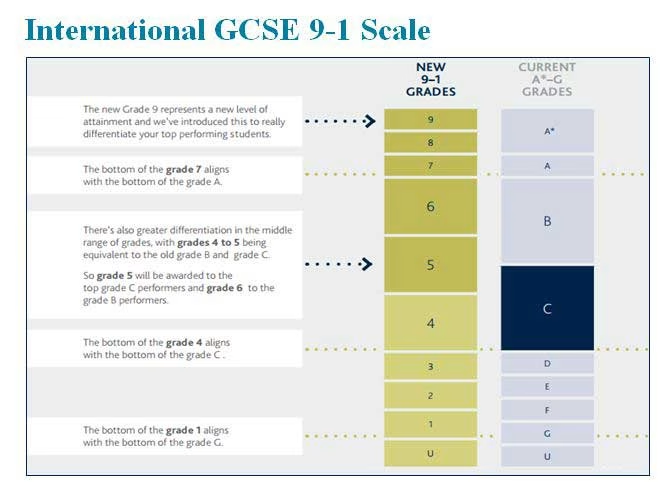
Grading System
Edexcel and Cambridge have used slightly different grading systems over the years.
Edexcel International GCSEs often use a 9–1 grading scale similar to GCSEs in England.
Cambridge commonly uses grades ranging from A* to G, although some subjects have begun adopting the 9–1 scale.
When selecting a pathway within the British curriculum, students should understand how their chosen school reports and interprets grades.
Subject Availability
Cambridge generally offers a larger number of subjects than Edexcel.
Cambridge includes unique options such as:
- Global Perspectives
- Environmental Management
- Travel and Tourism
- World Literature
Edexcel provides a strong range of traditional academic subjects but may offer fewer specialized choices.
Students seeking a broader subject portfolio within the British curriculum often find Cambridge advantageous.
Mathematics Comparison
Mathematics is one of the most popular IGCSE subjects.
Edexcel Mathematics
Edexcel Mathematics is often considered highly structured and predictable. Questions are designed to assess understanding while maintaining a consistent examination style.
Many students appreciate the clarity of Edexcel Mathematics papers.
Cambridge Mathematics
Cambridge Mathematics tends to emphasize reasoning and application. Questions may require deeper interpretation and problem-solving.
Both qualifications provide excellent preparation for advanced mathematics within the British curriculum.
Science Comparison
Science subjects are central to many students’ academic journeys.
Edexcel Science
Edexcel science courses are known for detailed specifications and focused assessment objectives. Students often find it easier to identify exactly what needs to be studied.
Cambridge Science
Cambridge science courses emphasize scientific inquiry and experimental thinking. Students are encouraged to understand concepts beyond memorization.
Both approaches support success in the British curriculum, but students may prefer one style over the other depending on their learning preferences.
English Language Comparison
English Language is another important consideration.
Edexcel English Language
Edexcel places considerable emphasis on analytical writing and examination techniques.
Assessment often focuses on comprehension, language analysis, and extended responses.
Cambridge English Language
Cambridge incorporates a broader range of communication skills, including directed writing, summary writing, and textual analysis.
Students following the British curriculum should review sample papers to determine which style aligns better with their strengths.
READ: Edexcel IGCSE English Language B sample answers
READ: Cambridge IGCSE English Language B Example
Edexcel IGCSE English Language VS Cambridge IGCSE English Language
1. The Single-Paper Challenge
Edexcel International GCSE English Language A is heavily dependent on one long examination paper.
Students must:
- Read lengthy unseen texts.
- Analyze language and structure in depth.
- Produce multiple extended responses.
- Complete substantial writing tasks.
- Manage time very carefully.
If a student struggles with time management, there is little opportunity to recover marks later.
In contrast, Cambridge often spreads assessment across different components and question types, which some students find less exhausting.
2. More Demanding Language Analysis
Many teachers report that Edexcel’s Section A requires a higher level of textual analysis.
Students must often:
- Explain precise language choices.
- Analyze effects on readers.
- Support points with carefully selected evidence.
- Develop sophisticated interpretations.
A common issue is that students can understand a text but struggle to express analysis at the depth required for top marks.
Cambridge comprehension questions can also be challenging, but they often reward broader understanding rather than sustained literary-style analysis.
3. Higher Dependence on Writing Quality
In Edexcel, weak writing can significantly affect performance across multiple questions.
Students need:
- Strong vocabulary.
- Accurate grammar.
- Sophisticated sentence structures.
- Effective organization.
Because marks are closely tied to written expression, even students with good reading skills can lose marks if their responses lack precision.
4. Grade Distribution in Schools
Many international schools report:
- More A*/A grades in Cambridge English Language.
- Fewer top grades in Edexcel English Language.
However, this is not necessarily because Cambridge is easier.
Several factors influence this:
- Schools may have more experience teaching Cambridge.
- Teachers may be better trained in Cambridge mark schemes.
- Students may be more familiar with Cambridge-style questions.
- Cohorts taking Edexcel may differ academically.
That said, many experienced English teachers do acknowledge that obtaining the highest grades in Edexcel often requires exceptionally strong analytical writing.
5. Top-End Discrimination
One reason Edexcel can feel harder is that it separates high-performing students more aggressively.
For example:
- A student with good comprehension and decent writing may achieve a strong grade in either board.
- To reach the very top grades in Edexcel, students often need sophisticated analysis and mature written expression.
This creates a perception that Edexcel is tougher, particularly among academically ambitious students.
6. What Teachers Commonly Say
A simplified summary often heard in international schools is:
| Aspect | Edexcel English Language | Cambridge English Language |
| Time pressure | Higher | Moderate |
| Text analysis | More intensive | Moderate to high |
| Writing flexibility | Lower | Higher |
| Examination predictability | Higher | Moderate |
| Achieving top grades | Often harder | Often more attainable |
| Student preference | Strong analytical students | Broader range of students |
Based on examiner reports, teacher feedback, and grade patterns observed in many international schools, it is reasonable to say that Edexcel IGCSE English Language is often perceived as harder than Cambridge IGCSE English Language, especially for students aiming for the highest grades.
The main reasons are:
- One lengthy paper with significant time pressure.
- Greater emphasis on detailed language analysis.
- Higher demands on analytical writing.
- Less room for recovery if one section goes poorly.
For a strong reader and analytical writer, Edexcel can be an excellent qualification. For the average student, Cambridge is often considered the more accessible route to achieving an A* or equivalent top grade.
Which Qualification Is More Difficult?
Many parents ask whether Edexcel or Cambridge is harder.
The reality is that neither qualification is universally more difficult. Difficulty depends on:
- Subject selection
- Individual learning style
- Teaching quality
- Assessment preferences
Some students find Cambridge examinations more challenging because of their emphasis on critical thinking.
Others find Edexcel difficult because of its detailed assessment requirements.
Success in the British curriculum ultimately depends more on preparation and study habits than on the examination board itself.
READ: Is AP Psychology Hard?
READ: College Board Advanced Placement(AP) At Educators
University Recognition
Universities generally do not favor one qualification over the other.
Leading institutions recognize both Edexcel and Cambridge IGCSE qualifications as equivalent secondary school credentials.
Whether a student studies Edexcel or Cambridge, they can progress to:
- A Levels
- International A Levels
- IB Diploma
- Foundation programs
- University entrance pathways
As a result, either route provides a strong foundation within the British curriculum.
Which Is Better for International Students?
Both qualifications are designed specifically for international learners.
However, certain characteristics may make one more suitable.
Edexcel may be preferable for students who:
- Prefer structured examinations
- Like clear specifications
- Benefit from predictable assessment styles
Cambridge may be preferable for students who:
- Enjoy project work
- Prefer inquiry-based learning
- Thrive in analytical environments
Choosing the right option within the British curriculum depends on the student’s educational profile rather than a universal ranking.
Factors Parents Should Consider
Before selecting an examination board, parents should evaluate several factors.
School Expertise
A school’s experience often matters more than the examination board itself.
Teachers who understand a syllabus thoroughly can provide more effective instruction.
Student Learning Style
Different learners respond differently to assessment methods.
Students who excel in examinations may favor Edexcel.
Students who enjoy practical and investigative learning may prefer Cambridge.
Future Academic Goals
Students planning to pursue science, medicine, engineering, business, or humanities should consider which syllabus best supports their intended pathway within the British curriculum.
Subject Availability
Schools may not offer every subject from both boards.
Availability often influences the final decision.
Advantages of Edexcel IGCSE
Key benefits include:
- Flexible examination sessions
- Clear syllabus structure
- Predictable assessment styles
- Strong international recognition
- Excellent preparation for International A Levels
Many students studying the British curriculum appreciate the straightforward organization of Edexcel courses.
Advantages of Cambridge IGCSE
Key benefits include:
- Extensive subject choices
- Inquiry-based learning approach
- Strong emphasis on critical thinking
- Practical assessment opportunities
These features make Cambridge a popular option within the British curriculum worldwide.
Common Misconceptions
Cambridge Is Always Harder
This is not necessarily true. Difficulty varies by subject and student.
Universities Prefer Cambridge
Most universities recognize both qualifications equally.
Edexcel Is Easier
Edexcel maintains rigorous standards and requires strong academic performance. In fact Edexcel IGCSE English Language is often perceived as harder than Cambridge IGCSE English Language, especially for students aiming for the highest grades.
One Qualification Guarantees Better Results
Success depends primarily on effort, teaching quality, and effective preparation rather than the examination board.
Students within the British curriculum should focus on mastering subject content rather than worrying excessively about perceived differences in difficulty.
Final Verdict
The debate between Edexcel IGCSE and Cambridge IGCSE does not have a universal winner. Both qualifications offer excellent preparation for higher education and future careers.
Edexcel is often preferred for its structured approach, flexible examination schedules, and clearly defined assessment criteria. Cambridge is frequently chosen for its emphasis on inquiry, broader subject offerings, and development of independent learning skills.
Students pursuing the British curriculum should consider their learning style, academic goals, and school resources before making a decision. Ultimately, the quality of teaching, student dedication, and consistent preparation play a far greater role in success than the choice of examination board. Whether a student chooses Edexcel IGCSE or Cambridge IGCSE, both pathways provide a respected and internationally recognized route toward academic achievement and future opportunities within the British curriculum.