
What Are Acids in Chemistry? In 4 simple steps: Definition, Properties, Types, and Uses Explained
Chemistry is the branch of science that studies matter and the changes it undergoes. Among the many substances studied in chemistry, an acid is one of the most important. Acids are found in laboratories, industries, living organisms, and even in many foods that people consume every day. Understanding what an acid is helps students learn many fundamental chemical concepts, including reactions, pH, and ion formation.
This article explains the definition, properties, types, examples, and applications of an acid in chemistry.
Definition of Acid
An acid is a substance that produces hydrogen ions (H⁺) when dissolved in water. The presence of hydrogen ions gives an acid its characteristic chemical behavior. Acids can react with bases, metals, and carbonates, producing different products depending on the reaction.
Several scientific theories explain the nature of an acid. The most common definitions are based on the Arrhenius, Brønsted–Lowry, and Lewis theories.
Arrhenius Definition
According to the Arrhenius theory, an acid is a substance that increases the concentration of hydrogen ions in an aqueous solution. For example, hydrochloric acid dissociates in water as follows:
HCl → H⁺ + Cl⁻
This definition is useful for understanding reactions that occur in water.
READ: What is a Base in Chemistry?
Brønsted–Lowry Definition
The Brønsted–Lowry theory defines an acid as a proton donor. In this theory, a proton is simply a hydrogen ion. Whenever a substance donates a proton to another substance, it acts as an acid.
For example:
HCl + H₂O → H₃O⁺ + Cl⁻
In this reaction, hydrochloric acid donates a proton to water.
Lewis Definition
The Lewis theory provides a broader definition. According to this concept, an acid is a substance that accepts an electron pair from another substance. This definition includes many reactions that do not involve hydrogen ions.
Properties of Acids
Every acid exhibits certain characteristic properties that help identify it. These properties result from the presence of hydrogen ions in solution.
Some common properties include:
- Sour taste
- Ability to turn blue litmus paper red
- Conductivity in aqueous solutions
- Reaction with metals to produce hydrogen gas
- Reaction with bases to form salt and water
- Corrosive nature in concentrated forms
These properties make an acid easy to distinguish from many other chemical substances.
Examples of Acids
Many substances commonly encountered in daily life contain an acid. Some examples include:
- Hydrochloric acid (HCl)
- Sulfuric acid (H₂SO₄)
- Nitric acid (HNO₃)
- Acetic acid (CH₃COOH)
- Citric acid (C₆H₈O₇)
- Carbonic acid (H₂CO₃)
Each acid has unique characteristics and applications. Some are strong mineral acids used in industry, while others occur naturally in fruits and beverages.
Strong and Weak Acids
An acid can be classified as strong or weak depending on how completely it ionizes in water.
Strong Acids
A strong acid ionizes almost completely in aqueous solution. As a result, it produces a high concentration of hydrogen ions.
Examples include:
- Hydrochloric acid
- Nitric acid
- Sulfuric acid
Strong acids are highly reactive and require careful handling.
Weak Acids
A weak acid ionizes only partially in water. Therefore, fewer hydrogen ions are produced compared to a strong acid of the same concentration.
Examples include:
- Acetic acid
- Carbonic acid
- Formic acid
Weak acids are generally less corrosive but remain important in biological and industrial processes.
The pH Scale and Acids
The pH scale is used to measure the acidity or alkalinity of a solution. The scale ranges from 0 to 14.
- pH less than 7: Acidic
- pH equal to 7: Neutral
- pH greater than 7: Basic
The lower the pH value, the stronger the acid generally is. For example, sulfuric acid has a very low pH, whereas vinegar, which contains acetic acid, has a higher pH.
The pH scale is widely used in chemistry, biology, medicine, and environmental science.
Reactions of Acids
An acid participates in many important chemical reactions. Some of the most common reactions are described below.
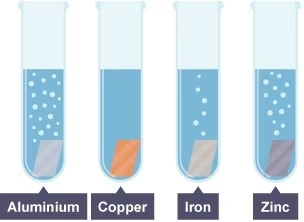
Reaction with Metals
When an acid reacts with certain metals, hydrogen gas is produced.
Example:
Zn + 2HCl → ZnCl₂ + H₂
This reaction is often demonstrated in chemistry laboratories.
Reaction with Bases
An acid reacts with a base in a neutralization reaction.
Example:
HCl + NaOH → NaCl + H₂O
The products are salt and water.
Reaction with Carbonates
An acid reacts with carbonates to produce carbon dioxide gas, water, and a salt.
Example:
2HCl + CaCO₃ → CaCl₂ + H₂O + CO₂
This reaction explains why limestone dissolves in acidic conditions.
Natural Occurrence of Acids
Many natural substances contain an acid. These substances contribute to flavor, digestion, and biological processes.
Examples include:
- Citric acid in lemons and oranges
- Acetic acid in vinegar
- Lactic acid in sour milk
- Carbonic acid in soft drinks
The presence of an acid often influences the taste and chemical behavior of these substances.
Industrial Uses of Acids
Industries rely heavily on various types of acid for manufacturing and processing. Important applications include:
Fertilizer Production
Sulfuric acid is widely used in the manufacture of fertilizers that support agricultural productivity.
Metal Processing
Many industrial processes use an acid to remove rust and clean metal surfaces before coating or welding.
Chemical Manufacturing
Numerous chemicals, dyes, plastics, and pharmaceuticals require an acid during production.
Battery Technology
Sulfuric acid serves as an essential component of lead-acid batteries used in vehicles and backup power systems.
Acids in the Human Body
The human body contains substances that function as an acid under specific conditions. One notable example is hydrochloric acid in the stomach.
This acid helps:
- Digest food
- Activate digestive enzymes
- Destroy harmful microorganisms
Maintaining the correct balance of an acid and other substances is important for normal physiological functions.
Safety Precautions When Handling Acids
Because an acid can be corrosive, proper safety measures are necessary when working in laboratories or industrial environments.
Important precautions include:
- Wearing safety goggles
- Using protective gloves
- Handling chemicals carefully
- Avoiding direct skin contact
- Adding acid to water rather than water to acid
- Storing chemicals in appropriate containers
These precautions help reduce the risk of accidents and injuries.
Environmental Effects of Acids
An acid can affect the environment when released in excessive amounts. One example is acid rain, which forms when sulfur dioxide and nitrogen oxides react with water vapor in the atmosphere.
Acid rain may:
- Damage forests
- Acidify lakes and rivers
- Corrode buildings and monuments
- Affect aquatic ecosystems
Understanding the behavior of an acid helps scientists develop strategies to minimize environmental damage.
Conclusion
An acid is a fundamental chemical substance that plays an essential role in chemistry, biology, industry, and everyday life. Whether defined as a producer of hydrogen ions, a proton donor, or an electron-pair acceptor, an acid exhibits distinctive properties and participates in many important reactions. From digestion in the human stomach to large-scale industrial manufacturing, the significance of an acid cannot be overstated. A solid understanding of acids provides a foundation for studying more advanced topics in chemistry and related sciences.