
How Many Rings Does Saturn Have? 9 Fascinating Facts About Saturn’s Ring System
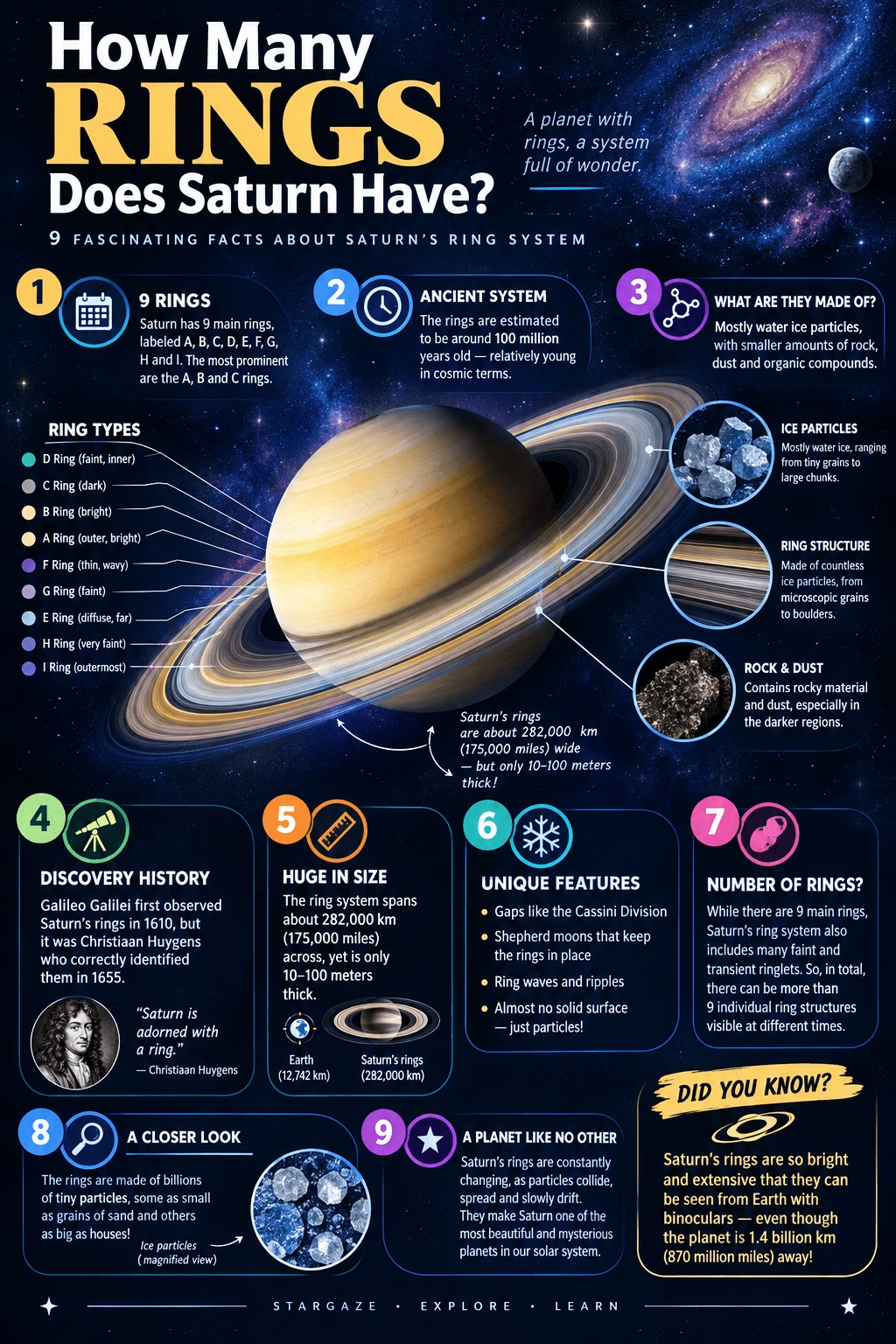
Saturn is one of the most recognizable planets in the Solar System, largely because of its spectacular ring system. These bright, wide rings make Saturn look dramatically different from the other planets when viewed through a telescope or spacecraft camera. But one question often causes confusion: how many rings does Saturn have?
The simplest answer is that Saturn has seven main rings, traditionally designated D, C, B, A, F, G, and E. However, this answer does not mean that Saturn has only seven individual rings. Each major ring is made up of countless narrow ringlets, gaps, bands, and structures. When scientists examine the system in greater detail, they find thousands of individual ring features.
So, when asking how many rings does Saturn have, it is important to distinguish between the seven major ring groups and the enormous number of smaller ringlets contained within them.
Saturn’s rings are not solid, continuous disks. They consist primarily of countless particles of water ice mixed with smaller amounts of rocky material and dust. Their sizes range from tiny grains to objects several meters across. Together, these particles create the brilliant bands that can be seen from Earth.
This article explains how Saturn’s rings are organized, how they formed, why they are so bright, and what spacecraft have discovered about this remarkable planetary feature.
Read More: How Many Moons Does Saturn Have? 293 Confirmed Moons and Their Fascinating World.
How Many Rings Does Saturn Have?
If you are looking for the standard scientific classification, Saturn has seven major rings. These are named:
- D Ring
- C Ring
- B Ring
- A Ring
- F Ring
- G Ring
- E Ring
They are generally identified from the planet outward, although their arrangement is not simply a sequence of seven equally wide bands. Some are broad and dense, while others are narrow and faint.
Therefore, the question how many rings does Saturn have has more than one possible answer depending on what is being counted.
The seven major rings are actually enormous systems containing numerous ringlets. In addition, Saturn has extremely faint outer structures, including the Phoebe ring, which is so diffuse that it cannot be seen easily with ordinary telescopes.
For this reason, saying that Saturn has seven rings is useful for basic education, but it is an oversimplification when discussing the complete ring system.
Read More: The Ultimate Guide To X-Ray Production And Modern Use In Diagnosis.
Why Does Saturn Have So Many Rings?
Saturn’s rings exist because the planet’s gravity controls enormous quantities of particles orbiting around it. These particles cannot easily gather into a single moon in regions where tidal forces interfere with the process of forming a large body.
The ring material remains spread around Saturn in orbit. Collisions between particles continually break, reshape, and redistribute material.
The question how many rings does Saturn have is therefore connected to another important question: why are these particles arranged into separate bands rather than forming one solid ring?
The answer involves Saturn’s gravity, the gravity of its moons, particle collisions, and orbital resonances.
Saturn’s rings contain gaps because gravitational interactions can remove or redistribute particles from particular orbital regions. Some gaps are influenced strongly by nearby moons. The famous Cassini Division, for example, separates the broad A and B rings.
Although the Cassini Division appears like a large empty gap, it is not completely empty. It contains faint ring material and smaller structures.
Read More: What Is a CT Scan? Understanding Its Uses, Benefits, and Risks.
The Seven Major Rings of Saturn
To understand how many rings does Saturn have, it helps to examine the major rings individually.
1. The D Ring
The D Ring is the innermost major ring system. It is relatively faint and lies closest to Saturn’s visible atmosphere.
Because it is much less prominent than the B or A rings, the D Ring can be difficult to observe from Earth. It contains fine particles and has a comparatively diffuse appearance.
Its location near Saturn means that the ring material experiences strong gravitational and electromagnetic influences from the planet.
2. The C Ring
The C Ring lies outside the D Ring and is sometimes called the “crepe ring” because it is relatively dark and translucent compared with the brighter B Ring.
The C Ring allows some light to pass through it. Its particles are less densely packed than those in the B Ring, making the ring appear darker when viewed against Saturn.
Scientists have observed waves and other structures within the C Ring that provide information about Saturn’s interior and gravitational environment.
3. The B Ring
The B Ring is the largest and brightest of Saturn’s main rings. It contains a high concentration of particles and is one of the most visually impressive features of the planet.
When people see photographs of Saturn, the B Ring contributes significantly to the broad, bright appearance of the ring system.
The B Ring also contains numerous fine structures and waves. Its particles are strongly affected by Saturn’s gravity and by interactions with nearby moons.
Because of its enormous width and density, the B Ring is an important subject of planetary science.
4. The A Ring
The A Ring lies outside the Cassini Division and is another prominent component of Saturn’s ring system.
One of its most famous features is the Encke Gap, a narrow division within the A Ring associated with the small moon Pan. The A Ring also contains the Keeler Gap, influenced by the moon Daphnis.
These features demonstrate that Saturn’s rings are dynamic systems rather than simple, unchanging bands.
5. The F Ring
The F Ring is a narrow and unusual ring located outside the A Ring. It is particularly interesting because its structure is strongly influenced by two small moons, Prometheus and Pandora.
These moons are sometimes described as “shepherd moons” because their gravitational interactions help shape and confine ring material.
The F Ring can develop complex structures, including strands and clumps. Its changing appearance makes it one of the most fascinating parts of Saturn’s ring system.
6. The G Ring
The G Ring is much fainter than the main A and B rings. It is located farther from Saturn and contains relatively diffuse material.
A small moon named Aegaeon is associated with a bright arc within the G Ring. Rather than being evenly distributed, some material in this region is concentrated in a partial ring-like structure.
This demonstrates why counting Saturn’s rings is not as simple as counting visible lines in a photograph.
7. The E Ring
The E Ring is a very broad and faint ring located far from Saturn. It is strongly associated with the moon Enceladus.
Enceladus has active geysers that release water vapor and icy particles into space. Some of this material enters orbit around Saturn and contributes to the E Ring.
This connection makes the E Ring especially important to scientists studying Saturn’s moons and the possibility of habitable environments beyond Earth.
Read More: Stars The Cosmic Kitchen: Birth and Death Explained.
So, How Many Rings Does Saturn Have in Total?
The answer depends on the definition of a “ring.”
If you are counting the major named ring groups, the answer is seven: D, C, B, A, F, G, and E.
If you count every individual ringlet, narrow band, arc, and faint structure, the number becomes much larger. Scientists have identified thousands of individual features within Saturn’s ring system.
There are also faint outer rings that do not fit neatly into the seven major groups.
For example, Saturn possesses a very large and extremely faint Phoebe ring. It extends an enormous distance from the planet and is composed of very sparse dust particles. It is difficult to detect because the material is widely dispersed.
Consequently, the best answer to how many rings does Saturn have is seven major ring groups, containing thousands of smaller ringlets and structures.
Read More: The Powerful Role of Conjugate Acid-Base Pairs in Chemistry.
Are Saturn’s Rings Solid?
No. Saturn’s rings are not solid surfaces.
They are enormous collections of individual particles orbiting Saturn independently. Most of the material is made of water ice, although the rings also contain rocky material and dust.
The particles can vary greatly in size. Some are microscopic grains, while others can be much larger.
If you could somehow travel through one of the major rings, you would not encounter a continuous wall of ice. Instead, you would pass through a region containing countless separate particles.
The high reflectivity of water ice is one reason Saturn’s main rings appear so bright.
This distinction is important when considering how many rings does Saturn have. A photograph may make the rings look like several continuous structures, but they are actually vast collections of orbiting particles.
Read More: A Beginner’s guide to the Periodic Table: Importance, Application, present days and history.
How Wide Are Saturn’s Rings?
Saturn’s main rings extend hundreds of thousands of kilometers across when their overall diameter is considered. However, they are remarkably thin compared with their enormous width.
The main ring system extends from close to Saturn outward across a huge region of space, yet its vertical thickness can be comparatively small in many locations.
This gives Saturn’s rings their distinctive disk-like appearance.
Their dimensions also change depending on which portion of the ring system is being measured. Some rings are broad, while others are narrow and faint.
The contrast between their enormous width and limited thickness is one of the most remarkable aspects of the system.
Read More: Is AP Chemistry Hard? 7 Encouraging Facts That Make It Easier to Master.
What Are Saturn’s Rings Made Of?
Saturn’s rings are composed primarily of water ice. The ice particles reflect sunlight extremely efficiently, which helps make the main rings visible from Earth.
There are also darker materials, including rocky particles and dust. The exact composition can vary among different ring regions.
Scientists study the color, brightness, temperature, and reflected light from the rings to learn about their composition.
Spacecraft observations have provided much more detailed information than Earth-based telescopes alone could provide.
The dominance of water ice is particularly interesting because Saturn’s moons also contain substantial amounts of ice. Interactions among the rings, moons, and Saturn’s magnetic environment create a complex planetary system.
Read More: What Is an Ideal Gas? 10 Remarkable Comprehensive Insights.
How Did Saturn’s Rings Form?
The origin of Saturn’s rings remains an important scientific question.
One possibility is that the rings formed from the remains of a moon or other icy body that was destroyed by Saturn’s gravitational forces. Another possibility is that some ring material represents remnants left over from the early Solar System.
Scientists continue to study different formation and evolution scenarios.
Saturn’s rings are not necessarily permanent features on astronomical timescales. Material can gradually fall into Saturn’s atmosphere, interact with moons, or otherwise move out of the ring system.
This means that asking how many rings does Saturn have describes Saturn as we observe it today rather than necessarily describing what the planet’s ring system has always looked like.
Read More: What is Organic Chemistry? 10 Fascinating and Powerful Insights into Carbon-Based Science.
What Is the Cassini Division?
The Cassini Division is one of the most famous features associated with Saturn’s rings.
It is a broad region between the A and B rings that appears dark from Earth. The division is named after Giovanni Domenico Cassini, the astronomer who studied Saturn and its moons in the seventeenth century.
Despite its name, the Cassini Division is not completely empty. It contains diffuse ring material and smaller structures.
Gravitational resonances, particularly interactions involving Saturn’s moon Mimas, play an important role in creating the prominent gap.
The Cassini Division also helps explain why the answer to how many rings does Saturn have can vary. What looks like a small number of distinct bands from a distance contains a much more complicated internal structure.
Read More: What is a Base in Chemistry: 15 Fascinating Insights That Make This a Powerful Guide.
What Are Ringlets?
A ringlet is a relatively narrow ring or band of material within a larger ring system.
Saturn’s major rings contain countless ringlets. Some are bright, some are faint, and some are separated by narrow gaps.
Ringlets can be created or maintained by gravitational interactions with moons. Other structures can result from waves, collisions, and variations in particle density.
When viewed from Earth, many of these features blend together because they are too small to resolve individually.
Modern spacecraft have provided much more detailed images, allowing scientists to study these structures directly.
Therefore, the phrase how many rings does Saturn have should not be interpreted as meaning that scientists see only seven simple circles.
Read More: What Is a Mole in Chemistry? 6 Mind-Blowing Facts & Easy Calculations.
How Did the Cassini Mission Change Our Understanding?
NASA’s Cassini mission, operated in partnership with the European Space Agency and the Italian Space Agency, dramatically expanded scientific knowledge of Saturn and its rings.
The spacecraft entered orbit around Saturn in 2004 and continued its mission until 2017. During that period, Cassini repeatedly observed the rings from different angles and distances.
Its instruments examined the composition, temperature, structure, and dynamics of the ring system.
Cassini discovered and studied numerous ring features and provided detailed observations of interactions between the rings and Saturn’s moons.
The mission also observed changes in the rings over time. These observations helped scientists understand that Saturn’s rings are dynamic and constantly influenced by gravitational forces.
Cassini’s observations remain central to discussions about how many rings does Saturn have because they revealed an extraordinary level of complexity hidden within the major ring groups.
Do Saturn’s Rings Have Moons Inside Them?
Yes. Several small moons orbit within or near Saturn’s rings.
These moons can influence ring material through their gravity. Some are known as shepherd moons because they help maintain or shape narrow ring structures.
Pan, for example, is associated with the Encke Gap in the A Ring. Daphnis moves within the Keeler Gap and produces waves along the nearby ring edges.
Prometheus and Pandora interact strongly with the F Ring.
These relationships show that Saturn’s rings and moons form an interconnected system rather than existing as completely separate objects.
Why Are Saturn’s Rings So Bright?
Saturn’s rings are bright mainly because they contain abundant water ice.
Ice is highly reflective, especially when the particles are relatively clean. When sunlight strikes the ring particles, much of that light is reflected back into space.
This makes the major rings especially easy to observe compared with many darker planetary ring systems.
The brightness is also influenced by viewing geometry. Rings can appear different depending on the angle from which they are observed and how sunlight illuminates them.
Their brightness has made Saturn one of the easiest planets to recognize through a telescope.
Can We See Saturn’s Rings From Earth?
Yes. Saturn’s rings can be observed with a suitable telescope, and even relatively modest amateur telescopes can reveal their basic structure under good viewing conditions.
However, the level of detail visible depends on telescope size, atmospheric conditions, Saturn’s position in the sky, and the angle of the rings.
A small telescope may show Saturn as a planet with a prominent ring system. A larger telescope can reveal additional features, including the Cassini Division under favorable conditions.
Professional observatories and spacecraft can detect far more detail than an amateur observer can see from Earth.
Do Saturn’s Rings Change Over Time?
Yes. Saturn’s rings are dynamic.
Particles continuously interact through collisions and gravitational forces. Small moons disturb the ring material, creating waves, gaps, arcs, and other structures.
Material can also migrate gradually within the system.
Saturn experiences a phenomenon sometimes called ring rain, in which icy material from the rings falls into the planet’s upper atmosphere. This process provides evidence that the rings are not completely stable or permanent.
Scientists therefore expect Saturn’s ring system to evolve over time.
This is another reason why the question how many rings does Saturn have is best answered by describing the current major ring groups rather than treating the number as an unchanging characteristic.
How Do Saturn’s Rings Compare With Other Planetary Rings?
Saturn is not the only planet with rings. Jupiter, Uranus, and Neptune also have ring systems.
However, Saturn’s rings are much more prominent and easily visible than those of the other giant planets.
Jupiter has a faint ring system composed largely of dust. Uranus has several narrow, dark rings. Neptune also has faint rings and partial ring arcs.
Saturn’s rings stand out because they are extensive, bright, and rich in reflective ice particles.
Their appearance is so distinctive that the planet is often used as the classic example of a ringed planet.
Why Does Saturn Have Rings While Earth Does Not?
Earth does not currently have a prominent planetary ring system like Saturn’s.
The difference is related to the formation and evolution of planetary systems. Saturn is a giant planet surrounded by numerous moons and vast amounts of material, while Earth is a rocky planet with a very different gravitational and environmental history.
Saturn’s large size and strong gravity help maintain a complex system of orbiting particles and moons.
Earth’s Moon also strongly influences the space surrounding our planet, but Earth does not possess a large, stable ring system comparable to Saturn’s.
Could Saturn’s Rings Disappear?
Eventually, Saturn’s rings may change substantially or become much less prominent.
Ring particles can fall into Saturn, collide with moons, or move through other processes that alter the system.
Scientists have estimated that significant changes can occur over astronomical timescales. However, the exact lifetime of the rings depends on which part of the ring system is considered and which physical processes dominate.
It is therefore important not to imagine Saturn’s rings as permanently fixed structures.
The Saturn we observe today has a particular ring configuration that has evolved over time and will continue to evolve.
Why Is the Number of Saturn’s Rings Confusing?
The confusion comes mainly from the difference between major ring groups and individual ringlets.
If someone asks, “How many major rings does Saturn have?” the standard answer is seven.
If someone asks how many individual rings or ringlets exist throughout the complete system, there is no equally simple single number.
Saturn’s ring system contains many subdivisions, gaps, arcs, waves, and narrow structures. Some faint outer rings are also included in broader scientific descriptions.
Thus, a statement that Saturn has seven rings is scientifically useful, but it should be understood as a classification of the major named ring groups.
Quick Facts About Saturn’s Rings
Here are several important facts to remember:
- Saturn has seven major named ring groups.
- The major rings are designated D, C, B, A, F, G, and E.
- The rings contain thousands of smaller ringlets and structures.
- Most of the visible ring material consists of water ice.
- The particles range from tiny grains to larger chunks.
- The B Ring is the broadest and brightest major ring.
- The Cassini Division separates the A and B rings.
- Small moons influence the shape and structure of several rings.
- Enceladus supplies material that contributes to the E Ring.
- Saturn also has extremely faint outer ring structures.
- The rings are dynamic and change over time.
- NASA’s Cassini mission greatly improved our understanding of Saturn’s rings.
Frequently Asked Questions (FAQ)
How many rings does Saturn have?
Saturn has seven major rings, traditionally named D, C, B, A, F, G, and E. However, these major groups contain thousands of smaller ringlets and other structures.
How many rings does Saturn have if every ringlet is counted?
There is no simple official number for every individual ringlet and small structure. Scientists identify numerous subdivisions within the major rings, so the complete system is much more complicated than seven simple rings.
What are Saturn’s rings made of?
Saturn’s rings are composed mainly of water ice, along with smaller amounts of rocky material and dust.
Which is Saturn’s largest ring?
The B Ring is one of the broadest and most massive major rings and is also among the brightest parts of the system.
What is the Cassini Division?
The Cassini Division is a broad gap-like region between Saturn’s A and B rings. It is not completely empty and contains faint material.
Are Saturn’s rings solid?
No. They consist of countless individual particles orbiting Saturn. They only appear solid from a distance because the particles are densely distributed across enormous areas.
Why are Saturn’s rings visible?
They are particularly easy to see because they contain abundant water ice, which reflects sunlight effectively.
Can Saturn’s rings be seen from Earth?
Yes. Saturn’s rings can be observed with a telescope. Their visibility and the amount of detail depend on the telescope, atmospheric conditions, and Saturn’s orientation.
Will Saturn always have its rings?
Not necessarily. Saturn’s rings are dynamic and can lose material over time. Their appearance and structure have changed and will continue to change over astronomical timescales.
Does Saturn have more than seven rings?
Yes, if smaller ringlets, arcs, and faint outer structures are included. The number seven refers to the principal named ring groups rather than every individual ring feature.
Conclusion
So, how many rings does Saturn have? The standard answer is seven major rings: D, C, B, A, F, G, and E. However, Saturn’s complete ring system is far more complicated than this number suggests.
Each major ring contains numerous smaller ringlets, gaps, waves, arcs, and other structures. Saturn also possesses extremely faint outer ring systems that are difficult to observe. The material itself is made primarily of water ice mixed with smaller amounts of rock and dust.
The rings are shaped by Saturn’s powerful gravity, interactions with its moons, collisions among particles, and orbital resonances. Missions such as Cassini revealed that these rings are active and constantly changing rather than being permanent, motionless bands.
Understanding how many rings does Saturn have therefore requires distinguishing between a simple educational count and the detailed scientific structure of Saturn’s ring system. For a basic answer, remember seven major rings. For a deeper understanding, think of Saturn’s rings as a vast, dynamic collection of countless icy particles organized into an intricate network of ring groups and ringlets.
Saturn’s rings remain one of the most spectacular sights in planetary astronomy, and continued observations will help scientists better understand their origin, evolution, and future.