
Chemistry Formulas: Essential Equations, Rules, Examples & Applications
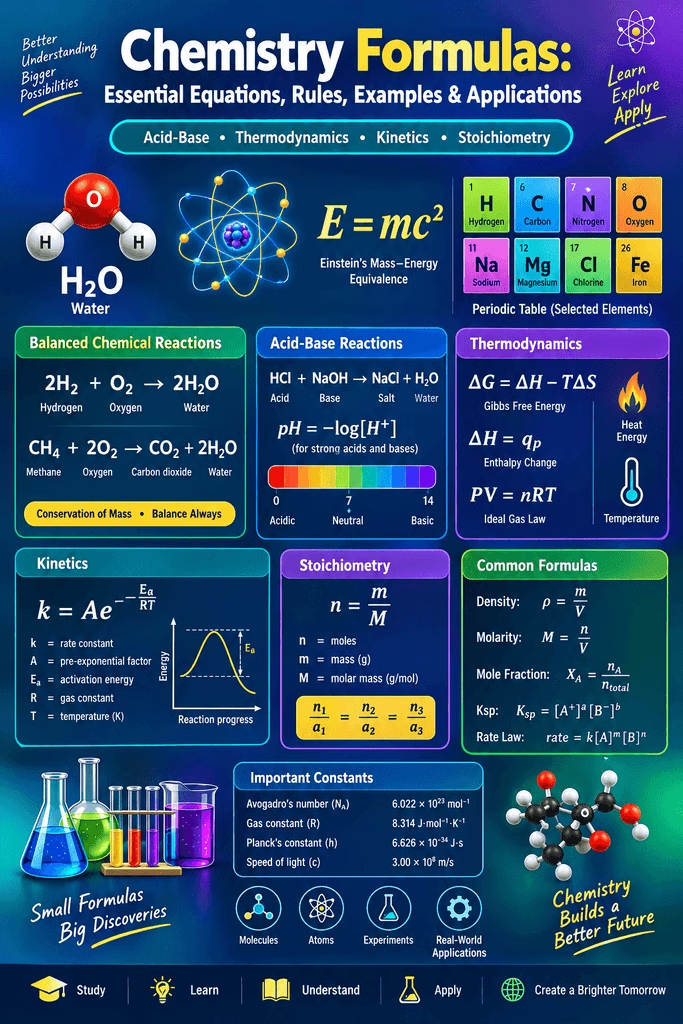
Chemistry is the science of matter, its properties, its composition, and the changes it undergoes. Whether you are studying atoms, molecules, acids, bases, salts, gases, chemical reactions, or organic compounds, mathematical relationships are an important part of understanding the subject. Chemistry formulas provide a concise way to represent these relationships and make complicated chemical concepts easier to calculate and explain.
From a simple molecular formula such as H₂O to more advanced relationships involving equilibrium, concentration, thermodynamics, and electrochemistry, formulas are used throughout chemistry. Learning them is not simply a matter of memorizing symbols. A strong understanding of what each symbol represents, when a formula should be used, and what units are required can make chemistry much easier.
This guide explains the most important chemistry formulas, their meanings, applications, and examples. It also discusses formulas used in physical, inorganic, analytical, and organic chemistry.
Read More: What Is Inorganic Chemistry? 11 Essential Concepts, Types, Reactions & Applications
What Are Chemistry Formulas?
A chemistry formula is a symbolic representation of a chemical substance, quantity, relationship, or law. Chemical formulas can tell us which elements are present in a compound and how many atoms of each element are involved.
For example, the formula for water is:
H₂O
This indicates that one molecule of water contains two hydrogen atoms and one oxygen atom.
Similarly, carbon dioxide is represented as:
CO₂
The subscript ₂ indicates that each molecule contains two oxygen atoms for every one carbon atom.
However, chemistry formulas are not limited to molecular formulas. They also include mathematical equations used to calculate quantities such as moles, concentration, pressure, energy, pH, equilibrium constants, and reaction rates.
Read More: What Is Organic Chemistry? 11 Essential Concepts, Types, Reactions & Applications
Why Are Chemistry Formulas Important?
Chemistry formulas are important because they provide a standardized language for describing chemical substances and processes.
They help students and scientists:
- Identify chemical substances.
- Represent chemical reactions.
- Calculate quantities of reactants and products.
- Determine concentrations.
- Calculate molar masses.
- Understand gas behavior.
- Calculate pH and pOH.
- Analyze equilibrium.
- Study reaction rates.
- Calculate energy changes.
- Understand electrochemical cells.
- Solve quantitative chemistry problems.
Instead of describing every relationship using lengthy sentences, chemistry uses symbols and equations to communicate information efficiently.
Read More: How to Calculate Moles in Chemistry: Formula, Methods, Examples & Tips
Basic Chemical Formulas
The simplest chemistry formulas represent elements and compounds.
Elemental Formulas
Some elements exist naturally as individual atoms, while others commonly exist as molecules.
Examples include:
- Hydrogen: H₂
- Oxygen: O₂
- Nitrogen: N₂
- Chlorine: Cl₂
- Fluorine: F₂
- Bromine: Br₂
- Iodine: I₂
The subscript indicates the number of atoms present in one molecule.
Noble gases such as helium and neon are normally represented simply as He and Ne because they exist as individual atoms under ordinary conditions.
Common Molecular Formulas
Some important compounds include:
- Water: H₂O
- Carbon dioxide: CO₂
- Ammonia: NH₃
- Methane: CH₄
- Sulfuric acid: H₂SO₄
- Nitric acid: HNO₃
- Sodium hydroxide: NaOH
- Calcium carbonate: CaCO₃
- Sodium chloride: NaCl
- Glucose: C₆H₁₂O₆
These formulas communicate the elemental composition of each substance.
Read More: The Powerful Role of Conjugate Acid-Base Pairs in Chemistry
The Mole Formula
The mole is one of the most important concepts in quantitative chemistry. A mole represents a specific number of particles.
One mole contains approximately:
6.022 × 10²³ particles
This number is known as Avogadro’s constant.
The relationship between the number of particles and the amount of substance is:
n = N / Nₐ
where:
- n = amount of substance in moles
- N = number of particles
- Nₐ = Avogadro’s constant
Therefore:
N = nNₐ
For example, one mole of oxygen molecules contains approximately 6.022 × 10²³ oxygen molecules.
Understanding the mole is essential because many chemistry formulas depend on converting between mass, particles, and amount of substance.
Read More: A Beginner’s guide to the Periodic Table: Importance, Application, present days and history
Formula Relating Moles and Mass
A very commonly used relationship is:
n = m / M
where:
- n = number of moles
- m = mass of the substance
- M = molar mass
Rearranging gives:
m = nM
For example, the molar mass of water is approximately 18.0 g mol⁻¹. Therefore, 36.0 g of water corresponds to:
n = 36.0 / 18.0
n = 2.0 mol
This relationship is fundamental to stoichiometric calculations.
Read More: Is AP Chemistry Hard? 7 Encouraging Facts That Make It Easier to Master
Molar Mass
Molar mass is the mass of one mole of a substance. It is normally expressed in g mol⁻¹.
To calculate molar mass, add the relative atomic masses of all atoms present in the formula.
For water:
H₂O
M = 2(1.0) + 16.0
M = 18.0 g mol⁻¹
For carbon dioxide:
CO₂
M = 12.0 + 2(16.0)
M = 44.0 g mol⁻¹
This calculation is frequently required before using other chemistry formulas.
Read More: What Is an Ideal Gas? 10 Remarkable Comprehensive Insights
Concentration Formulas
Concentration describes how much solute is present in a particular quantity of solution.
The molar concentration formula is:
c = n / V
where:
- c = concentration in mol dm⁻³
- n = amount of solute in moles
- V = volume of solution in dm³
Therefore:
n = cV
If the volume is given in cm³, convert it to dm³:
1 dm³ = 1000 cm³
For example, if 0.20 mol of sodium hydroxide is dissolved to make 500 cm³ of solution:
V = 500 / 1000
V = 0.500 dm³
Therefore:
c = 0.20 / 0.500
c = 0.40 mol dm⁻³
Read More: What is Organic Chemistry? 10 Fascinating and Powerful Insights into Carbon-Based Science
Dilution Formula
When a solution is diluted, the amount of solute remains constant while the volume increases.
The dilution relationship is:
c₁V₁ = c₂V₂
where:
- c₁ = initial concentration
- V₁ = initial volume
- c₂ = final concentration
- V₂ = final volume
This equation is widely used in laboratory calculations.
For example, if 100 cm³ of a 2.0 mol dm⁻³ solution is diluted to 500 cm³:
c₁V₁ = c₂V₂
2.0 × 100 = c₂ × 500
c₂ = 0.40 mol dm⁻³
Read More:What is a Base in Chemistry: 15 Fascinating Insights That Make This a Powerful Guide
Empirical Formula
An empirical formula shows the simplest whole-number ratio of atoms in a compound.
For example, hydrogen peroxide has the molecular formula:
H₂O₂
The simplest ratio of hydrogen to oxygen is 1:1, so its empirical formula is:
HO
To determine an empirical formula from experimental data, the usual steps are:
- Convert each element’s mass to moles.
- Divide all mole values by the smallest value.
- Obtain a whole-number ratio.
- Write the empirical formula.
Read More: What Is a Mole in Chemistry? 6 Mind-Blowing Facts & Easy Calculations
Molecular Formula
A molecular formula shows the actual number of atoms of each element in one molecule.
The relationship between molecular and empirical formulas is:
Molecular formula = (Empirical formula) × n
where:
n = molecular molar mass / empirical formula mass
For example, if the empirical formula is CH₂O and the molecular mass is 180, while the empirical formula mass is 30:
n = 180 / 30
n = 6
Therefore, the molecular formula is:
C₆H₁₂O₆
Stoichiometric Formulas
Stoichiometry involves calculating the quantitative relationships between reactants and products in chemical reactions.
Consider the reaction:
2H₂ + O₂ → 2H₂O
The coefficients indicate the mole ratio:
2 : 1 : 2
This means that two moles of hydrogen react with one mole of oxygen to produce two moles of water.
Balanced equations are essential because the law of conservation of mass requires the same number of atoms of each element on both sides of a chemical equation.
Percentage Yield
In real experiments, the amount of product obtained is often lower than the theoretical amount.
Percentage yield is calculated using:
Percentage yield = (Actual yield / Theoretical yield) × 100%
For example, if the theoretical yield is 10 g and the actual yield is 8 g:
Percentage yield = (8 / 10) × 100%
Percentage yield = 80%
A low percentage yield may result from incomplete reactions, side reactions, product loss during purification, or measurement limitations.
Percentage Composition
Percentage composition determines the percentage by mass of an element in a compound.
The general relationship is:
Percentage of element = (Mass of element in one mole of compound / Molar mass of compound) × 100%
For water:
H₂O
Molar mass = 18.0 g mol⁻¹
Mass of hydrogen = 2.0 g mol⁻¹
Therefore:
Percentage hydrogen = (2.0 / 18.0) × 100%
≈ 11.1%
The remaining percentage is oxygen.
Gas Laws
Gas behavior is described using several important relationships.
Boyle’s Law
At constant temperature:
P₁V₁ = P₂V₂
This means that pressure and volume are inversely proportional when temperature and amount of gas remain constant.
Charles’s Law
At constant pressure:
V₁ / T₁ = V₂ / T₂
Temperature must be measured in kelvin.
Pressure Law
At constant volume:
P₁ / T₁ = P₂ / T₂
Again, absolute temperature in kelvin should be used.
Combined Gas Law
The combined gas law is:
P₁V₁ / T₁ = P₂V₂ / T₂
It combines the relationships between pressure, volume, and temperature.
Ideal Gas Equation
One of the most important gas relationships is:
PV = nRT
where:
- P = pressure
- V = volume
- n = number of moles
- R = gas constant
- T = absolute temperature
The value of R depends on the units being used.
Density Formula
Density is defined as mass per unit volume:
ρ = m / V
where:
- ρ = density
- m = mass
- V = volume
The equation can be rearranged as:
m = ρV
and:
V = m / ρ
Density calculations are useful in chemistry, laboratory science, engineering, and material identification.
Relative Atomic Mass and Relative Molecular Mass
Relative atomic mass compares the average mass of atoms of an element with a standard reference.
Relative molecular mass is obtained by adding the relative atomic masses of all atoms in a molecule.
For water:
Mᵣ = 2(1) + 16
Mᵣ = 18
Relative molecular mass has no unit because it is a ratio.
Acids and Bases
Acid-base chemistry includes several important chemistry formulas.
The pH of an aqueous solution is defined as:
pH = −log[H⁺]
where [H⁺] is the hydrogen-ion concentration in mol dm⁻³.
Similarly:
pOH = −log[OH⁻]
At 25°C:
pH + pOH = 14
For a strong acid with a hydrogen-ion concentration of 1.0 × 10⁻³ mol dm⁻³:
pH = −log(1.0 × 10⁻³)
pH = 3
The pH scale is logarithmic, meaning that a change of one pH unit represents a tenfold change in hydrogen-ion concentration.
Acid Dissociation Constant
For a weak acid represented as HA:
HA ⇌ H⁺ + A⁻
The acid dissociation constant is:
Kₐ = [H⁺][A⁻] / [HA]
A larger Kₐ generally indicates a stronger acid.
The corresponding pKₐ is:
pKₐ = −log Kₐ
These relationships are important for understanding weak acids and acid-base equilibria.
Base Dissociation Constant
For a weak base:
B + H₂O ⇌ BH⁺ + OH⁻
The base dissociation constant is:
Kᵦ = [BH⁺][OH⁻] / [B]
The relationship between Kₐ and Kᵦ for a conjugate acid-base pair at 25°C is:
KₐKᵦ = Kᵥ
where Kᵥ represents the ionic product of water.
Ionic Product of Water
Water undergoes slight self-ionization:
H₂O ⇌ H⁺ + OH⁻
At 25°C:
Kᵥ = [H⁺][OH⁻]
and:
Kᵥ = 1.0 × 10⁻¹⁴
Thus, for neutral water at 25°C:
[H⁺] = [OH⁻] = 1.0 × 10⁻⁷ mol dm⁻³
Therefore:
pH = 7
The value of Kᵥ changes with temperature, so the statement that neutral water always has a pH of exactly 7 applies specifically to 25°C.
Equilibrium Constant
For a general reaction:
aA + bB ⇌ cC + dD
the equilibrium constant is:
Kc = [C]ᶜ[D]ᵈ / [A]ᵃ[B]ᵇ
The equilibrium expression includes the concentrations of species involved in the equilibrium. Pure solids and pure liquids are normally omitted from the expression.
The value of Kc provides information about the position of equilibrium under specified conditions.
Reaction Rate
Reaction rate describes how quickly reactants are consumed or products are formed.
A simple rate expression can be written as:
Rate = −Δ[Reactant] / Δt
or:
Rate = Δ[Product] / Δt
The negative sign for a reactant is used because reactant concentration decreases with time.
The rate law for a reaction may have the form:
Rate = k[A]ᵐ[B]ⁿ
where:
- k = rate constant
- [A] and [B] = concentrations
- m and n = reaction orders
The overall order is:
Overall order = m + n
Reaction orders must normally be determined experimentally rather than assumed from the balanced chemical equation.
Arrhenius Equation
The Arrhenius equation describes the relationship between temperature and the rate constant:
k = Ae⁻ᴱᵃ/ᴿᵀ
where:
- k = rate constant
- A = frequency factor
- Eₐ = activation energy
- R = gas constant
- T = absolute temperature
As temperature increases, a greater proportion of molecules can possess enough energy to overcome the activation-energy barrier.
Enthalpy Change
Enthalpy change measures the heat energy absorbed or released during a process at constant pressure.
For a reaction:
ΔH = H(products) − H(reactants)
An exothermic reaction has:
ΔH < 0
An endothermic reaction has:
ΔH > 0
For example, combustion reactions are generally exothermic because they release energy to the surroundings.
Calorimetry Formula
Heat transfer can often be calculated using:
q = mcΔT
where:
- q = heat energy transferred
- m = mass
- c = specific heat capacity
- ΔT = temperature change
If a substance has a mass of 100 g, a specific heat capacity of 4.18 J g⁻¹ K⁻¹, and its temperature increases by 10 K:
q = 100 × 4.18 × 10
q = 4180 J
Calorimetry is commonly used to investigate energy changes in chemical reactions.
Hess’s Law
Hess’s law states that the total enthalpy change for a reaction is independent of the route taken.
It can be represented as:
ΔHreaction = ΣΔHsteps
This principle allows chemists to calculate enthalpy changes that cannot be measured directly.
Bond Energy
The enthalpy change of a reaction can also be estimated using bond energies:
ΔH ≈ Σ(Bond energies of bonds broken) − Σ(Bond energies of bonds formed)
Breaking bonds requires energy, while forming bonds releases energy.
This method provides an approximate value because bond energies are average values.
Electrochemistry Formulas
Electrochemistry studies chemical reactions involving electron transfer and electrical energy.
A basic relationship for charge is:
Q = It
where:
- Q = electrical charge
- I = current
- t = time
The amount of substance produced during electrolysis can be related to charge.
Faraday’s law gives:
Q = nF
where:
- n = amount of electrons in moles
- F = Faraday constant
The Faraday constant is approximately:
F = 96,485 C mol⁻¹
These relationships are widely used in electrolysis calculations.
Cell Potential
For an electrochemical cell:
E°cell = E°cathode − E°anode
A positive standard cell potential indicates that the cell reaction is thermodynamically favorable under standard conditions.
Electrochemical calculations connect chemical reactions with electrical energy and are important in batteries, fuel cells, electroplating, and corrosion studies.
Organic Chemistry Formulas
Organic chemistry focuses mainly on carbon-containing compounds.
Common general formulas include:
Alkanes
CₙH₂ₙ₊₂
Alkanes contain only single carbon-carbon bonds.
Examples:
- Methane: CH₄
- Ethane: C₂H₆
- Propane: C₃H₈
- Butane: C₄H₁₀
Alkenes
CₙH₂ₙ
Alkenes contain at least one carbon-carbon double bond.
Examples include:
- Ethene: C₂H₄
- Propene: C₃H₆
Alkynes
CₙH₂ₙ₋₂
Alkynes contain at least one carbon-carbon triple bond.
An example is ethyne:
C₂H₂
Alcohols
A simple general representation of alcohols is:
CₙH₂ₙ₊₁OH
Ethanol, for example, is:
C₂H₅OH
Functional Groups
Functional groups determine many of the characteristic chemical properties of organic compounds.
Important functional groups include:
- Alcohol: −OH
- Aldehyde: −CHO
- Ketone: >C=O
- Carboxylic acid: −COOH
- Ester: −COO−
- Amine: −NH₂
- Alkene: C=C
- Alkyne: C≡C
Recognizing functional groups helps students predict reactions and identify organic compounds.
Structural and Displayed Formulas
A molecular formula shows the number of atoms, but it does not necessarily show how those atoms are connected.
For example, ethanol can be written as:
C₂H₅OH
Its structural formula can be represented as:
CH₃CH₂OH
Structural formulas provide additional information about molecular connectivity.
Displayed formulas go further by showing individual bonds between atoms.
Chemistry Formulas for Common Compounds
Students often need to remember the formulas of frequently encountered substances.
| Substance | Formula |
| Water | H₂O |
| Hydrogen | H₂ |
| Oxygen | O₂ |
| Nitrogen | N₂ |
| Carbon dioxide | CO₂ |
| Carbon monoxide | CO |
| Ammonia | NH₃ |
| Methane | CH₄ |
| Sodium chloride | NaCl |
| Sodium hydroxide | NaOH |
| Hydrochloric acid | HCl |
| Nitric acid | HNO₃ |
| Sulfuric acid | H₂SO₄ |
| Calcium carbonate | CaCO₃ |
| Calcium hydroxide | Ca(OH)₂ |
| Glucose | C₆H₁₂O₆ |
Memorizing common formulas can save time, but understanding how formulas are constructed is more valuable than memorization alone.
How to Use Chemistry Formulas Correctly
Knowing a formula is only the first step. Correct application requires careful attention to units, quantities, and chemical conditions.
Identify the Required Quantity
First determine what the question is asking you to calculate.
For example, the question may ask for:
- Mass
- Moles
- Concentration
- Volume
- Pressure
- Temperature
- Energy
- pH
- Equilibrium constant
Write the Appropriate Formula
Choose the equation that directly connects the known quantities to the unknown quantity.
Convert Units
Unit conversion is one of the most important steps in numerical chemistry.
For example:
1000 cm³ = 1 dm³
and:
T(K) = T(°C) + 273.15
Using the wrong unit can produce a completely incorrect answer.
Substitute Values Carefully
Write the values clearly and maintain appropriate significant figures.
Check the Answer
Ask whether the final value is chemically reasonable. Checking units and magnitude can often reveal calculation errors.
Common Mistakes When Using Chemistry Formulas
Students frequently make mistakes not because they lack mathematical ability but because they misunderstand what a formula represents.
Ignoring Units
A numerical value without the correct unit may be meaningless.
Using Celsius Instead of Kelvin
Gas-law calculations involving absolute temperature require kelvin.
Forgetting Volume Conversion
Concentration calculations often require volume in dm³ rather than cm³.
Confusing Molar Mass and Molecular Mass
Molar mass has units such as g mol⁻¹, whereas relative molecular mass is dimensionless.
Incorrectly Balancing Equations
Coefficients should be changed when balancing an equation, not the subscripts within chemical formulas.
For example:
2H₂ + O₂ → 2H₂O
is correct.
Changing H₂O to H₂O₂ to balance an equation would change the substance itself and therefore be incorrect.
Tips for Learning Chemistry Formulas
A systematic approach makes formula learning easier.
Understand Before Memorizing
Do not simply memorize an equation. Learn what every symbol represents and why the relationship works.
Organize Formulas by Topic
Create separate groups for:
- Mole calculations
- Stoichiometry
- Gas laws
- Acids and bases
- Equilibrium
- Energetics
- Electrochemistry
- Organic chemistry
Practice Different Types of Problems
A formula becomes easier to remember when it is repeatedly applied to meaningful problems.
Pay Attention to Units
Units often provide clues about which equation should be used.
Use Dimensional Analysis
Checking whether the units on both sides of an equation are consistent is an effective way to detect mistakes.
Frequently Asked Questions (FAQ)
What are chemistry formulas?
Chemistry formulas are symbolic representations used to describe chemical substances, quantities, relationships, and scientific laws. They include molecular formulas as well as mathematical equations used for calculations.
What is the most important chemistry formula?
There is no single formula that is most important for every student. However, relationships such as n = m/M, c = n/V, PV = nRT, and q = mcΔT are widely used in quantitative chemistry.
How can I memorize chemistry formulas?
Understand the meaning of each equation, organize equations by topic, practice regularly, and pay attention to units. Applying equations to problems is generally more effective than repeatedly reading a formula sheet.
What is the formula for calculating moles?
The basic relationship is:
n = m / M
Here, n is the amount in moles, m is mass, and M is molar mass.
What is the formula for concentration?
Molar concentration can be calculated using:
c = n / V
where c is concentration, n is the amount of solute, and V is the volume of solution in dm³.
What is the ideal gas formula?
The ideal gas equation is:
PV = nRT
It connects pressure, volume, amount of gas, temperature, and the gas constant.
Why are units important in chemistry formulas?
Units ensure that quantities are compatible and that the final answer has the correct physical meaning. Many chemistry errors occur because students substitute values without converting units first.
Are chemistry formulas difficult to learn?
They can seem difficult when treated as isolated equations. They become much easier when grouped by topic and understood through practical examples.
Conclusion
Chemistry formulas form the mathematical foundation of many areas of chemistry. They allow students to move from qualitative descriptions to quantitative analysis, making it possible to calculate masses, moles, concentrations, gas volumes, energy changes, pH values, equilibrium quantities, reaction rates, and electrochemical properties.
The most effective way to master chemistry formulas is not to memorize a long list without context. Instead, understand the meaning of each symbol, learn when an equation applies, practice unit conversions, and solve a variety of problems. Common relationships such as n = m/M, c = n/V, PV = nRT, pH = −log[H⁺], q = mcΔT, and E°cell = E°cathode − E°anode become much easier once their scientific meaning is understood.
Whether you are preparing for a school examination, studying advanced chemistry, working in a laboratory, or simply developing your scientific knowledge, a strong command of chemistry formulas will make many topics clearer. With consistent practice and careful attention to units and chemical principles, these equations can become practical tools rather than difficult facts to memorize.