
Physical Chemistry: 9 Essential Concepts, Principles, Branches & Applications
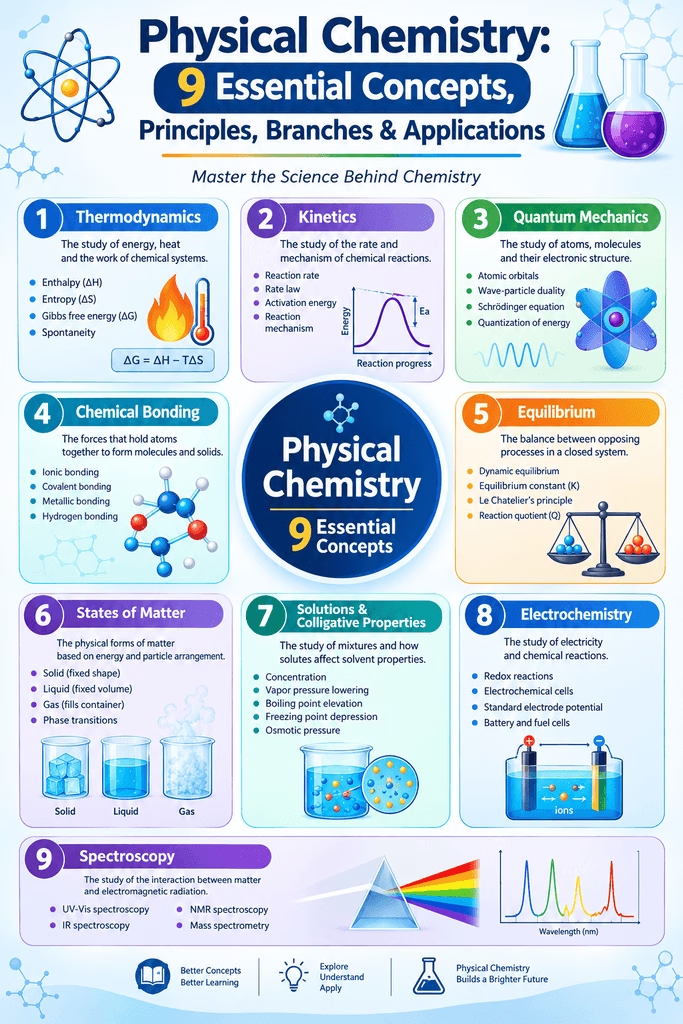
Chemistry is the science of matter, its composition, its properties, and the changes it undergoes. However, understanding chemical substances requires more than knowing which elements they contain or how they react. Scientists must also explain why reactions occur, how quickly they proceed, how energy changes during a reaction, and how temperature, pressure, and concentration influence chemical behaviour.
Physical chemistry is the branch of chemistry that applies the principles of physics and mathematics to understand chemical systems. It explains the relationship between matter and energy, the behaviour of atoms and molecules, the rates of chemical reactions, and the conditions under which chemical processes occur.
This field provides the theoretical foundation for many areas of modern science. It helps explain why certain reactions release heat, why some reactions proceed rapidly while others take years, how electrical energy can produce chemical changes, and how molecular structure influences the properties of substances.
From batteries and medicines to industrial manufacturing and environmental science, its principles have numerous practical applications. A clear understanding of the subject is therefore essential for students, researchers, engineers, and anyone interested in how the chemical world operates.
Read More: Chemistry Formulas: Essential Equations, Rules, Examples & Applications
What Is Physical Chemistry?
Physical chemistry is the branch of chemistry that uses physical principles, mathematical relationships, and experimental measurements to explain the properties and behaviour of chemical substances.
It investigates the fundamental processes that determine how atoms and molecules interact. These processes include the transfer of energy, the movement of particles, the formation and breaking of chemical bonds, and the transformation of reactants into products.
For example, when a chemical reaction takes place, several questions may arise:
- How much energy is absorbed or released?
- How quickly do the reactants form products?
- What conditions favour the formation of the products?
- How does temperature influence the reaction rate?
- Why does a chemical equilibrium shift when pressure changes?
- How do electrons move during an electrochemical reaction?
The subject provides mathematical and theoretical methods for answering these questions.
Consider the reaction between hydrogen and oxygen to form water. The chemical equation is:
2H₂ + O₂ → 2H₂O
The equation identifies the reactants and product. However, it does not explain the energy released, the reaction mechanism, the rate of the reaction, or the conditions needed to initiate it.
These questions require a deeper investigation of energy, molecular motion, reaction kinetics, and thermodynamics.
This is where the subject becomes particularly important.
Read More: What Is Inorganic Chemistry? 11 Essential Concepts, Types, Reactions & Applications
Why Is Physical Chemistry Important?
The importance of this field lies in its ability to connect observable chemical behaviour with the underlying physical processes.
It explains the scientific principles behind many familiar phenomena, including evaporation, condensation, rusting, combustion, electrolysis, and the operation of batteries.
It also provides tools for predicting how chemical systems respond when their surroundings change.
For example, increasing the temperature of a reaction often increases its rate because a greater proportion of molecules possess sufficient energy to overcome the activation-energy barrier. Similarly, changing the concentration of a reactant can alter the rate at which products form.
Understanding these relationships allows scientists to control chemical processes more effectively.
The subject is important for several reasons:
- It explains the energy changes associated with chemical reactions.
- It helps predict whether a reaction is thermodynamically favourable.
- It explains the factors that influence reaction rates.
- It describes the behaviour of gases, liquids, and solids.
- It provides a foundation for electrochemistry and battery technology.
- It helps scientists understand atomic and molecular structures.
- It supports the development of medicines, catalysts, and advanced materials.
- It improves the efficiency of industrial chemical processes.
- It contributes to environmental monitoring and pollution control.
By combining experimental evidence with mathematical models, researchers can understand existing chemical systems and predict the behaviour of new ones.
Read More: What Is Organic Chemistry? 11 Essential Concepts, Types, Reactions & Applications
The Main Branches of Physical Chemistry
The subject contains several interconnected branches. Each investigates a different aspect of chemical behaviour, but they often overlap when explaining complex systems.
1. Chemical Thermodynamics
Chemical thermodynamics studies energy, heat, work, and the conditions that determine whether a process is thermodynamically favourable.
It examines how energy changes during chemical reactions and how temperature, pressure, and composition influence the properties of a system.
One of its most important quantities is enthalpy, represented by H.
At constant pressure, the change in enthalpy is equal to the heat transferred to or from a system when only pressure–volume work is involved.
ΔH = qₚ
Here:
ΔH = change in enthalpy
qₚ = heat transferred at constant pressure
If ΔH is negative, the process is exothermic and releases heat to the surroundings.
If ΔH is positive, the process is endothermic and absorbs heat from the surroundings.
For example, the combustion of many fuels is exothermic because chemical energy is transferred to the surroundings as heat.
Another important thermodynamic quantity is entropy, represented by S. Entropy helps describe the dispersal of energy and the number of microscopic arrangements available to a system.
The second law of thermodynamics states that the total entropy of an isolated system does not decrease in a spontaneous process.
For a process occurring at constant temperature and pressure, the Gibbs free-energy change is particularly useful:
ΔG = ΔH − TΔS
Here:
ΔG = change in Gibbs free energy
ΔH = change in enthalpy
T = absolute temperature
ΔS = change in entropy
A negative value of ΔG indicates that a process is thermodynamically favourable in the forward direction under the specified conditions. However, this does not necessarily mean that the process will occur rapidly.
Thermodynamics therefore helps predict the direction of a process, while reaction kinetics helps determine its rate.
Read More: How to Calculate Moles in Chemistry: Formula, Methods, Examples & Tips
2. Chemical Kinetics
Chemical kinetics is the study of reaction rates and the factors that influence them.
A reaction rate describes how quickly the concentration of a reactant decreases or the concentration of a product increases over time.
For a reactant A, the average rate of disappearance can be written as:
Rate = −Δ[A]/Δt
Here:
[A] = concentration of A
Δt = time interval
The negative sign indicates that the concentration of the reactant decreases as the reaction proceeds.
Several factors influence reaction rates, including:
- Temperature
- Reactant concentration
- Pressure, for gaseous reactants
- Surface area
- Catalysts
- The chemical nature of the reactants
Temperature is especially important because it affects molecular motion and the distribution of molecular energies.
The Arrhenius equation describes the relationship between the rate constant and temperature:
k = Ae⁻ᴱᵃ⁄ᴿᵀ
Here:
k = rate constant
A = pre-exponential factor
Eₐ = activation energy
R = universal gas constant
T = absolute temperature
The activation energy is the energy barrier that must be overcome for a reaction to proceed through a particular pathway.
A catalyst provides an alternative reaction pathway with a lower activation energy. Consequently, it can increase the reaction rate without being consumed overall in the reaction.
Chemical kinetics is essential in industrial manufacturing, pharmaceutical development, food preservation, combustion research, and enzyme studies.
Read More: The Powerful Role of Conjugate Acid-Base Pairs in Chemistry
3. Chemical Equilibrium
Chemical equilibrium occurs when the forward and reverse reactions in a reversible system proceed at equal rates.
At equilibrium, the concentrations of reactants and products remain constant over time, provided the external conditions remain unchanged.
This does not mean that the reactions have stopped. Both processes continue, but their rates are equal.
Consider the reversible reaction:
N₂(g) + 3H₂(g) ⇌ 2NH₃(g)
This reaction is used in the industrial production of ammonia.
The equilibrium constant in terms of concentration is:
K꜀ = [NH₃]²/([N₂][H₂]³)
The brackets represent equilibrium molar concentrations.
The equilibrium constant indicates the relative proportions of products and reactants at equilibrium under a specified temperature.
A large equilibrium constant generally indicates that products are favoured, whereas a small value generally indicates that reactants are favoured.
Le Chatelier’s principle helps explain how an equilibrium responds to a change in conditions.
For example, changing the pressure of a gaseous equilibrium can shift the equilibrium position when the number of gas molecules differs between the two sides of the equation.
Changing the temperature can also alter the equilibrium constant.
This branch is important in industrial chemistry because it helps determine suitable operating conditions for maximising product yield.
Read More: A Beginner’s guide to the Periodic Table: Importance, Application, present days and history
4. Electrochemistry
Electrochemistry investigates the relationship between chemical reactions and electrical energy.
It focuses on oxidation–reduction reactions, in which electrons are transferred between chemical species.
Oxidation involves the loss of electrons, while reduction involves the gain of electrons.
For example:
Zn → Zn²⁺ + 2e⁻
This equation represents the oxidation of zinc.
In a galvanic cell, a spontaneous chemical reaction produces electrical energy. In an electrolytic cell, an external electrical source drives a non-spontaneous chemical reaction.
Electrochemistry is important in:
- Batteries
- Fuel cells
- Electrolysis
- Metal extraction
- Electroplating
- Corrosion prevention
- Electrochemical sensors
The relationship between electrical potential and Gibbs free energy can be expressed as:
ΔG = −nFE
Here:
n = number of moles of electrons transferred per mole of reaction
F = Faraday constant
E = cell potential under the specified conditions
A positive cell potential corresponds to a negative Gibbs free-energy change for the reaction as written under the relevant conditions.
This relationship connects measurable electrical properties with the thermodynamics of chemical reactions.
Read More: Is AP Chemistry Hard? 7 Encouraging Facts That Make It Easier to Master
5. Quantum Chemistry
Quantum chemistry applies quantum mechanics to atoms, molecules, and chemical systems.
It explains how electrons occupy allowed energy states and how their behaviour determines chemical bonding, molecular structure, and many spectroscopic properties.
Classical physics cannot fully explain the behaviour of electrons at atomic scales. Quantum mechanics provides a more accurate framework for describing these particles.
Electrons are described using wavefunctions, which contain information about the quantum state of a system.
The time-independent Schrödinger equation is commonly written as:
Ĥψ = Eψ
Here:
Ĥ = Hamiltonian operator, representing the total energy operator
ψ = wavefunction
E = energy eigenvalue
Solving this equation exactly is possible only for a limited number of simple systems. For more complicated atoms and molecules, scientists use approximations and computational methods.
Quantum chemistry helps explain:
- Chemical bonding
- Molecular orbitals
- Atomic spectra
- Molecular geometry
- Electronic transitions
- Reactivity
- The properties of materials
It also supports research into semiconductors, solar cells, catalysts, and advanced molecular materials.
Read More: What Is an Ideal Gas? 10 Remarkable Comprehensive Insights
6. Spectroscopy
Spectroscopy studies how matter interacts with electromagnetic radiation.
Atoms and molecules can absorb, emit, or scatter radiation under suitable conditions. The resulting spectra provide information about their structures and energy levels.
Different regions of the electromagnetic spectrum reveal different types of molecular behaviour.
For example:
- Infrared spectroscopy helps identify molecular vibrations.
- Ultraviolet-visible spectroscopy investigates electronic transitions.
- Nuclear magnetic resonance spectroscopy provides information about molecular environments.
- Raman spectroscopy examines inelastic light scattering.
Spectroscopic techniques are widely used to identify unknown compounds, monitor chemical reactions, analyse pharmaceutical products, and investigate materials.
The principles behind spectroscopy are closely connected to quantum mechanics because molecular energy levels determine which transitions can occur.
Read More: What is Organic Chemistry? 10 Fascinating and Powerful Insights into Carbon-Based Science
7. Statistical Mechanics
Statistical mechanics connects the microscopic properties of individual particles with the macroscopic behaviour of large collections of particles.
A gas contains an enormous number of molecules, each with its own position, velocity, and energy. Measuring every molecule individually is generally impractical.
Statistical mechanics uses probability and statistical distributions to predict the overall properties of the system.
For example, the pressure and temperature of a gas can be related to the collective motion of its molecules.
The Maxwell–Boltzmann distribution describes the distribution of molecular speeds in a classical ideal gas at thermal equilibrium.
Statistical mechanics helps explain heat capacity, entropy, phase transitions, molecular energy distributions, and the behaviour of gases and liquids.
It provides a bridge between molecular-scale processes and the quantities measured in laboratory experiments.
Read More: What is a Base in Chemistry: 15 Fascinating Insights That Make This a Powerful Guide
8. Surface Chemistry and Interfaces
Surface chemistry examines the physical and chemical processes occurring at the boundaries between different phases.
These interfaces may occur between a solid and a gas, a solid and a liquid, or two immiscible liquids.
The behaviour of molecules at a surface can differ significantly from their behaviour in the bulk of a material.
Important surface processes include adsorption, desorption, wetting, and heterogeneous catalysis.
Adsorption occurs when atoms, ions, or molecules accumulate on a surface. It differs from absorption, in which a substance enters the bulk of another material.
Surface chemistry is important in:
- Catalytic converters
- Water purification
- Gas sensors
- Activated-carbon filtration
- Corrosion
- Nanotechnology
- Industrial chemical reactions
For example, a heterogeneous catalyst provides a surface on which reactant molecules can adsorb and react. This can create a more favourable pathway for the chemical transformation.
Read More: What Is a Mole in Chemistry? 6 Mind-Blowing Facts & Easy Calculations
9. Phase Equilibria and Phase Transitions
Phase equilibria studies the conditions under which substances exist as solids, liquids, and gases.
A phase transition occurs when a substance changes from one physical state to another.
Examples include melting, freezing, boiling, condensation, sublimation, and deposition.
Temperature and pressure determine which phase is thermodynamically stable under specified conditions.
A phase diagram represents the stable phases of a substance across different combinations of temperature and pressure.
The triple point is the unique combination of temperature and pressure at which solid, liquid, and gas phases coexist in equilibrium for a pure substance.
The critical point marks the end of the liquid–gas phase boundary. Above the critical temperature and critical pressure, a substance can exist as a supercritical fluid rather than as a distinct liquid or gas.
Understanding phase behaviour is important in refrigeration, materials processing, food technology, chemical separation, and industrial gas handling.
Read More: What Is the Temperature of Saturn? 9 Essential Facts, Layers, Causes & Complete Guide
Fundamental Laws and Equations
Several fundamental relationships are used throughout the subject. They describe the behaviour of gases, the transfer of energy, reaction rates, and electrochemical processes.
The Ideal Gas Law
The ideal gas equation relates pressure, volume, temperature, and the amount of gas.
PV = nRT
Here:
P = pressure
V = volume
n = amount of gas in moles
R = universal gas constant
T = absolute temperature
The equation combines Boyle’s law, Charles’s law, and Avogadro’s law.
It is most accurate for gases at sufficiently low pressure and sufficiently high temperature, where molecular volume and intermolecular forces have relatively small effects.
Read More: What Does Saturn Look Like? 9 Fascinating Features of the Ringed Planet
The First Law of Thermodynamics
The first law expresses the conservation of energy.
Using the convention that work done on a system is positive:
ΔU = q + w
Here:
ΔU = change in internal energy
q = heat transferred to the system
w = work done on the system
The equation states that the internal energy changes through heat transfer and work.
It provides a foundation for analysing energy changes during physical and chemical processes.
Read More:Saturn from Earth: Distance, Closest Approach, Farthest Point & Complete Guide
The Gibbs Free-Energy Equation
At constant temperature and pressure, Gibbs free energy helps determine whether a process is thermodynamically favourable.
ΔG = ΔH − TΔS
A negative value of ΔG indicates that the forward process is thermodynamically favourable under the specified conditions.
A positive value indicates that the forward process is unfavourable, while a value of zero corresponds to equilibrium for the process under those conditions.
The Arrhenius Equation
The Arrhenius equation describes how the rate constant depends on temperature:
k = Ae⁻ᴱᵃ⁄ᴿᵀ
It helps explain why many chemical reactions become faster when the temperature increases.
The Nernst Equation
The Nernst equation describes how the electrode potential of an electrochemical system depends on temperature and the activities of the chemical species involved.
For a reaction involving n electrons:
E = E° − (RT/nF) ln Q
Here:
E = cell or electrode potential for the specified reaction
E° = standard potential
R = universal gas constant
T = absolute temperature
n = number of electrons transferred
F = Faraday constant
Q = reaction quotient
This relationship is useful for understanding batteries, electrochemical sensors, and concentration cells.
Read More: How Far Is Saturn from the Sun? Distance, Orbit, and Fascinating Facts
Physical Chemistry in Everyday Life
The principles of this subject appear in many familiar situations.
Cooking and Food Preservation
Temperature affects the rates of chemical reactions involved in cooking and food spoilage.
Refrigeration slows many chemical and biological processes, helping preserve food. Cooking, meanwhile, changes the structures of proteins and promotes other chemical transformations.
The exact behaviour depends on the food composition, moisture content, temperature, and reaction mechanisms.
Batteries and Electronic Devices
Batteries convert chemical energy into electrical energy through electrochemical reactions.
The voltage, capacity, efficiency, and lifetime of a battery depend on the chemical species involved, electrode materials, reaction kinetics, and transport processes.
A deeper understanding of electrochemistry helps researchers develop batteries with improved performance and safety.
Medicines and Pharmaceutical Development
The solubility, stability, and reaction rates of pharmaceutical compounds influence how medicines are manufactured and stored.
Thermodynamics helps assess the stability of different forms of a compound, while kinetics helps estimate degradation rates.
Spectroscopy and quantum-chemical calculations can also assist in characterising molecules and understanding their interactions.
Air Conditioning and Refrigeration
Refrigeration systems rely on phase changes and the transfer of heat.
A refrigerant absorbs heat as it evaporates and releases heat as it condenses under suitable operating conditions.
Thermodynamic principles help engineers select refrigerants and design efficient cooling systems.
Corrosion Prevention
Corrosion involves chemical or electrochemical reactions between materials and their surroundings.
The principles of electrochemistry help explain how corrosion occurs and how it can be controlled through coatings, inhibitors, material selection, and cathodic protection.
These methods are important for protecting pipelines, bridges, ships, machinery, and buildings.
Read More: How Many Rings Does Saturn Have? 9 Fascinating Facts About Saturn’s Ring System
Applications in Industry and Modern Research
The subject plays an important role in the development and optimisation of industrial technologies.
Chemical Manufacturing
Industrial reactions must be designed to produce the desired products efficiently and safely.
Thermodynamics helps determine favourable operating conditions, while kinetics helps establish the reaction rate and the role of catalysts.
Combining these approaches allows engineers to balance product yield, energy consumption, operating costs, and safety.
Renewable Energy
Solar cells, fuel cells, hydrogen production systems, and energy-storage technologies all involve physical and chemical processes.
Researchers use thermodynamics, electrochemistry, spectroscopy, and materials science to investigate energy conversion and storage.
For example, electrochemical studies help improve the efficiency of fuel cells and water-electrolysis systems.
Environmental Science
Environmental scientists use chemical and physical principles to understand pollutants in air, water, and soil.
Reaction kinetics helps estimate how quickly contaminants degrade. Surface chemistry helps explain how pollutants attach to soil particles or activated carbon.
Thermodynamics can also help predict the distribution of chemical species between environmental phases.
Nanotechnology
Nanomaterials have a high surface-area-to-volume ratio, making surface processes particularly important.
The properties of nanoparticles can differ from those of bulk materials because of their size, surface structure, and quantum effects.
Researchers use molecular modelling, spectroscopy, and thermodynamic analysis to investigate these properties and develop new materials.
Read More: How Many Moons Does Saturn Have? 293 Confirmed Moons and Their Fascinating World
Physical Chemistry and Other Branches of Chemistry
Although the branches of chemistry are interconnected, each has a different primary focus.
Organic chemistry mainly studies carbon-containing compounds, their structures, reactions, and synthesis.
Inorganic chemistry investigates metals, minerals, coordination compounds, and many substances that are not primarily classified as organic compounds.
Analytical chemistry focuses on identifying substances and determining their composition or concentration.
Biochemistry studies the chemical processes and molecules associated with living organisms.
Physical chemistry examines the physical principles underlying chemical systems, including energy, reaction rates, molecular structure, and equilibrium.
These distinctions are useful for organising scientific knowledge, but they are not strict boundaries. For example, a researcher developing a new medicine may use organic synthesis, analytical measurements, thermodynamic calculations, and kinetic studies within the same project.
Read More: The Ultimate Guide To X-Ray Production And Modern Use In Diagnosis
Essential Skills for Studying Physical Chemistry
Students can develop a strong understanding of the subject by building several fundamental skills.
Mathematics
Algebra, logarithms, proportional relationships, and graph interpretation are particularly important.
More advanced topics may require calculus, differential equations, probability, and linear algebra.
Understanding Units
Scientific equations are meaningful only when their quantities and units are used consistently.
Students should understand pressure, volume, energy, temperature, concentration, and the conversion between common units.
Graph Analysis
Graphs are frequently used to investigate relationships between physical quantities.
For example, experimental data may reveal how reaction rate changes with temperature or how pressure changes with volume.
Experimental Reasoning
Laboratory measurements help test theoretical predictions.
Students should learn to identify measurement uncertainty, control variables, compare observations with models, and interpret unexpected results.
Problem-Solving
A useful approach is to identify the known quantities, determine the required quantity, select the appropriate equation, substitute compatible values, and check whether the answer is physically reasonable.
Practising these steps regularly helps develop confidence and accuracy.
Read More: What Is a CT Scan? Understanding Its Uses, Benefits, and Risks
Common Misconceptions
Several misunderstandings can make the subject more difficult than necessary.
Thermodynamic Favourability Does Not Guarantee a Fast Reaction
A reaction may be thermodynamically favourable but proceed extremely slowly because of a high activation-energy barrier.
Thermodynamics and kinetics answer different questions.
Equilibrium Does Not Mean That Reactions Have Stopped
At dynamic equilibrium, the forward and reverse reactions continue at equal rates.
The concentrations remain constant because there is no net change in composition.
A Catalyst Does Not Change the Equilibrium Constant
A catalyst provides a different reaction pathway and speeds up the approach to equilibrium.
It does not change the equilibrium constant at a given temperature.
Heat and Temperature Are Different
Temperature describes the thermal state of a system, whereas heat is energy transferred because of a temperature difference.
A large object and a small object can have the same temperature but different internal energies.
Ideal-Gas Behaviour Is an Approximation
Real gas molecules have finite volume and experience intermolecular forces.
The ideal-gas model works well under many conditions, but more advanced models are needed when these effects become significant.
Read More: Stars The Cosmic Kitchen: Birth and Death Explained
Key Takeaways
The essential points to remember are:
- Physical chemistry applies physical principles and mathematics to explain chemical systems.
- Chemical thermodynamics investigates heat, work, energy, entropy, and free energy.
- Chemical kinetics explains reaction rates and the factors that influence them.
- Chemical equilibrium describes the balance between forward and reverse reactions.
- Electrochemistry connects chemical reactions with electrical energy.
- Quantum chemistry explains atomic and molecular behaviour using quantum mechanics.
- Spectroscopy provides information about molecular structure and energy levels.
- Statistical mechanics connects microscopic particle behaviour with macroscopic properties.
- Surface chemistry studies processes at interfaces.
- Phase equilibria explains the stability of different physical states.
- The subject supports research in medicine, energy, manufacturing, environmental science, and materials development.
- Mathematics, experimental reasoning, and careful use of units are essential for solving problems accurately.
Frequently Asked Questions (FAQ)
What is physical chemistry in simple words?
It is the branch of chemistry that uses physics and mathematics to explain how substances behave, how chemical reactions occur, how energy changes during reactions, and how factors such as temperature and pressure influence chemical systems.
What are the main branches of physical chemistry?
The major areas include chemical thermodynamics, chemical kinetics, chemical equilibrium, electrochemistry, quantum chemistry, spectroscopy, statistical mechanics, surface chemistry, and phase equilibria.
Why is physical chemistry important?
It provides a scientific foundation for understanding reaction rates, energy changes, molecular behaviour, and chemical equilibrium. Its principles are used in medicine, energy technology, industrial manufacturing, environmental science, and materials research.
What is the difference between physical chemistry and organic chemistry?
Organic chemistry primarily studies carbon-containing compounds, including their structures, reactions, and synthesis. The other field focuses on the physical principles that explain chemical behaviour, including energy, kinetics, equilibrium, and molecular properties. Both fields often overlap in research.
Is mathematics important in physical chemistry?
Yes. Algebra, logarithms, graphs, and proportional relationships are essential for introductory study. Advanced work may involve calculus, differential equations, probability, and computational methods.
What is the difference between thermodynamics and chemical kinetics?
Thermodynamics helps determine whether a process is thermodynamically favourable and describes its energy changes. Chemical kinetics investigates how quickly the process occurs and how its rate depends on different conditions.
What is chemical equilibrium?
Chemical equilibrium is a dynamic state in which the forward and reverse reaction rates are equal. The concentrations of reactants and products remain constant when the external conditions are unchanged.
How is physical chemistry used in everyday life?
Its principles help explain refrigeration, battery operation, cooking, corrosion, gas behaviour, and many processes involved in medicines and household products.
What is the role of quantum chemistry?
Quantum chemistry applies quantum mechanics to atoms and molecules. It helps explain chemical bonding, molecular structure, electronic energy levels, spectroscopy, and chemical reactivity.
What careers use physical chemistry?
Relevant careers include research scientist, chemical engineer, materials scientist, pharmaceutical researcher, electrochemist, energy researcher, laboratory analyst, and academic scientist. The required qualifications depend on the specific role.
Conclusion
Physical chemistry provides a fundamental framework for understanding the relationship between physical processes and chemical behaviour. It explains how energy changes during reactions, why reaction rates vary, how equilibrium is established, and how the microscopic properties of atoms and molecules determine the macroscopic behaviour of matter.
Its major branches, including thermodynamics, kinetics, electrochemistry, quantum chemistry, spectroscopy, and statistical mechanics, address different aspects of chemical systems. Together, they allow scientists to investigate matter from the molecular scale to large industrial processes.
The subject is not limited to theoretical equations or laboratory experiments. Its principles support battery development, pharmaceutical research, refrigeration, corrosion prevention, renewable energy, environmental protection, and advanced materials.
A strong understanding begins with basic concepts such as energy, temperature, pressure, molecular motion, and reaction rates. By learning these principles and applying them to numerical problems and experiments, students can develop the skills needed to understand more complex chemical systems.
Ultimately, the subject helps answer a fundamental scientific question: Why do substances behave the way they do, and how can their behaviour be predicted and controlled? Its combination of physical laws, mathematical reasoning, and chemical evidence makes it an essential part of modern science.