
What Is Oxidation in Chemistry? A Complete Guide to Rules, Reactions, Examples, and Applications
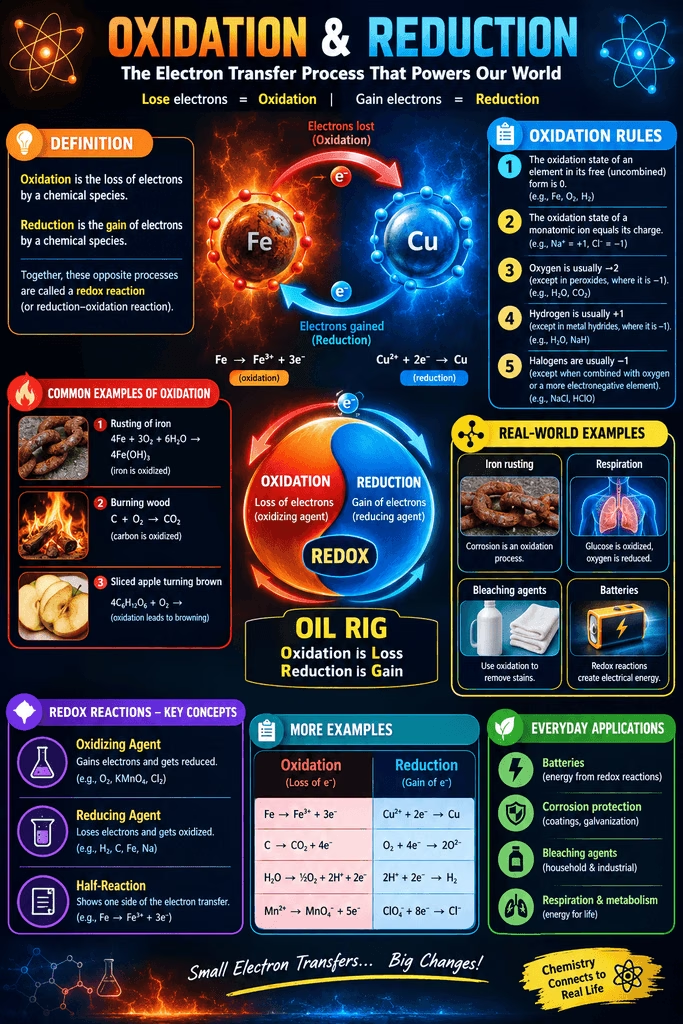
Chemistry explains how substances interact, change, and form new products through chemical reactions. One of the most important concepts in this field is oxidation, which occurs in many everyday processes, including rusting, combustion, respiration, and the operation of batteries. Understanding oxidation in chemistry helps students explain how electrons are transferred between substances and how chemical reactions take place.
Oxidation was originally associated with the combination of a substance with oxygen. However, modern chemistry provides a broader definition based on electron transfer and changes in oxidation states. This broader explanation allows chemists to identify oxidation even when oxygen is not involved in a reaction.
For example, when magnesium burns in oxygen, it forms magnesium oxide. When iron reacts with oxygen and moisture, rust develops on its surface. Similarly, when a metal reacts with certain nonmetals, electrons may be transferred even without the direct involvement of oxygen.
These examples demonstrate why oxidation is essential for understanding inorganic chemistry, electrochemistry, industrial processes, and biological systems.
This article explains oxidation in chemistry through its definition, fundamental principles, rules, chemical equations, practical examples, differences from reduction, and applications in everyday life and industry.
Read More: Physical Chemistry: 9 Essential Concepts, Principles, Branches & Applications
What Is Oxidation in Chemistry?
Oxidation in chemistry is a chemical process in which an atom, ion, or molecule loses electrons or experiences an increase in its oxidation state.
According to the modern definition, oxidation involves the loss of electrons by a chemical species. The substance that undergoes oxidation is called the reducing agent because it causes another substance to gain electrons through reduction.
A simple example is the reaction between sodium and chlorine.
2Na+Cl22NaCl
In this reaction, each sodium atom loses one electron to form a positively charged sodium ion. Chlorine gains electrons and forms negatively charged chloride ions.
The corresponding half-equations are:
NaNa++e-
Cl2+2e-2Cl-
Sodium undergoes oxidation because it loses electrons, while chlorine undergoes reduction because it gains electrons.
The modern definition is particularly useful because oxidation can occur in reactions involving oxygen, chlorine, and other substances, as well as in reactions where electrons are transferred indirectly.
Read More: Chemistry Formulas: Essential Equations, Rules, Examples & Applications
The Traditional Definition of Oxidation
Historically, oxidation referred to the combination of a substance with oxygen. This definition remains useful when studying reactions such as combustion and the formation of metal oxides.
For example, magnesium reacts with oxygen to produce magnesium oxide.
2Mg+O22MgO
During this reaction, magnesium combines with oxygen and loses electrons. Its oxidation state increases from 0 to +2.
Another example is the oxidation of carbon monoxide to carbon dioxide.
2CO+O22CO2
Carbon monoxide combines with oxygen to form carbon dioxide. The oxidation state of carbon increases from +2 to +4.
Although the traditional definition describes many familiar reactions, it does not explain every oxidation process. Therefore, electron transfer and oxidation-state changes provide a more comprehensive understanding.
Read More: What Is Inorganic Chemistry? 11 Essential Concepts, Types, Reactions & Applications
The Main Principles of Oxidation
Several principles help explain how oxidation occurs and how it can be identified in chemical reactions.
1. Loss of Electrons
The loss of electrons is the fundamental definition of oxidation in terms of electron transfer.
Consider the oxidation of iron(II) ions to iron(III) ions.
Fe2+Fe3++e-
An iron(II) ion loses one electron and becomes an iron(III) ion. Its charge changes from +2 to +3, indicating oxidation.
This principle is especially important in electrochemistry, where electron transfer produces an electric current in electrochemical cells.
Read More: What Is Organic Chemistry? 11 Essential Concepts, Types, Reactions & Applications
2. Increase in Oxidation State
Oxidation can also be identified by an increase in the oxidation state of an element.
For example:
Fe2+Fe3+
The oxidation state of iron increases from +2 to +3. Therefore, iron undergoes oxidation.
In more complex reactions, oxidation-state changes may occur without the transfer of free electrons directly from one atom to another. Nevertheless, an increase in oxidation state identifies oxidation.
3. Gain of Oxygen
A substance is traditionally considered oxidized when it gains oxygen.
For example, copper reacts with oxygen when heated in air.
2Cu+O22CuO
Copper combines with oxygen to form copper(II) oxide. The oxidation state of copper increases from 0 to +2.
This reaction illustrates the traditional definition and agrees with the modern oxidation-state definition.
Read More: How to Calculate Moles in Chemistry: Formula, Methods, Examples & Tips
4. Loss of Hydrogen
In many chemical reactions, a substance undergoes oxidation by losing hydrogen atoms.
For example, ethanol can be oxidized to ethanal under suitable conditions.
CH3CH2OH+[O]CH3CHO+H2O
Here, [O] represents an oxidizing equivalent rather than necessarily indicating free atomic oxygen. The equation summarizes the conversion of ethanol into ethanal using an oxidizing agent.
In organic chemistry, the removal of hydrogen often accompanies an increase in the oxidation state of carbon.
Read More:The Powerful Role of Conjugate Acid-Base Pairs in Chemistry
Oxidation and Reduction: Understanding the Relationship
Oxidation and reduction are closely related processes. They occur together in reactions known as redox reactions.
Oxidation involves the loss of electrons or an increase in oxidation state. Reduction involves the gain of electrons or a decrease in oxidation state.
The mnemonic OIL RIG is commonly used to remember these definitions:
- OIL: Oxidation Is Loss of electrons.
- RIG: Reduction Is Gain of electrons.
Consider the reaction between zinc and copper(II) sulfate.
Zn+CuSO4ZnSO4+Cu
The ionic equation is:
Zn+Cu2+Zn2++Cu
Zinc loses two electrons:
ZnZn2++2e-
Copper(II) ions gain two electrons:
Cu2++2e-Cu
Therefore, zinc undergoes oxidation, while copper(II) ions undergo reduction.
Neither process occurs independently in this reaction because the electrons lost by zinc are accepted by copper(II) ions.
Differences Between Oxidation and Reduction
| Oxidation | Reduction |
| Involves the loss of electrons. | Involves the gain of electrons. |
| Oxidation state increases. | Oxidation state decreases. |
| Often involves the gain of oxygen. | Often involves the loss of oxygen. |
| May involve the loss of hydrogen. | May involve the gain of hydrogen. |
| Occurs at the anode in an electrochemical cell. | Occurs at the cathode in an electrochemical cell. |
The terms anode and cathode describe the locations of oxidation and reduction, respectively, regardless of whether the electrochemical cell is galvanic or electrolytic.
Read More: A Beginner’s guide to the Periodic Table: Importance, Application, present days and history
Oxidation Numbers and Their Rules
Oxidation numbers, also called oxidation states, help chemists identify oxidation and reduction in chemical reactions.
An oxidation number is an assigned value that represents the apparent charge of an atom according to a set of chemical rules. In ionic compounds, it often corresponds to the actual ionic charge. In covalent compounds, it is determined by assigning bonding electrons to the more electronegative atom.
The following rules are particularly important.
Rule 1: Free Elements Have an Oxidation Number of Zero
An element in its uncombined form has an oxidation number of zero.
Examples include:
Na=0
O2=0
Cl2=0
Fe=0
This rule applies whether the element exists as individual atoms or as molecules containing identical atoms.
Read More: Is AP Chemistry Hard? 7 Encouraging Facts That Make It Easier to Master
Rule 2: Monatomic Ions Have Oxidation Numbers Equal to Their Charges
For a monatomic ion, the oxidation number equals its electrical charge.
Examples include:
Na+=+1
Mg2+=+2
Cl-=-1
O2-=-2
These values make it easier to determine which species undergoes oxidation or reduction.
Rule 3: Oxygen Usually Has an Oxidation Number of −2
Oxygen generally has an oxidation number of −2 in compounds such as water, magnesium oxide, and carbon dioxide.
For water:
H2O
Each hydrogen atom has an oxidation number of +1. Since the molecule is electrically neutral, oxygen must have an oxidation number of −2.
However, exceptions exist. In peroxides, such as hydrogen peroxide, oxygen has an oxidation number of −1. In compounds with fluorine, oxygen can have a positive oxidation number.
Read More: What Is an Ideal Gas? 10 Remarkable Comprehensive Insights
Rule 4: Hydrogen Usually Has an Oxidation Number of +1
Hydrogen generally has an oxidation number of +1 when bonded to nonmetals.
For example, in water, each hydrogen atom has an oxidation number of +1.
In metal hydrides, such as sodium hydride, hydrogen has an oxidation number of −1.
Rule 5: The Sum of Oxidation Numbers Equals the Overall Charge
In a neutral compound, the sum of all oxidation numbers is zero. In a polyatomic ion, the sum equals the overall charge of the ion.
Consider sulfuric acid, H2SO4.
Let the oxidation number of sulfur be x.
2(+1)+x+4(-2)=0
2+x-8=0
x=+6
Therefore, sulfur has an oxidation number of +6 in sulfuric acid.
These rules allow students to determine whether oxidation has occurred even when a reaction contains several elements and compounds.
Read More: What is Organic Chemistry? 10 Fascinating and Powerful Insights into Carbon-Based Science
Types of Oxidation Reactions
Oxidation can occur through different chemical mechanisms. Recognizing these types helps explain reactions in laboratories, industries, and natural environments.
1. Oxidation by Oxygen
This type occurs when a substance combines with oxygen.
For example, carbon burns in oxygen to form carbon dioxide.
C+O2CO2
The oxidation state of carbon increases from 0 to +4. Therefore, carbon is oxidized.
The reaction releases energy as heat and light, making it an example of combustion.
2. Oxidation by Electron Transfer
Some oxidation reactions occur without oxygen participating directly.
For example, zinc reacts with copper(II) ions to form zinc ions and copper metal.
Zn+Cu2+Zn2++Cu
Zinc loses electrons and undergoes oxidation. This reaction demonstrates that oxygen is not necessary for oxidation to occur.
Read More: What is a Base in Chemistry: 15 Fascinating Insights That Make This a Powerful Guide
3. Oxidation in Organic Chemistry
In organic chemistry, oxidation frequently involves increasing the number of bonds between carbon and oxygen, decreasing the number of bonds between carbon and hydrogen, or both.
For example, a primary alcohol can be oxidized to an aldehyde and, under suitable conditions, further oxidized to a carboxylic acid.
CH3CH2OHCH3CHO
CH3CHO+[O]CH3COOH
The products and reaction conditions depend on the oxidizing agent, solvent, temperature, and other factors.
4. Oxidation in Biological Systems
Living organisms depend on oxidation reactions to release energy from nutrients.
During cellular respiration, glucose is gradually oxidized, and the released energy is used to produce ATP, which supplies energy for cellular activities.
The overall equation for aerobic respiration is:
C6H12O6+6O26CO2+6H2O
Glucose is oxidized to carbon dioxide, while oxygen is reduced to water. The actual process involves many enzyme-controlled steps rather than one direct reaction.
Read More: What Is a Mole in Chemistry? 6 Mind-Blowing Facts & Easy Calculations
Common Examples of Oxidation in Chemistry
Examples from everyday life make the concept easier to understand.
1. Rusting of Iron
Rusting occurs when iron reacts with oxygen and moisture over time. The process produces hydrated iron(III) oxides and related corrosion products.
A simplified representation is:
4Fe+3O22Fe2O3
This equation represents the formation of iron(III) oxide, not the complete composition of ordinary rust, which is generally hydrated and chemically more complex.
Iron loses electrons during corrosion, while oxygen is reduced. Water and dissolved substances help the electrochemical reactions proceed.
Rusting damages bridges, vehicles, pipelines, tools, and other iron-containing structures. Protective paint, galvanization, and suitable coatings can slow the process.
2. Burning of Magnesium
When magnesium ribbon burns in air, it produces an intense white light and forms magnesium oxide.
2Mg+O22MgO
Magnesium changes from an oxidation state of 0 to +2. Oxygen changes from 0 to −2.
This reaction is highly exothermic, meaning that it releases energy.
3. Combustion of Carbon
Carbon reacts with sufficient oxygen to form carbon dioxide.
C+O2CO2
Carbon is oxidized, and oxygen is reduced. This reaction occurs during the complete combustion of carbon-containing fuels, although real fuels often contain hydrogen and other elements as well.
When oxygen is insufficient, incomplete combustion may produce carbon monoxide or soot.
4. Oxidation of Copper
Copper reacts with oxygen when heated, forming black copper(II) oxide.
2Cu+O22CuO
This reaction demonstrates how oxidation changes the chemical composition and appearance of a metal.
Copper-containing surfaces can also develop green patinas over time due to reactions with substances in the atmosphere. These surface products are not simply copper(II) oxide.
5. Oxidation of Glucose
During aerobic respiration, glucose is oxidized through a series of biochemical reactions.
C6H12O6+6O26CO2+6H2O
This process supports life by transferring energy from glucose into forms that cells can use.
Oxidizing Agents and Reducing Agents
An oxidizing agent is a substance that causes another substance to undergo oxidation. It accepts electrons and is itself reduced.
A reducing agent causes another substance to undergo reduction. It donates electrons and is itself oxidized.
Consider the reaction:
Zn+Cu2+Zn2++Cu
Zinc is the reducing agent because it supplies electrons to copper(II) ions.
Copper(II) ions are the oxidizing agent because they accept electrons from zinc.
Common oxidizing agents include oxygen, chlorine, hydrogen peroxide, potassium permanganate, and potassium dichromate. Their suitability depends on the reaction conditions and the substances involved.
Common reducing agents include hydrogen, carbon monoxide, zinc, and magnesium. Some reducing agents are used to extract metals from their ores, while others are important in organic synthesis and industrial manufacturing.
It is essential to distinguish an agent’s role from the process it undergoes. The oxidizing agent causes oxidation but undergoes reduction itself. Similarly, the reducing agent causes reduction but undergoes oxidation.
Oxidation in Electrochemistry
Electrochemistry studies the relationship between chemical reactions and electrical energy. Oxidation and reduction are central to this field because electron transfer can generate electricity or be driven by an external power source.
Oxidation at the Anode
Oxidation always occurs at the anode.
In a galvanic cell, oxidation releases electrons that travel through the external circuit. In an electrolytic cell, an external power source drives the nonspontaneous reaction.
For example, during the operation of a zinc-based galvanic cell, zinc may be oxidized according to the following half-equation:
ZnZn2++2e-
The released electrons move through the external circuit toward the cathode, where reduction takes place.
Role in Batteries
Batteries use redox reactions to convert chemical energy into electrical energy or, in rechargeable systems, to store electrical energy as chemical energy.
During discharge, oxidation occurs at the negative electrode of a typical galvanic battery, while reduction occurs at the positive electrode. During charging, the reactions are driven in the reverse direction.
Different battery chemistries use different electrode materials and reaction mechanisms. Nevertheless, oxidation and reduction remain essential to their operation.
Applications of Oxidation in Everyday Life and Industry
Oxidation has numerous applications in science, manufacturing, medicine, energy production, and environmental management.
1. Metal Extraction
Many metals occur naturally in ores as compounds rather than as pure elements. Extracting these metals often requires reduction of their compounds, while oxidation reactions may help prepare ores or refine metals during other stages of processing.
For example, the production of iron in a blast furnace involves the reduction of iron oxides by carbon monoxide.
Fe2O3+3CO2Fe+3CO2
In this reaction, iron(III) oxide is reduced to iron, while carbon monoxide is oxidized to carbon dioxide.
This example illustrates how oxidation and reduction work together in industrial metallurgy.
2. Water Treatment
Oxidizing agents are used in water treatment to help control microorganisms, remove certain contaminants, and transform dissolved substances into forms that can be removed more easily.
Chlorine and ozone are examples of oxidizing agents used in appropriate treatment systems. The choice depends on water quality, treatment goals, operating conditions, and safety requirements.
Oxidation does not automatically make every contaminant harmless. Effective water treatment requires suitable chemical control and monitoring.
3. Food Preservation
Oxidation affects food quality by changing color, flavor, aroma, and nutritional properties.
For example, exposure to oxygen can cause fats and oils to become rancid. Cut apples and other fruits may turn brown when enzymes catalyze oxidation-related reactions.
Food manufacturers reduce unwanted oxidation by using suitable packaging, controlling storage conditions, limiting oxygen exposure, or adding approved antioxidants.
4. Energy Production
Combustion involves oxidation and releases energy that can be used for heating, transportation, and electricity generation.
Fossil fuels react with oxygen to produce heat, but their combustion also generates carbon dioxide and may release other pollutants.
Fuel cells use electrochemical reactions rather than ordinary flame combustion. In a hydrogen fuel cell, hydrogen is oxidized at one electrode, while oxygen is reduced at the other, producing electrical energy and water under suitable operating conditions.
5. Chemical Manufacturing
Oxidation reactions are used to manufacture alcohol derivatives, aldehydes, ketones, carboxylic acids, and many other chemicals.
For instance, controlled oxidation can convert alcohols into valuable intermediates used in pharmaceuticals, polymers, solvents, and fragrances.
Industrial chemists select oxidizing agents and reaction conditions to obtain the desired product while minimizing waste and unwanted side reactions.
Factors That Affect Oxidation
The rate and extent of oxidation depend on several factors.
Temperature
Higher temperatures often increase reaction rates because particles move more rapidly and a greater proportion of collisions can overcome the activation energy barrier.
For example, many metals oxidize more rapidly when heated. However, the effect of temperature depends on the reaction mechanism and the substances involved.
Concentration
Increasing the concentration of a reactant may increase the reaction rate when that reactant participates in the rate-determining process.
For example, changing the concentration of an oxidizing agent can affect the speed of certain oxidation reactions in solution.
Surface Area
A greater exposed surface area can increase the rate of oxidation when a solid reacts with a gas or solution.
Powdered metals often react more rapidly than large pieces of the same metal because more of the material is exposed to the reacting substance.
Nature of the Reactants
Different substances have different tendencies to lose or gain electrons. Their chemical structures, bonding, electrode potentials, and reaction conditions influence whether oxidation is favorable and how quickly it occurs.
Catalysts
Catalysts can increase reaction rates by providing an alternative reaction pathway with a lower activation energy. Some oxidation processes rely on catalysts to improve efficiency and selectivity.
However, a catalyst does not necessarily make every oxidation reaction faster under every possible condition.
How to Identify Oxidation in a Chemical Equation
Students can identify oxidation systematically by following a few steps.
- Write the balanced chemical equation.
- Determine the oxidation number of the relevant element before the reaction.
- Determine its oxidation number after the reaction.
- Compare the two values.
- Identify an increase as oxidation and a decrease as reduction.
Consider the following equation:
2FeCl2+Cl22FeCl3
In iron(II) chloride, iron has an oxidation number of +2. In iron(III) chloride, iron has an oxidation number of +3.
Therefore, iron is oxidized because its oxidation number increases from +2 to +3.
Chlorine changes from an oxidation number of 0 in Cl2 to −1 in iron(III) chloride. Therefore, chlorine is reduced.
This method is useful for reactions involving covalent compounds, ionic compounds, and substances in aqueous solutions.
Common Misconceptions About Oxidation
Several misunderstandings can make this topic difficult for beginners.
Misconception 1: Oxidation always requires oxygen.
This is incorrect. Oxidation can occur through electron loss or an increase in oxidation state without oxygen being present in the reaction.
Misconception 2: Oxidation and reduction can occur independently in a redox reaction.
Oxidation and reduction occur together because electrons lost by one species must be accepted by another species in the overall electron-transfer process.
Misconception 3: An oxidizing agent is itself oxidized.
An oxidizing agent accepts electrons and is reduced. The reducing agent donates electrons and is oxidized.
Misconception 4: Oxidation always involves a positive charge.
Oxidation does not necessarily mean that a species develops a positive electrical charge. In covalent compounds, oxidation can be identified through changes in assigned oxidation states even when the molecule remains electrically neutral.
Misconception 5: Rusting and burning are identical processes.
Both involve oxidation, but they differ considerably in rate, conditions, and energy release. Burning is generally a rapid reaction that releases substantial heat, whereas rusting is usually a much slower corrosion process.
Understanding these distinctions helps students apply the concept accurately to different chemical reactions.
Frequently Asked Questions (FAQ)
1. What is oxidation in chemistry?
Oxidation in chemistry is the process in which a chemical species loses electrons or experiences an increase in oxidation state. It may also involve gaining oxygen or losing hydrogen in many familiar reactions.
2. What is the simplest example of oxidation?
The reaction between magnesium and oxygen is a simple example.
2Mg+O22MgO
Magnesium loses electrons and forms magnesium ions, while oxygen gains electrons and forms oxide ions.
3. What is the difference between oxidation and reduction?
Oxidation involves electron loss and an increase in oxidation state. Reduction involves electron gain and a decrease in oxidation state. Both occur together in a redox reaction.
4. Does oxidation always involve oxygen?
No. A substance can undergo oxidation without reacting directly with oxygen. For example, zinc loses electrons when it reacts with copper(II) ions.
5. What is an oxidizing agent?
An oxidizing agent accepts electrons from another species, causing that species to undergo oxidation. The oxidizing agent itself undergoes reduction.
6. What is a reducing agent?
A reducing agent donates electrons to another species, causing that species to undergo reduction. The reducing agent itself undergoes oxidation.
7. How can oxidation be identified using oxidation numbers?
Compare the oxidation number of an element before and after a reaction. If the oxidation number increases, the element has undergone oxidation.
8. Is rusting an oxidation reaction?
Yes. Rusting involves oxidation of iron and reduction of oxygen in the presence of moisture. It produces hydrated iron oxides and other corrosion products.
9. Why is oxidation important in everyday life?
Oxidation is important in respiration, combustion, batteries, metal processing, water treatment, and chemical manufacturing. It also influences food quality and the corrosion of metals.
10. Where does oxidation occur in an electrochemical cell?
Oxidation occurs at the anode in both galvanic and electrolytic cells. Reduction occurs at the cathode.
Conclusion
Oxidation in chemistry is a fundamental concept that explains many chemical reactions, from the rusting of iron to the generation of electricity in batteries. Although oxidation was originally defined as the combination of a substance with oxygen, the modern definition focuses on electron loss and increases in oxidation state.
Understanding oxidation numbers, half-equations, oxidizing agents, and reducing agents allows students to recognize oxidation in a wide variety of reactions. The concept also provides a foundation for studying electrochemistry, organic chemistry, metallurgy, environmental science, and biological energy production.
By learning how oxidation works and how it relates to reduction, students can develop a clearer understanding of chemical changes and their importance in everyday life.