
Spectroscopy in Chemistry: 9 Essential Techniques, Principles, and Applications
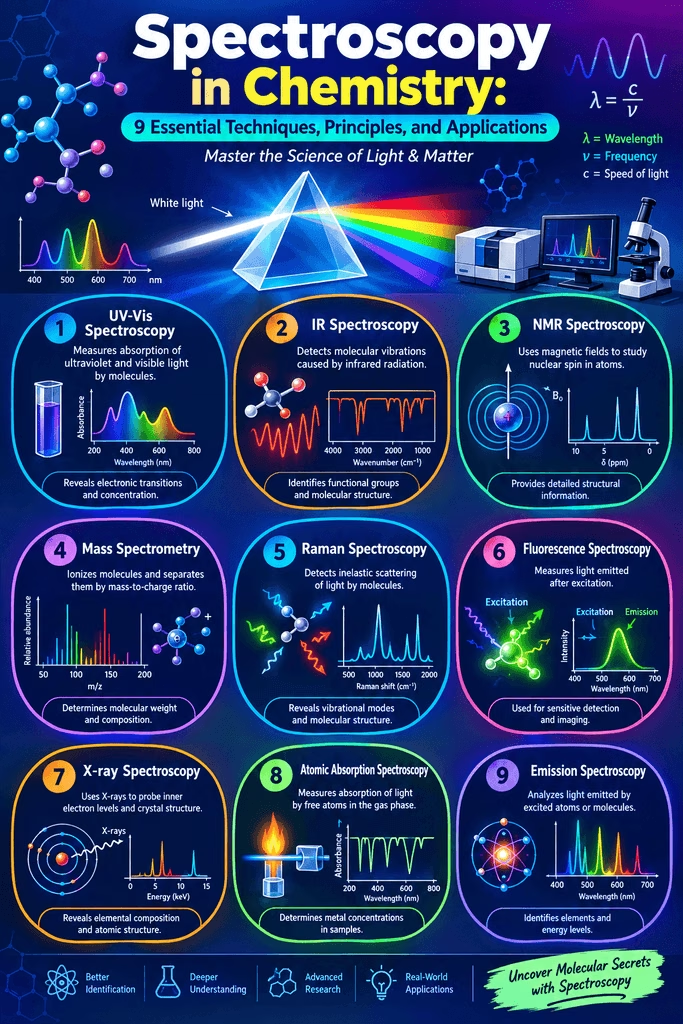
Chemistry is the study of matter, its composition, properties, structure, and the changes it undergoes. To understand the microscopic world of atoms and molecules, scientists need reliable methods for identifying substances and investigating their chemical properties. One of the most important analytical methods used for this purpose is spectroscopy in chemistry. It helps scientists examine how matter interacts with electromagnetic radiation and use the resulting information to determine the identity, structure, and concentration of chemical substances.
Many substances appear similar to the naked eye but have different molecular structures and chemical compositions. Ordinary observation cannot always distinguish between them. Spectroscopic techniques provide a way to investigate these differences by measuring the absorption, emission, or scattering of radiation by matter. The resulting measurements contain valuable information about the energy levels and behavior of atoms and molecules.
These techniques are widely used in laboratories, universities, pharmaceutical companies, environmental monitoring facilities, food industries, and research institutions. They help scientists identify unknown compounds, analyze chemical reactions, test the purity of materials, and investigate the composition of distant stars and planets.
Understanding spectroscopy in chemistry is therefore essential for students who want to learn how modern analytical chemistry works. It connects fundamental concepts such as electromagnetic radiation, quantized energy levels, atomic structure, and molecular vibrations with practical applications in science and industry.
Read More: What Is Oxidation in Chemistry? A Complete Guide to Rules, Reactions, Examples, and Applications
What Is Spectroscopy in Chemistry?
Spectroscopy in chemistry is the study of how electromagnetic radiation interacts with atoms, molecules, and other forms of matter. It involves measuring and interpreting the radiation absorbed, emitted, or scattered by a substance to obtain information about its chemical composition, molecular structure, and physical properties.
When electromagnetic radiation interacts with a substance, its atoms or molecules may absorb energy and move to higher energy states. Under suitable conditions, they may also release energy as radiation when they return to lower energy states. These interactions produce characteristic spectral patterns that can be analyzed to identify substances and investigate their properties.
For example, when a sample absorbs ultraviolet or visible light, electrons may move from lower-energy orbitals to higher-energy orbitals. In infrared spectroscopy, molecules absorb radiation that causes particular vibrational motions, such as stretching or bending of chemical bonds. In nuclear magnetic resonance spectroscopy, atomic nuclei interact with radiofrequency radiation in a magnetic field.
Each technique provides different types of information. Some are especially useful for identifying functional groups, while others reveal molecular connectivity, electronic structure, or elemental composition.
A spectrum is the record of a measured response as a function of wavelength, frequency, wavenumber, or another relevant quantity. By examining the position, intensity, and shape of spectral features, chemists can obtain information that may not be available through ordinary chemical tests.
Read More: Physical Chemistry: 9 Essential Concepts, Principles, Branches & Applications
The Basic Principle of Spectroscopy
The fundamental principle behind spectroscopic analysis is that matter interacts with radiation in ways determined by its energy levels and physical structure.
Atoms and molecules possess specific allowed energy states. When radiation interacts with them, energy can be absorbed or released if the interaction satisfies the relevant physical conditions.
1. Absorption of Radiation
Absorption occurs when an atom or molecule takes in energy from incoming radiation. If the energy of the radiation matches an allowed energy difference within the substance, a transition may occur from a lower energy state to a higher one.
The relationship between the energy of a photon and its frequency is expressed as:
[
E=h\nu
]
Here, (E) represents the energy of the photon, (h) is Planck’s constant, and (\nu) is the frequency of the radiation.
The energy difference between two states can be expressed as:
[
\Delta E=E_2-E_1=h\nu
]
where (E_1) and (E_2) represent the initial and final energy levels, respectively.
This relationship explains why different types of radiation produce different effects. Ultraviolet and visible radiation can cause electronic transitions, while infrared radiation commonly excites molecular vibrations.
2. Emission of Radiation
Emission occurs when an excited atom or molecule releases energy as radiation while moving to a lower energy state. The emitted photon has an energy corresponding to the difference between the two states.
Emission measurements are particularly useful in atomic spectroscopy. For example, when certain elements are heated in a flame or excited in a plasma, their atoms can emit light at characteristic wavelengths.
These wavelengths help scientists identify the elements present in a sample.
3. Scattering of Radiation
Scattering occurs when radiation interacts with matter and changes direction. In some scattering processes, the radiation retains approximately the same energy. In others, its energy changes because of interactions with molecular vibrations or other energy states.
Raman spectroscopy uses inelastic scattering to investigate molecular vibrations. It complements infrared spectroscopy because the two methods follow different selection rules and may reveal different vibrational information.
Together, absorption, emission, and scattering form the foundation of many analytical techniques used in modern chemistry.
Read More: Chemistry Formulas: Essential Equations, Rules, Examples & Applications
Why Do Different Substances Produce Different Spectra?
Different substances have different atomic arrangements, molecular structures, chemical bonds, and energy levels. Consequently, they interact with electromagnetic radiation in different ways.
For example, two compounds may contain the same types of atoms but differ in the arrangement of those atoms. Their vibrational modes and electronic transitions may therefore differ, producing distinguishable spectral patterns.
The spectrum of a substance can contain several important features:
- Peak position: Indicates the wavelength, frequency, or energy associated with a particular interaction.
- Peak intensity: Provides information about the amount of radiation absorbed, emitted, or scattered.
- Peak shape: May reveal information about molecular environments, interactions, and experimental conditions.
- Peak width: Can be influenced by factors such as temperature, collisions, instrumental resolution, and the lifetime of excited states.
Scientists compare observed spectra with reference data, theoretical predictions, and known spectral patterns to identify substances. However, a single peak is not always sufficient for identification. Reliable analysis often requires several features and supporting evidence.
Read More: What Is Inorganic Chemistry? 11 Essential Concepts, Types, Reactions & Applications
The Main Types of Spectroscopy in Chemistry
Different spectroscopic techniques investigate different aspects of matter. The choice of method depends on the sample, the information required, and the available equipment.
1. Ultraviolet-Visible Spectroscopy
Ultraviolet-visible spectroscopy, commonly called UV-Vis spectroscopy, measures the absorption of ultraviolet and visible light by a sample.
When a molecule absorbs radiation in this region, electrons may move from lower-energy orbitals to higher-energy orbitals. These transitions are especially important in molecules containing conjugated systems, aromatic rings, and certain functional groups.
UV-Vis spectroscopy is widely used to determine the concentration of substances in solution. It is also useful for studying reaction rates, analyzing colored compounds, and investigating chemical equilibria.
The Beer-Lambert law describes the relationship between absorbance and concentration under suitable conditions:
[
A=\varepsilon lc
]
Here, (A) is absorbance, (\varepsilon) is the molar absorption coefficient, (l) is the path length of the sample cell, and (c) is the concentration of the absorbing species.
When the other variables remain constant, absorbance is proportional to concentration within the method’s applicable range.
For example, a chemist can measure the absorbance of a colored solution and use a calibration curve to estimate the concentration of a dissolved compound.
Read More: What Is Organic Chemistry? 11 Essential Concepts, Types, Reactions & Applications
2. Infrared Spectroscopy
Infrared spectroscopy investigates the absorption of infrared radiation by molecules. This radiation can excite molecular vibrations, including stretching and bending motions of chemical bonds.
Different bonds and functional groups absorb infrared radiation at characteristic ranges of wavenumbers. As a result, an infrared spectrum provides valuable information about molecular structure.
For example, O–H bonds commonly produce broad absorption bands in characteristic regions, while carbonyl groups often produce strong absorption bands in the approximate region of 1650–1800 cm⁻¹. The exact position depends on the molecular environment and experimental conditions.
Infrared spectroscopy is especially useful for identifying functional groups, distinguishing related compounds, monitoring chemical reactions, and checking the identity of chemical materials.
The region below approximately 1500 cm⁻¹ is often called the fingerprint region because its complex pattern can help distinguish one compound from another.
3. Nuclear Magnetic Resonance Spectroscopy
Nuclear magnetic resonance spectroscopy, or NMR spectroscopy, is a powerful method for determining molecular structure.
Certain atomic nuclei possess a property called nuclear spin. When these nuclei are placed in a strong magnetic field, they can occupy different energy states. Radiofrequency radiation can induce transitions between these states under appropriate conditions.
The precise resonance frequencies depend on the chemical environment surrounding the nuclei. Consequently, NMR spectra provide information about the number and types of chemically distinct nuclei in a molecule.
Proton NMR, which studies hydrogen-1 nuclei, is particularly useful for investigating organic compounds. Carbon-13 NMR provides complementary information about the carbon framework.
Important features of an NMR spectrum include chemical shifts, signal integration, and spin-spin splitting. Together, these features help chemists determine how atoms are connected and distinguish between possible molecular structures.
NMR spectroscopy is widely used in organic chemistry, pharmaceutical research, biochemical studies, and the identification of unknown compounds.
Read More: How to Calculate Moles in Chemistry: Formula, Methods, Examples & Tips
4. Raman Spectroscopy
Raman spectroscopy is based on the inelastic scattering of monochromatic light, usually from a laser. A small proportion of the scattered photons exchange energy with molecular vibrations, producing frequency shifts that can be measured.
These shifts provide information about molecular vibrations and chemical bonding.
Raman spectroscopy is complementary to infrared spectroscopy. Some vibrations that produce weak infrared signals may produce strong Raman signals, depending on how the molecular polarizability changes during the vibration.
The technique can be useful for analyzing solids, liquids, powders, pigments, pharmaceuticals, minerals, and certain biological samples. It can also be used with limited sample preparation in suitable circumstances.
One challenge is fluorescence, which may overwhelm the Raman signal in some samples. Scientists select appropriate laser wavelengths and experimental conditions to reduce this interference.
5. Atomic Absorption Spectroscopy
Atomic absorption spectroscopy, commonly abbreviated as AAS, is used mainly to determine the concentrations of particular elements in a sample.
In this technique, a sample is converted into free atoms, often using a flame or an electrothermal atomizer. Light of a characteristic wavelength passes through the atomic vapor, and the instrument measures how much light is absorbed.
Each element absorbs radiation at particular wavelengths associated with its electronic transitions. The measured absorption can be related to the concentration of the target element using calibration standards.
AAS is commonly used to measure metals such as copper, zinc, iron, calcium, and lead in suitable samples.
Its applications include water-quality testing, food analysis, soil analysis, industrial quality control, and the measurement of trace elements in biological materials.
Read More: The Powerful Role of Conjugate Acid-Base Pairs in Chemistry
6. Atomic Emission Spectroscopy
Atomic emission spectroscopy identifies and measures elements by analyzing the radiation emitted by excited atoms or ions.
A sample is introduced into an energy source, such as a flame, an electrical discharge, or an inductively coupled plasma. The energy excites atoms and ions, which emit radiation as they return to lower energy states.
Because different elements produce characteristic emission wavelengths, the resulting spectrum can reveal which elements are present.
Inductively coupled plasma optical emission spectrometry, commonly called ICP-OES, is particularly useful for determining multiple elements in a sample.
These techniques are used in environmental analysis, metallurgy, geological research, chemical manufacturing, and food testing.
7. Fluorescence Spectroscopy
Fluorescence spectroscopy measures light emitted by a substance after it absorbs radiation and enters an excited electronic state.
Following excitation, some molecules release part of the absorbed energy through non-radiative processes and then emit light as they return to lower-energy states. The emitted light often has a longer wavelength than the excitation light.
Fluorescence measurements can be highly sensitive, making them useful for detecting low concentrations of certain substances.
The technique is applied in biochemical research, pharmaceutical analysis, environmental monitoring, and the study of fluorescent dyes and molecular probes.
However, not all substances fluoresce strongly. Fluorescence intensity can also be affected by temperature, solvent properties, concentration, and quenching by other species.
Read More: A Beginner’s guide to the Periodic Table: Importance, Application, present days and history
8. X-Ray Spectroscopy
X-ray spectroscopy uses X-rays to investigate the elemental composition or electronic and chemical properties of materials, depending on the specific technique.
For example, X-ray fluorescence spectroscopy measures characteristic X-rays emitted after a material is excited by incoming X-rays. These emissions can be used to identify and quantify many elements.
X-ray photoelectron spectroscopy, in contrast, measures electrons emitted from a material following X-ray irradiation. It provides information about surface elemental composition and chemical states.
These methods are important in materials science, geology, electronics, metallurgy, and the investigation of catalysts and industrial materials.
9. Mass Spectrometry and Its Relationship to Spectroscopy
Mass spectrometry is often discussed alongside spectroscopic methods in analytical chemistry, but it is not technically a form of electromagnetic spectroscopy. Instead, it separates and detects ions according to their mass-to-charge ratios.
A sample is ionized, and the resulting ions are analyzed by a mass analyzer. The measured signals form a mass spectrum that can provide information about molecular mass, isotopic composition, and possible molecular structures.
Mass spectrometry is frequently combined with separation techniques, such as gas chromatography or liquid chromatography, to analyze complex mixtures.
It also complements methods such as NMR and infrared spectroscopy when identifying unknown compounds. Using several analytical methods together often produces a more reliable structural assignment than relying on a single technique.
Read More: Is AP Chemistry Hard? 7 Encouraging Facts That Make It Easier to Master
Important Components of a Spectroscopic Instrument
A spectroscopic instrument contains several components that work together to measure the interaction between radiation and a sample. Although the design varies between techniques, many instruments share similar basic components.
1. Radiation Source
The radiation source provides the energy needed for the measurement. Depending on the technique, it may produce ultraviolet light, visible light, infrared radiation, radiofrequency radiation, or X-rays.
For example, a deuterium lamp may be used for ultraviolet measurements, while a tungsten-halogen lamp can provide visible light.
2. Wavelength Selector
A wavelength selector isolates a particular wavelength or a narrow range of wavelengths from the radiation source. Monochromators and optical filters are commonly used for this purpose.
Selecting the appropriate wavelength helps the instrument measure the desired interaction accurately.
3. Sample Holder
The sample holder keeps the material in the correct position during measurement. Its design depends on the physical state of the sample and the radiation being used.
For example, UV-Vis spectroscopy often uses a cuvette, whereas infrared spectroscopy may use a suitable transmission cell or an accessory designed for solid samples.
4. Detector
The detector measures the radiation reaching it and converts the signal into an electrical response. The instrument’s electronics then process this signal to produce measurable data.
Different detectors are designed for different spectral regions and measurement requirements.
5. Data Processing System
Modern instruments use computer software to display spectra, identify characteristic peaks, calculate concentrations, and compare results with reference data.
These components allow scientists to transform the interaction between radiation and matter into useful chemical information.
Read More: What Is an Ideal Gas? 10 Remarkable Comprehensive Insights
Applications of Spectroscopy in Chemistry
The applications of spectroscopy in chemistry extend across scientific research, industrial production, healthcare, environmental protection, and education. Its ability to provide information about chemical composition and molecular structure makes it an essential part of modern analytical science.
1. Identification of Unknown Compounds
One of the most important applications is identifying unknown chemical substances. Scientists compare the measured spectrum of an unknown sample with reference spectra or predicted spectral features.
Infrared spectroscopy can reveal functional groups, while NMR spectroscopy can provide detailed information about molecular connectivity. UV-Vis spectroscopy may help identify compounds with characteristic electronic transitions.
Combining several techniques improves the reliability of identification, especially when different compounds have similar properties.
2. Determination of Concentration
Spectroscopic methods can measure the concentration of substances in solutions and other samples.
For example, UV-Vis spectroscopy can determine the concentration of a light-absorbing compound by measuring its absorbance and applying the Beer-Lambert law under suitable conditions.
Atomic absorption and atomic emission techniques are useful for measuring the concentrations of specific elements. Fluorescence methods can detect very small quantities of compounds that produce strong fluorescent signals.
These measurements are important in research laboratories, manufacturing facilities, and quality-control departments.
Read More: What is Organic Chemistry? 10 Fascinating and Powerful Insights into Carbon-Based Science
3. Pharmaceutical Analysis
Pharmaceutical companies use analytical techniques to examine raw materials, active pharmaceutical ingredients, and finished medicines.
Infrared spectroscopy can help verify the identity of ingredients, while UV-Vis methods can support concentration measurements. NMR spectroscopy can be used to investigate molecular structures and assess the identity of synthesized compounds.
These methods also help researchers study chemical stability, detect certain impurities, and monitor changes during product development.
The specific method used depends on the substance, the required detection limit, and the applicable quality standards.
4. Environmental Monitoring
Spectroscopic techniques are valuable for monitoring environmental pollution. Scientists use them to investigate contaminants in water, soil, air, and industrial waste.
Atomic absorption and ICP-OES can measure potentially harmful metals in environmental samples. Infrared techniques can help identify certain organic pollutants, while fluorescence methods can detect particular substances under suitable conditions.
These measurements support environmental assessments, pollution-control programs, and water-quality investigations.
5. Food Quality and Safety
Food laboratories use spectroscopic methods to examine composition, authenticity, and quality.
Near-infrared spectroscopy can help estimate moisture, protein, fat, and other properties in suitable food products. Infrared methods can also assist in analyzing oils and identifying changes in food composition.
Fluorescence and atomic spectroscopy may be used for specific quality and contaminant measurements.
These techniques can make routine testing faster and help manufacturers maintain consistent product quality. However, accurate results depend on appropriate calibration, sample preparation, and validation.
6. Study of Chemical Reactions
Spectroscopic measurements allow scientists to monitor chemical changes as reactions occur.
For example, UV-Vis spectroscopy can track changes in absorbance when a reactant or product absorbs light. Infrared spectroscopy can monitor the disappearance of particular functional groups and the formation of new bonds.
By recording measurements over time, researchers can investigate reaction rates, identify intermediates in suitable systems, and study reaction mechanisms.
This information helps chemists understand how experimental conditions influence chemical reactions.
7. Forensic Chemistry
Forensic laboratories use analytical methods to examine unknown materials associated with criminal investigations.
Infrared spectroscopy can help identify fibers, polymers, paints, and certain chemical residues. Raman spectroscopy may be used to examine pigments, pharmaceuticals, and other materials. Mass spectrometry can provide complementary information about molecular composition.
The choice of technique depends on the sample and the question being investigated. Results must be interpreted carefully and supported by validated procedures to ensure that conclusions are scientifically defensible.
8. Materials Science
Researchers use spectroscopic techniques to investigate the properties of metals, semiconductors, polymers, nanomaterials, and other advanced materials.
X-ray photoelectron spectroscopy can provide information about surface composition and chemical states. Raman spectroscopy can help characterize carbon-based materials and investigate structural changes. UV-Vis spectroscopy can examine optical absorption in semiconductors and other materials.
These applications support the development of batteries, solar cells, sensors, catalysts, and electronic devices.
9. Astronomy and Space Research
Spectroscopy is also important in astronomy. Scientists analyze radiation received from stars, galaxies, and other celestial objects to investigate their chemical composition, temperature, motion, and physical conditions.
Elements produce characteristic spectral lines under appropriate conditions. By examining these lines, astronomers can identify elements present in distant objects.
Shifts in spectral lines can also provide information about relative motion through the Doppler effect. Spectral measurements therefore allow scientists to study objects that cannot be sampled directly.
Read More: What is a Base in Chemistry: 15 Fascinating Insights That Make This a Powerful Guide
Advantages of Spectroscopy in Chemistry
Spectroscopic methods offer several advantages that make them valuable in analytical and research laboratories.
1. Rapid analysis: Many measurements can be completed quickly, allowing scientists to analyze numerous samples efficiently.
2. High sensitivity: Certain techniques can detect very small amounts of particular substances when suitable instruments and procedures are used.
3. Structural information: Methods such as infrared and NMR spectroscopy provide valuable information about molecular structure and chemical bonding.
4. Quantitative measurements: Appropriate calibration allows many spectroscopic techniques to determine the concentration of specific substances.
5. Small sample requirements: Some methods require only small quantities of material, which is particularly useful when samples are expensive or difficult to obtain.
6. Versatility: Different techniques can be applied to gases, liquids, solids, and complex mixtures, depending on the instrument and method.
7. Non-destructive analysis: Some spectroscopic methods can examine samples without significantly altering them, although other techniques require preparation or may change the sample.
8. Process monitoring: Spectroscopic instruments can be integrated into industrial systems to monitor chemical processes and detect changes during production.
Despite these advantages, no single technique provides every type of chemical information. Scientists must select an appropriate method for each analytical problem.
Read More: What Is a Mole in Chemistry? 6 Mind-Blowing Facts & Easy Calculations
Limitations of Spectroscopy
Although spectroscopic techniques are powerful, they have certain limitations that must be considered when interpreting results.
1. Instrument Cost
Advanced spectroscopic instruments can be expensive to purchase, maintain, and operate. Techniques such as high-field NMR and certain X-ray methods may require specialized facilities and trained personnel.
2. Interference from Other Substances
Components of a sample may produce overlapping signals or interfere with the measurement. Complex mixtures can therefore be difficult to analyze without additional separation or complementary techniques.
3. Sample Preparation
Some methods require samples to be dissolved, purified, diluted, dried, or converted into a suitable physical form. Improper preparation can introduce errors or alter the sample.
4. Need for Calibration
Quantitative measurements often require calibration standards, reference materials, or validated mathematical models. Instrument drift and changes in experimental conditions can affect accuracy.
5. Difficulty Interpreting Complex Spectra
Spectra from large molecules or mixtures may contain many overlapping features. Interpreting them can require considerable expertise, reference databases, and computational support.
6. Different Methods Provide Different Information
A technique that is effective for determining elemental composition may not provide sufficient information about molecular connectivity. Similarly, a method that identifies functional groups may not uniquely determine an entire molecular structure.
For this reason, chemists often combine complementary analytical methods to obtain a more complete understanding of a sample.
Difference Between Spectroscopy and Spectrometry
The terms spectroscopy and spectrometry are closely related, but they emphasize different aspects of measurement.
Spectroscopy generally refers to the study of interactions between radiation and matter, including the interpretation of spectra. Spectrometry emphasizes the measurement of a physical quantity using an instrument.
In practice, the terminology overlaps. For example, ultraviolet-visible spectroscopy is commonly used to measure absorbance, while infrared spectrometry describes the instrumental measurement of infrared radiation. Both terms appear in scientific literature and laboratory practice.
Mass spectrometry is an important distinction because it measures the mass-to-charge ratios of ions rather than analyzing electromagnetic radiation absorbed or emitted by a sample in the conventional spectroscopic sense.
Understanding this distinction helps students use scientific terminology correctly.
How to Choose the Right Spectroscopic Technique
Selecting an appropriate analytical method depends on the nature of the sample and the information required.
- For functional-group identification: Infrared spectroscopy is often a useful starting point.
- For detailed molecular structure: NMR spectroscopy is particularly valuable.
- For concentration measurements in solution: UV-Vis spectroscopy may be suitable when the substance absorbs light appropriately.
- For elemental analysis: Atomic absorption or ICP-OES can be appropriate.
- For molecular vibrations through light scattering: Raman spectroscopy may be useful.
- For highly sensitive detection of fluorescent compounds: Fluorescence spectroscopy may be appropriate.
- For surface composition and chemical states: X-ray photoelectron spectroscopy can provide valuable information.
- For molecular mass and ion composition: Mass spectrometry can complement spectroscopic methods.
The best choice depends on sensitivity, selectivity, sample condition, cost, available equipment, and the accuracy required. In many investigations, combining techniques produces stronger evidence than using any one method alone.
Frequently Asked Questions (FAQ)
1. What is spectroscopy in chemistry?
Spectroscopy in chemistry is the study of how electromagnetic radiation interacts with matter. It helps scientists identify substances, investigate molecular structures, measure concentrations, and understand the energy states of atoms and molecules.
2. What is the main purpose of spectroscopy?
The main purpose is to obtain information about the composition, structure, and properties of a substance by measuring its interaction with radiation.
3. What are the main types of spectroscopy?
The major types include ultraviolet-visible spectroscopy, infrared spectroscopy, nuclear magnetic resonance spectroscopy, Raman spectroscopy, atomic absorption spectroscopy, atomic emission spectroscopy, fluorescence spectroscopy, and X-ray spectroscopy.
4. What is the difference between absorption and emission spectroscopy?
Absorption spectroscopy measures the radiation absorbed by a sample, whereas emission spectroscopy measures radiation released by excited atoms or molecules as they move to lower energy states.
5. How is spectroscopy used to identify unknown substances?
Scientists analyze characteristic peaks, compare the measured spectrum with reference data, and interpret the patterns using established chemical principles. Multiple analytical methods may be combined to confirm an identification.
6. What is the Beer-Lambert law?
The Beer-Lambert law relates the absorbance of radiation to the concentration of an absorbing substance and the path length through the sample. It is widely used for quantitative analysis under suitable conditions.
7. Is spectroscopy destructive?
Not always. Many spectroscopic methods can analyze samples without significantly damaging them. However, some procedures involve heating, ionization, chemical treatment, or other processes that may alter the sample.
8. Why is infrared spectroscopy important?
Infrared spectroscopy is important because it provides information about molecular vibrations and helps identify functional groups and distinguish between chemical compounds.
9. What is the difference between spectroscopy and mass spectrometry?
Spectroscopy traditionally examines interactions between radiation and matter. Mass spectrometry separates and detects ions according to their mass-to-charge ratios. Both techniques are valuable in chemical analysis, but their underlying measurement principles differ.
Conclusion
Spectroscopy in chemistry is one of the most important approaches for understanding the composition, structure, and behavior of matter. By investigating how atoms and molecules absorb, emit, or scatter electromagnetic radiation, scientists can obtain information that is difficult to obtain through ordinary observation.
Different techniques serve different purposes. UV-Vis spectroscopy supports concentration measurements and electronic-transition studies, infrared spectroscopy helps identify functional groups, and NMR spectroscopy provides detailed information about molecular structure. Raman, atomic, fluorescence, and X-ray methods offer additional capabilities for investigating materials and chemical systems.
These techniques contribute to pharmaceutical development, environmental monitoring, food analysis, forensic investigations, materials science, and astronomical research. Although instrument costs, sample interference, and complex data interpretation can present challenges, careful method selection and proper calibration improve the reliability of results.
As analytical instruments and computational tools continue to advance, spectroscopic methods will remain essential to chemical research and industrial quality control. Understanding their principles, applications, advantages, and limitations gives students a strong foundation for studying modern chemistry and exploring the molecular world.